Within Chain of Custody
What a Credible UFO Debris Recovery Looks Like
A credible recovery record begins at the scene with coordinates, photographs, sealed packaging, transfer logs and preserved controls.
On this page
- Documenting the scene before removal
- Packaging, labelling and transfer controls
- Storage, comparison samples and independent retesting
Page outline Jump by section
Introduction
A defensible recovery record is the foundation of any scientifically credible claim about alleged UFO crash debris. Regardless of how unusual a fragment appears in laboratory testing, its evidential value depends first on demonstrating that it genuinely came from the claimed location, at the claimed time, and remained identifiable from recovery through analysis. Without that documented history, even sophisticated chemical or metallurgical results cannot establish a connection between the material and an alleged crash.
This requirement does not assume that any particular UFO crash claim is true or false. Instead, it applies standard forensic and scientific evidence practices used in criminal investigations, accident inquiries and contamination-sensitive research. The aim is to make future examination possible, reproducible and independently verifiable rather than dependent on memory, reputation or anecdote.[ojp.gov]nij.ojp.govNational Institute of JusticeCrime Scene Investigation: Guides for Law Enforcement | National Institute of JusticeJuly 12, 2017…
Documenting the scene before removal
The recovery record begins before the first fragment is touched. Once an object has been moved, information about its original position is permanently lost.
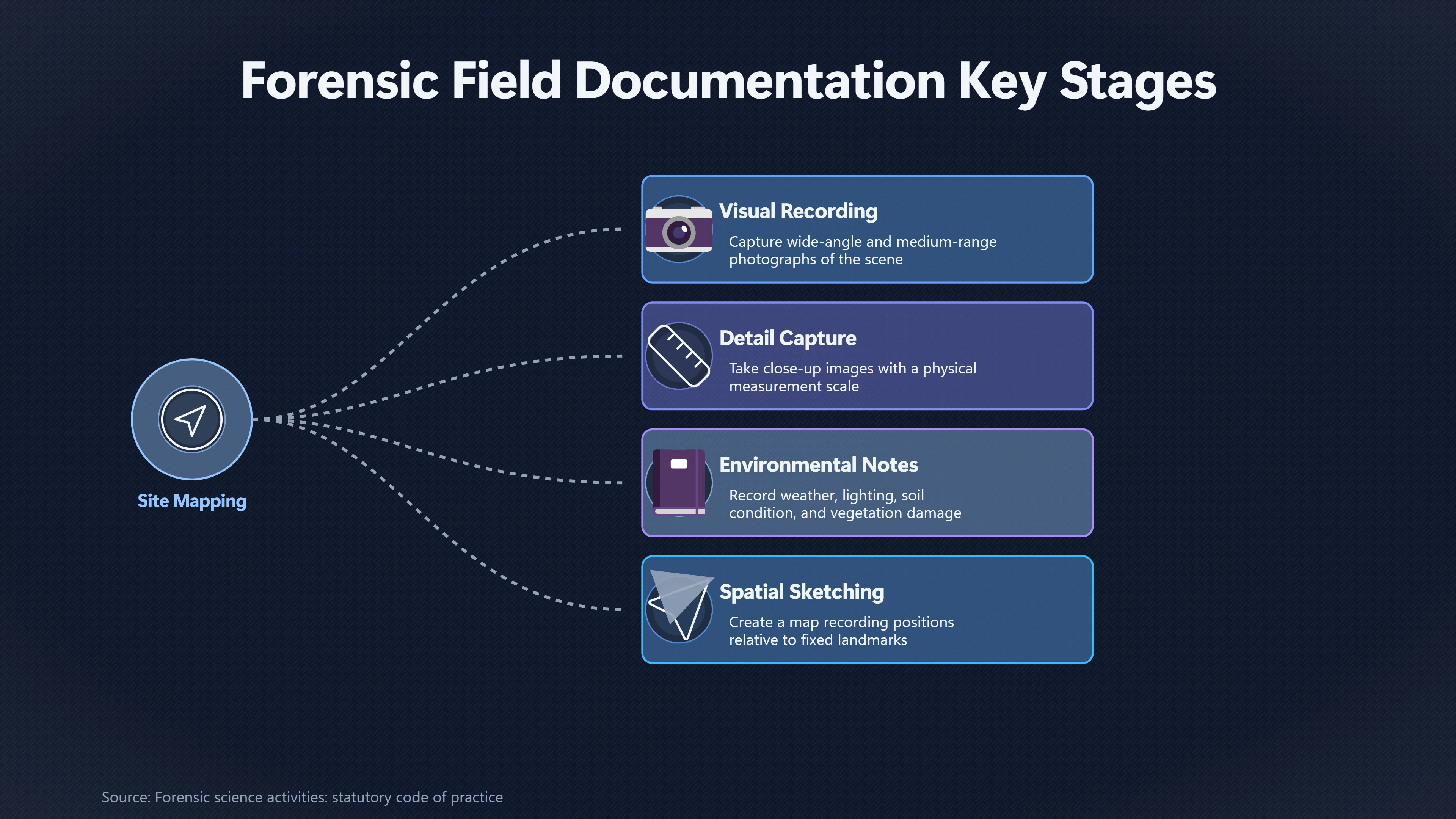
A credible field record should establish:
- The exact location using GPS coordinates or surveyed reference points.
- Wide-angle photographs showing the overall setting.
- Medium-range photographs placing each fragment within the scene.
- Close-up images with a measurement scale before removal.
- Notes describing weather, lighting, vegetation, soil condition and any evidence of recent disturbance.
- A sketch or map recording the position of every recovered item relative to fixed landmarks.
Modern forensic guidance emphasises that photographs alone are insufficient. Investigators should combine photography with written notes, measurements and scene sketches because each records different information. Sketches preserve spatial relationships that may not be obvious in photographs, while contemporaneous notes capture observations that cameras cannot record.[National Institute of Justice]nij.ojp.govNational Institute of JusticeArchived | Crime Scene and DNA Basics for Forensic Analysts | Documentation - Chain of Custody | National In…
For alleged crash sites, documenting the surrounding environment is especially important because later investigators may wish to compare vegetation damage, burn patterns, impact marks or soil chemistry with the recovered material.
Packaging, labelling and transfer controls
Once an object is collected, the recovery record shifts from documenting location to protecting identity.
Each recovered fragment should receive a unique identifier that follows it throughout its lifetime. Good practice includes recording:
- Collection date and time.
- Collector’s identity.
- Exact recovery location.
- Item number.
- Brief physical description.
- Photographic reference numbers.
- Container or seal number.
Each fragment should normally be packaged separately. Mixing multiple fragments in one container creates opportunities for abrasion, contamination and confusion over which laboratory result belongs to which object. Packaging materials should also match the intended analyses because adhesives, fibres, oils or moisture introduced during collection can compromise later trace-element or surface examinations.[nist.gov]nist.govStandard for On-Scene Collection and Preservation of Physical EvidenceStandard for On-Scene Collection and Preservation of Physical EvidenceApril 18, 2026…
Tamper-evident seals are valuable not because they make tampering impossible, but because they make unauthorised opening detectable. Preserving original seals, adding dated signatures across closures and recording seal numbers allows later examiners to determine whether the package remained intact during transport and storage.[National Institute of Justice]nij.ojp.govNational Institute of JusticeArchived | Law 101: Legal Guide for the Forensic Expert | A Chain of Custody: The Typical Checklist | Nation…
Every transfer should be traceable
The chain of custody is more than a list of owners. It is a chronological record demonstrating continuous accountability.
For each transfer, the record should document:
- Who released the item.
- Who received it.
- Date and time.
- Reason for transfer.
- Condition of the package.
- Seal status or new seal numbers if opened.
- Storage location before and after transfer.
Modern forensic standards require recovered exhibits to remain uniquely identifiable throughout their handling and storage, with documentation showing who possessed the item at every stage. Unexplained gaps do not automatically prove fraud, but they reduce confidence because substitution, accidental mixing or undocumented handling can no longer be ruled out.[gov.uk]GOV.UKForensic science activities: statutory code of practiceversion 2 (accessible) - GOV.UK…
For alleged UFO debris, long periods spent in private collections without documented custody are particularly problematic. A laboratory may accurately identify the composition of a specimen decades later while having no evidential basis for concluding that it is the same object reportedly recovered from the original site.
Storage, comparison samples and independent retesting
A defensible recovery record extends beyond collection and transport. Long-term storage determines whether future investigators can verify earlier conclusions.
Important practices include:
- Restricted, logged storage access.
- Environmental controls appropriate for the material.
- Preservation of an untouched reference specimen.
- Documentation of every destructive analysis.
- Retention of unused material whenever practical.
If a laboratory removes part of a fragment for destructive testing, the exact sampling location should be recorded. Different areas of the same object may have different coatings, corrosion products or manufacturing features, making later comparisons impossible unless sampling locations are documented.[National Institute of Justice]nij.ojp.govNational Institute of JusticeArchived | Law 101: Legal Guide for the Forensic Expert | A Chain of Custody: The Typical Checklist | Nation…
Equally important is collecting comparison material at the scene. Background soil, nearby rocks, industrial debris, known aircraft materials or naturally occurring metallic fragments allow laboratories to distinguish unusual findings from local environmental contamination. Without these controls, trace elements detected on a specimen may reflect the recovery environment rather than the object’s origin.
Independent retesting is another essential safeguard. Scientific confidence increases when separate laboratories, working from independently preserved material and without influencing one another’s procedures, obtain consistent results.
Recovery records cannot prove extraordinary origins
Even a flawless recovery record cannot establish that debris originated from a non-human craft.
Instead, a well-documented record establishes narrower but crucial propositions:
- The specimen came from a documented location.
- Its recovery history is continuous.
- Laboratory results correspond to the recovered object.
- Later investigators can independently evaluate the same evidence.
Those propositions allow composition, manufacturing methods, isotope measurements and microscopic examinations to be interpreted within a known provenance rather than being attached to an unverifiable narrative.
Conversely, poor documentation does not necessarily prove that an object is ordinary. It simply means that the scientific questions become much harder—or impossible—to answer with confidence because the relationship between the specimen and the alleged crash cannot be independently verified.
Common weaknesses in alleged UFO debris records
Many historical UFO debris claims fall short of modern forensic expectations for reasons unrelated to laboratory competence.
Recurring weaknesses include:
- Recovery locations identified only years later.
- No photographs taken before collection.
- Missing or approximate coordinates.
- Fragments combined before documentation.
- No original field notes.
- Undocumented transfers between private owners.
- Containers replaced without recorded seal history.
- Entire specimens consumed during testing without retaining reference material.
- No comparison samples collected from the surrounding environment.
None of these shortcomings automatically invalidate an individual claim. However, each increases uncertainty by weakening the documented connection between the analysed specimen and the alleged recovery site. As uncertainty accumulates, confidence in any subsequent scientific interpretation correspondingly decreases.
What a credible recovery record ultimately achieves
A defensible recovery record is not designed to prove extraordinary claims. Its purpose is to preserve the integrity of evidence so that competing explanations can be tested fairly.
For alleged UFO crash debris, that means creating an auditable record from the moment of discovery through storage and laboratory examination. Coordinates, photographs, contemporaneous notes, unique identifiers, tamper-evident packaging, documented transfers, preserved comparison samples and retained material for independent retesting together create a recovery history that others can scrutinise. Only when that foundation exists can laboratory analyses meaningfully address whether recovered material is consistent with ordinary terrestrial sources or merits further investigation.[ojp.gov]nij.ojp.govNational Institute of JusticeCrime Scene Investigation: Guides for Law Enforcement | National Institute of JusticeJuly 12, 2017…
Amazon book picks
Further Reading
Books and field guides related to What a Credible UFO Debris Recovery Looks Like. Use these as the next step if you want deeper reading beyond the article.
Practical Crime Scene Processing and Investigation
All too often, the weakest link in the chain of criminal justice is the crime scene investigation. Improper collection of evidence blocks...
Criminalistics: An Introduction to Forensic Science
For introductory courses in Forensic Science and Crime Scene Investigation. This best-selling text, written for the non-scientist, is app...
Crime Scene Photography
Crime Scene Photography is a book wrought from years of experience, with material carefully selected for ease of use and effectiveness in...
eBay marketplace picks
Marketplace Samples
Live-tested eBay searches with available results related to this page.
Selected fromRoswell collectible oneBay.co.uk.


Endnotes
1.
Source: GOV.UK
Title: Forensic science activities: statutory code of practice
Link:https://www.gov.uk/government/publications/forensic-science-activities-statutory-code-of-practice-version-2/forensic-science-activities-statutory-code-of-practice-version-2-accessible
Source snippet
version 2 (accessible) - GOV.UK...
2.
Source: nist.gov
Title: Standard for On-Scene Collection and Preservation of Physical Evidence
Link:https://www.nist.gov/system/files/documents/2021/04/01/2021-N-0018_Standard%20for%20On-Scene%20Collection%20and%20Preservation%20of%20Physical%20Evidence_DRAFT%20OSAC%20PROPOSED.pdf
Source snippet
Standard for On-Scene Collection and Preservation of Physical EvidenceApril 18, 2026...
Published: April 18, 2026
3.
Source: store.astm.org
Link:https://store.astm.org/e1492-25.html
Source snippet
astm.orgE1492 Standard Practice for Receiving, Documenting, Storing, and Retrieving Evidence by a Forensic Service ProviderJuly 8, 2026 —...
Published: July 8, 2026
4.
Source: GOV.UK
Title: www.gov.uk[Withdrawn] Forensic Science Regulator: Code of Practice (accessible)
Link:https://www.gov.uk/government/publications/statutory-code-of-practice-for-forensic-science-activities/forensic-science-regulator-code-of-practice-accessible
5.
Source: nist.gov
Title: evidence management
Link:https://www.nist.gov/forensic-science/interdisciplinary-topics/evidence-management
6.
Source: nist.gov
Title: biological evidence preservation handbook best practices evidence handlers
Link:https://www.nist.gov/publications/biological-evidence-preservation-handbook-best-practices-evidence-handlers
7.
Source: store.astm.org
Title: e1459 92r05
Link:https://store.astm.org/e1459-92r05.html
8.
Source: nij.ojp.gov
Link:https://nij.ojp.gov/topics/articles/crime-scene-investigation-guides-law-enforcement
Source snippet
National Institute of JusticeCrime Scene Investigation: Guides for Law Enforcement | National Institute of JusticeJuly 12, 2017...
Published: July 12, 2017
9.
Source: nij.ojp.gov
Link:https://nij.ojp.gov/nij-hosted-online-training-courses/law-101-legal-guide-forensic-expert/sources-scientific-evidence/testing-or-evaluating-evidence-and-writing-reports/chain-custody-typical-checklist
Source snippet
National Institute of JusticeArchived | Law 101: Legal Guide for the Forensic Expert | A Chain of Custody: The Typical Checklist | Nation...
10.
Source: nij.ojp.gov
Link:https://nij.ojp.gov/nij-hosted-online-training-courses/crime-scene-and-dna-basics-forensic-analysts/evidence-crime-scene/documentation-chain-custody
Source snippet
National Institute of JusticeArchived | Crime Scene and DNA Basics for Forensic Analysts | Documentation - Chain of Custody | National In...
11.
Source: nij.ojp.gov
Link:https://nij.ojp.gov/library/publications/crime-scene-investigation-guide-law-enforcement
12.
Source: nij.ojp.gov
Title: preservation evidence
Link:https://nij.ojp.gov/nij-hosted-online-training-courses/crime-scene-and-dna-basics-forensic-analysts/evidence-crime-scene/preservation-evidence
13.
Source: nij.ojp.gov
Title: chain custody
Link:https://nij.ojp.gov/nij-hosted-online-training-courses/collecting-dna-evidence-at-property-crime-scenes/evidence-collection/chain-custody
14.
Source: nij.ojp.gov
Title: biological evidence preservation handbook best practices evidence handlers
Link:https://nij.ojp.gov/library/publications/biological-evidence-preservation-handbook-best-practices-evidence-handlers
15.
Source: nij.ojp.gov
Title: crime scene investigation reference law enforcement training
Link:https://nij.ojp.gov/library/publications/crime-scene-investigation-reference-law-enforcement-training
16.
Source: ojp.gov
Link:https://www.ojp.gov/library/publications/crime-scene-investigation-guide-law-enforcement-0
18.
Source: archives.fbi.gov
Link:https://archives.fbi.gov/archives/about-us/lab/forensic-science-communications/fsc/oct1999/trace.htm
Additional References
19.
Source: forensiccsi.com
Title: It refers to the documented chronologic
Link:https://forensiccsi.com/chain-of-custody-best-practices-evidence-packaging/
Source snippet
Chain of Custody: Best Practices for Evidence Packaging – ForensicCSIMay 31, 2026 — CHAIN OF CUSTODY: BEST PRACTICES FOR EVIDENCE PACKAGI...
Published: May 31, 2026
20.
Source: youtube.com
Title: Professor Garry Nolan & Ross Coulthart: Full interview | UFO UAP News
Link:https://www.youtube.com/watch?v=XR0JtbuLhPo
Source snippet
UFO crash recovery chain of custody debris analysis Whitley Strieber describes his alien visitor NewsNation...
21.
Source: youtube.com
Title: New UAP Materials Tests: What the Results Reveal | Dr. Garry Nolan
Link:https://www.youtube.com/watch?v=Mifx4nzPY68
Source snippet
The Future of UAP Evidence: What Would Finally Prove a UFO Case?...
22.
Source: youtube.com
Title: How To Scientifically Test & Analyze Potential UAP/UFO Material
Link:https://www.youtube.com/watch?v=SbAtCzZIIsk
Source snippet
New UAP Materials Tests: What the Results Reveal | Dr. Garry Nolan...
23.
Source: youtube.com
Title: I-Team: UFO meta materials
Link:https://www.youtube.com/watch?v=t-T4Aa4UPI8
Source snippet
Professor Garry Nolan & Ross Coulthart: Full interview | UFO UAP News...
24.
Source: youtube.com
Title: The Future of UAP Evidence: What Would Finally Prove a UFO Case?
Link:https://www.youtube.com/watch?v=BxBVwapvuMw
Source snippet
I-Team: UFO meta materials...
25.
Source: youtu.be
Title: News Nation
Link:https://youtu.be/JzS2GqSB6OI
Source snippet
🔥Boy Gets a Universal Recycling System, Turns Debris Into Mechs and Warships, Builds a Space Empire...
26.
Source: youtube.com
Title: Lex Clips
Link:https://www.youtube.com/watch?v=uTCc2-1tbBQ
Source snippet
New UAP Materials Tests: What the Results Reveal | Dr. Garry Nolan The Sol Foundation...
27.
Source: college.police.uk
Title: Forensics | College of Policing
Link:https://www.college.police.uk/app/investigation/forensics?highlight=locards+principle
28.
Source: pmc.ncbi.nlm.nih.gov
Link:https://pmc.ncbi.nlm.nih.gov/articles/PMC10000967/