Within Case Comparison
Was Kecksburg Really the Soviet Probe Kosmos 96?
Tracking data places the Soviet probe's re-entry hours before the Kecksburg fireball, leaving the satellite theory without a convincing timeline.
On this page
- Why the Soviet probe became a leading theory
- What re entry tracking says about the timing
- Why missing records do not repair the mismatch
Page outline Jump by section
Introduction
One of the most persistent conventional explanations for the 9 December 1965 Kecksburg incident is that the object was Kosmos 96, a failed Soviet Venus probe that re-entered Earth’s atmosphere on the same day. The theory gained traction because it appears to offer a straightforward alternative to claims of an unidentified craft: a classified Soviet spacecraft falling during the height of the Cold War could also explain reports of military interest.
However, when the available tracking data, astronomical analysis and later orbital reconstructions are examined together, the Kosmos 96 explanation becomes significantly weaker. The central problem is not simply that the evidence is incomplete—it is that the known timing and trajectory of Kosmos 96 do not align well with the observed Kecksburg fireball. Although uncertainty remains over some historical records, the missing documentation does not remove the basic mismatch identified by multiple analyses.[Wikipedia]WikipediaKosmos 96Kosmos 96
Why the Soviet probe became a leading theory
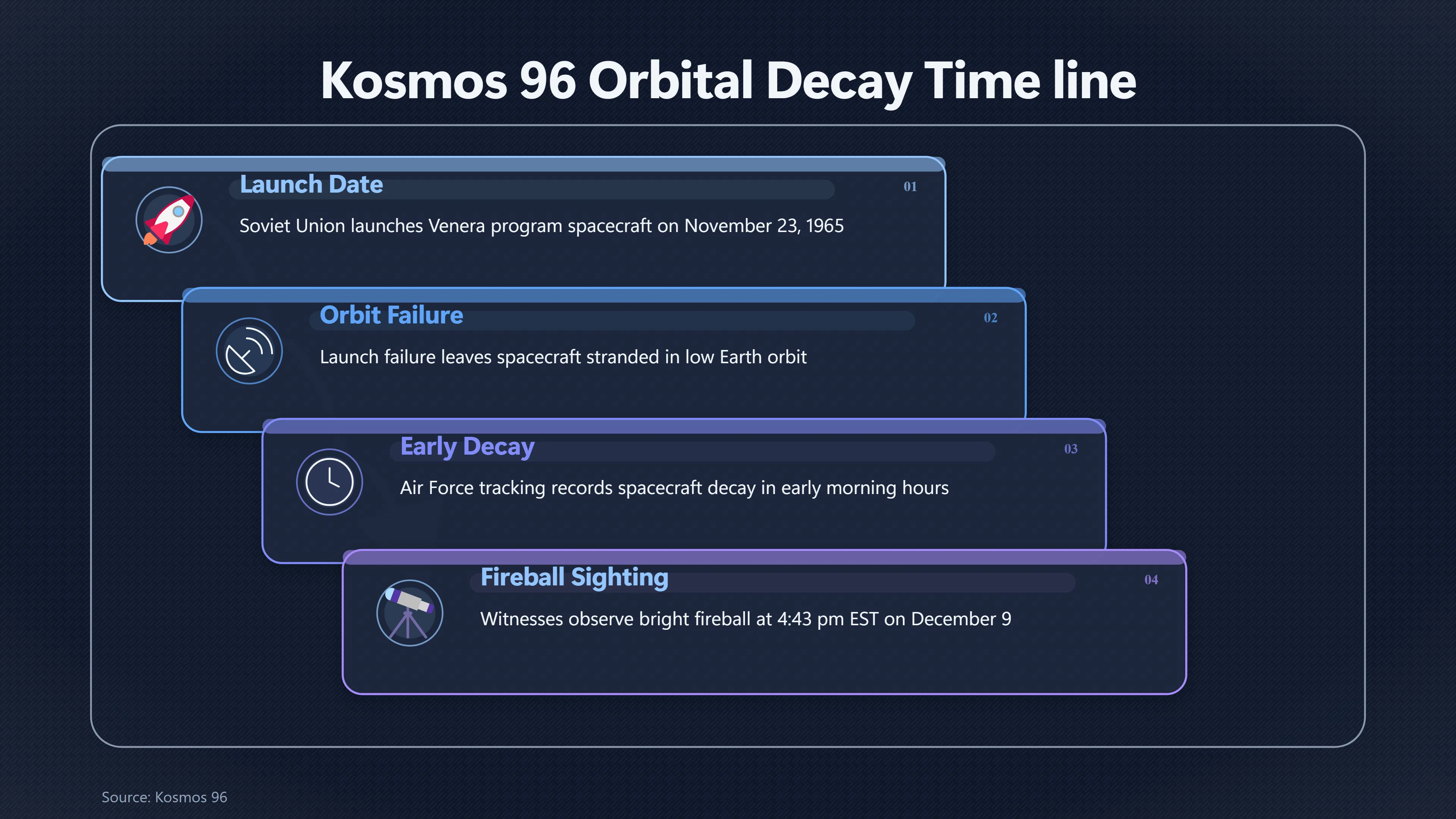
Kosmos 96 was launched by the Soviet Union on 23 November 1965 as part of the Venera programme intended to explore Venus. A launch failure prevented the spacecraft from leaving Earth orbit, leaving it stranded in low orbit for more than two weeks before it re-entered the atmosphere on 9 December 1965.[Wikipedia]WikipediaKosmos 96Kosmos 96
The coincidence of dates naturally attracted attention. Witnesses across Ontario and several US states reported an exceptionally bright fireball on the afternoon of 9 December, while later reports from Kecksburg described an object allegedly descending into woodland followed by a military response. During the Cold War, recovery of Soviet space hardware would have been an intelligence prize, making Kosmos 96 an attractive explanation for those who rejected both a meteor and an extraterrestrial spacecraft.[The Black Vault]theblackvault.comthe vault files the 1965 kecksburg pennsylvania crashThe Black VaultThe Vault Files: The 1965 Kecksburg, Pennsylvania Crash - The Black Vault Case Files…
Some early researchers also noted that Soviet planetary probes contained robust re-entry hardware capable of surviving atmospheric descent better than ordinary satellites, making the idea superficially plausible.
What re-entry tracking says about the timing
The strongest objection to the Kosmos 96 hypothesis comes from orbital tracking rather than witness testimony.
US Air Force space-tracking records indicated that Kosmos 96’s orbit decayed before the fireball seen over the Great Lakes region. NASA’s catalogue likewise notes that Air Force tracking placed the spacecraft’s orbital decay earlier than the observed fireball, preventing a straightforward identification of the two events.[Wikipedia]WikipediaKosmos 96Kosmos 96
Several later summaries place the discrepancy at roughly 13 hours, with the spacecraft believed to have re-entered during the early hours of 9 December, whereas the widely observed fireball occurred during the afternoon (approximately 4:43 pm EST). While precise historical orbital calculations naturally contain uncertainties, the difference is measured in hours rather than minutes, making reconciliation difficult.[DECUR]decur.orgKecksburg UFO IncidentKecksburg UFO Incident - DECUR…
The timing problem is particularly important because orbital decay predictions from tracked satellites are constrained by repeated observations before re-entry. Small errors of a few minutes or changes in the final orbital revolution are expected; shifting the event by many hours is not.
The observed trajectory also creates problems
Timing is only one difficulty.
Analyses of photographs and eyewitness observations concluded that the fireball followed a path too steep to match the expected geometry of an object re-entering from Earth orbit. Instead, investigators concluded that the observed trajectory more closely resembled that of a natural meteoroid entering the atmosphere from interplanetary space.[Wikipedia]WikipediaKosmos 96Kosmos 96
This distinction matters because orbital spacecraft re-enter the atmosphere at relatively shallow angles after gradually losing altitude. Natural meteoroids often enter on significantly steeper trajectories and produce different flight characteristics.
Some reconstructions further suggested that the luminous fireball terminated over western Lake Erie rather than continuing to Kecksburg, although precise endpoint estimates based solely on eyewitness reports remain uncertain. Even allowing for uncertainty in witness-based trajectory reconstruction, the calculated path does not comfortably match the expected behaviour of Kosmos 96.[Wikipedia]WikipediaKosmos 96Kosmos 96
Why missing records do not repair the mismatch
The Kecksburg case is often linked to missing NASA files, especially after litigation seeking agency records concerning the incident.
Those missing records have encouraged speculation that evidence connecting Kecksburg with Kosmos 96 was suppressed. Yet the absence of some historical files does not remove the independent evidence from orbital tracking and astronomical reconstruction.
Even researchers who originally considered Kosmos 96 seriously have concluded that improved orbital analysis ultimately ruled it out. Space historian James Oberg has written that subsequent analysis confirmed the authenticity of the Air Force tracking data and showed that the spacecraft’s path could not be reconciled with the observed meteor trajectory, leading him to regard the coincidence of the two events on the same day as just that—a coincidence.[James Oberg]jamesoberg.comJames Oberg Jim Oberg on the “NASA lawsuit over Kecksburg UFO Documents”James ObergJim Oberg on the “NASA lawsuit over Kecksburg UFO Documents”November 1, 2024…
NASA’s published catalogue has also evolved from presenting the Soviet spacecraft as a possible explanation to emphasising that the fireball’s trajectory was probably inconsistent with orbital re-entry while noting the earlier Air Force decay time. The surviving public evidence therefore points away from Kosmos 96 rather than toward it.[Wikipedia]WikipediaKosmos 96Kosmos 96
What this means for the Kecksburg case
Rejecting the Kosmos 96 explanation does not automatically validate claims that an extraterrestrial craft crashed at Kecksburg.
Instead, it narrows the field of plausible explanations:
- The coincidence of the Soviet probe’s re-entry and the Kecksburg fireball made Kosmos 96 an understandable early hypothesis.
- Air-tracking data place the spacecraft’s re-entry substantially earlier than the reported Kecksburg event.
- Independent trajectory studies indicate that the observed fireball behaved more like a natural meteor than an orbital spacecraft.
- Missing archival records may leave some historical questions unanswered, but they do not erase the existing orbital evidence that conflicts with the Kosmos 96 timeline.[wikipedia.org]WikipediaKosmos 96Kosmos 96
Within comparisons of major alleged UFO crash cases, this makes Kecksburg unusual. The strongest conventional explanation often discussed in popular culture—the Soviet probe theory—does not fit the available tracking evidence particularly well. At the same time, the failure of that explanation does not supply positive evidence for an extraterrestrial crash. Instead, it leaves Kecksburg as a case in which the most popular non-UFO explanation appears weaker than commonly assumed, while the extraordinary alternative remains unsupported by verifiable physical evidence.
Amazon book picks
Further Reading
Books and field guides related to Was Kecksburg Really the Soviet Probe Kosmos 96?. Use these as the next step if you want deeper reading beyond the article.

Beyond Earth: A Chronicle of Deep Space Exploration, 1958–2016
This is a completely updated and revised version of a monograph published in 2002 by the NASA History Office under the original title Dee...
Challenge to Apollo: The Soviet Union and the Space Race, 194...
The book received the Emme Award for Astronautical Literature at the March 20 2000 luncheon of the Goddard Memorial Symposium, sponsored...
UFOs and Government: A Historical Inquiry
Governments around the world have had to deal with the UFO phenomenon for a good part of a century. How and why they did so is the subjec...
Rockets and People, Volume III: Hot Days of the Cold War
Volume 3 of the memoirs of Academician Boris Chertok, translated from the original Russian. Covers the history of the Soviet space progra...
eBay marketplace picks
Marketplace Samples
Live-tested eBay searches with available results related to this page.
Selected fromspace probe model oneBay.co.uk.


Endnotes
1.
Source: Wikipedia
Title: Kosmos 96
Link:https://en.wikipedia.org/wiki/Kosmos_96
2.
Source: decur.org
Title: Kecksburg UFO Incident
Link:https://decur.org/cases/kecksburg-1965
Source snippet
Kecksburg UFO Incident - DECUR...
3.
Source: nasa.gov
Title: ST S-96
Link:https://www.nasa.gov/mission/sts-96/
Source snippet
Orbiter Discovery mission duration 9 days, 19 hours, 13 minutes, 57 seconds Launch May 27, 1999...
Published: May 27, 1999
4.
Source: theblackvault.com
Title: the vault files the 1965 kecksburg pennsylvania crash
Link:https://www.theblackvault.com/casefiles/the-vault-files-the-1965-kecksburg-pennsylvania-crash/
Source snippet
The Black VaultThe Vault Files: The 1965 Kecksburg, Pennsylvania Crash - The Black Vault Case Files...
5.
Source: thecoldfile.com
Title: 1965 kecksburg
Link:https://www.thecoldfile.com/articles/1965-kecksburg/
Source snippet
The Acorn in the Woods: The 1965 Kecksburg Incident | The Cold FileMay 25, 2026 — UFO/UAP / Case file / Filed May 25, 2026 THE ACORN IN T...
Published: May 25, 2026
6.
Source: jamesoberg.com
Title: James Oberg Jim Oberg on the “[NASA lawsuit]({{ ‘nasa-lawsuit/’ | relative_url }}) over Kecksburg UFO Documents”
Link:https://www.jamesoberg.com/statement_nasa_kecksburg.pdf
Source snippet
James ObergJim Oberg on the “NASA lawsuit over Kecksburg UFO Documents”November 1, 2024...
Published: November 1, 2024
7.
Source: enigmalabs.io
Title: Kecksburg Incident | Enigma Labs
Link:https://enigmalabs.io/library/f45bb19d-5803-4ab6-a373-8799f64095c0
Source snippet
Air Force’s investigation into unidentified flying objects, told the Associated Press late on De...
Additional References
8.
Source: handwiki.org
Title: Astronomy:Kosmos 96
Link:https://www.handwiki.org/wiki/Astronomy%3AKosmos_96
Source snippet
June 9, 2026 — ASTRONOMY:KOSMOS 96 From HandWiki [Input] Kosmos 96 Mission type | Venus flyby ^{[1]} Operator | OKB-1 COSPAR ID |...
Published: June 9, 2026
9.
Source: youtube.com
Link:https://www.youtube.com/watch?v=HX_RrO7ZQaU
Source snippet
Episode 184 Kecksburg Revisited with Stan Gordon...
10.
Source: ufo-graph-map.pages.dev
Title: UFO.ai Kosmos 96 re-entry (Kecksburg prosaic explanation). — UFO.ai
Link:https://ufo-graph-map.pages.dev/node/kosmos96_reentry
Source snippet
96 re-entry (Kecksburg prosaic explanation). — UFO.ai...
11.
Source: youtube.com
Title: The Truth About The Kecksburg UFO Crash | A Soviet Satellite Or Alien Ship?
Link:https://www.youtube.com/watch?v=PgVIuew8eoI
Source snippet
The Kecksburg UFO Case: Finally Solved After 60 Years?...
12.
Source: youtube.com
Title: The Kecksburg Incident: What Really Happened Here?
Link:https://www.youtube.com/watch?v=BXh2zTD9Kug
Source snippet
The Truth About The Kecksburg UFO Crash | A Soviet Satellite Or Alien Ship?...
13.
Source: astronomyufo.com
Link:https://www.astronomyufo.com/UFO/earthly.htm
14.
Source: scribd.com
Link:https://www.scribd.com/document/428734219/Mufon-Drones-CARET
15.
Source: ufodesigns3d.com
Link:https://ufodesigns3d.com/blogs/lore/the-kecksburg-incident-the-day-a-ufo-crashed-in-pennsylvania
16.
Source: smithsonianmag.com
Link:https://www.smithsonianmag.com/air-space-magazine/the-things-that-fell-to-earth-8797089/
17.
Source: youtube.com
Title: Episode 184 Kecksburg Revisited with Stan Gordon
Link:https://www.youtube.com/watch?v=CKK66LtZ1Hs
Source snippet
The Kecksburg Incident: What Really Happened Here?...