Within Satellite Debris
Why Space Debris Lands Far From the Fireball
A satellite can break apart high in the atmosphere while surviving pieces continue far beyond the visible fireball.
On this page
- Where spacecraft usually break apart
- How mass, shape and winds separate fragments
- Why the apparent crash point is often wrong
Page outline Jump by section
Introduction
Reports of a blazing object apparently “crashing” into the ground have sometimes fuelled UFO recovery stories. One of the most common sources of confusion is the re-entry of satellites and rocket stages. Unlike an aircraft accident, a spacecraft returning from orbit does not normally leave a compact crash site. Instead, it often breaks apart high in the atmosphere while still travelling at several kilometres per second, allowing surviving fragments to continue far beyond the point where observers last saw the fireball. The result can be a debris field stretching hundreds of kilometres, making the apparent crash location very different from where any surviving hardware eventually lands.[Orbital Debris Program Office]orbitaldebris.jsc.nasa.govOpen source on nasa.gov.
Understanding this mechanism helps explain why searches near the visible end of a fireball frequently find nothing, while genuine spacecraft debris may later be recovered far downrange. It also explains why isolated pieces of unfamiliar metal can become associated with alleged UFO recoveries even when they originated from a well-understood re-entry.
Where spacecraft usually break apart
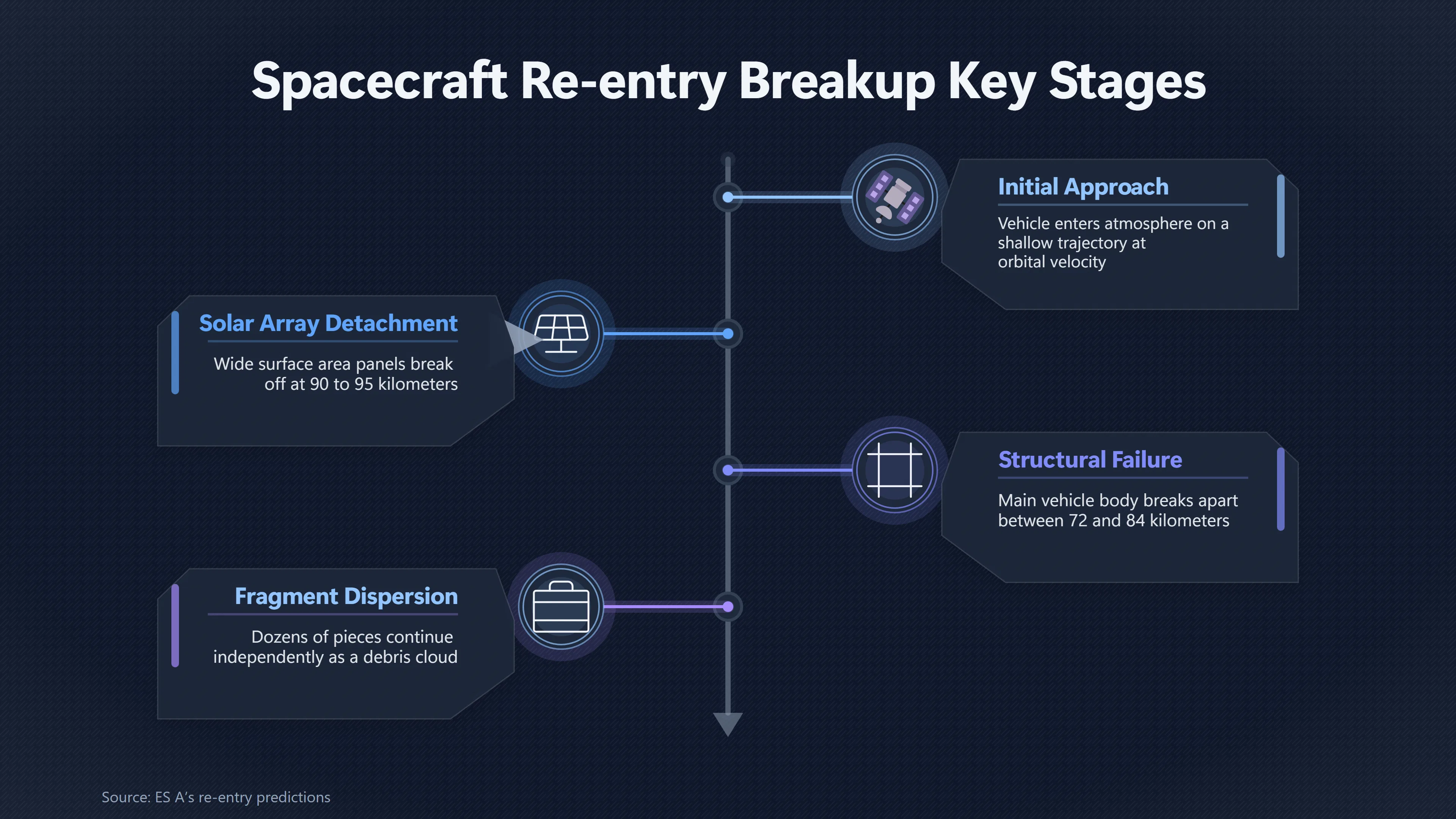
A spacecraft re-entering from orbit does not fall vertically. It approaches Earth’s atmosphere on a shallow trajectory at orbital velocity, encountering steadily increasing aerodynamic pressure and intense heating.
Structural failure usually begins long before any surviving fragments approach the ground. NASA’s Orbital Debris Program Office identifies a typical breakup altitude between about 72 and 84 kilometres, with 78 kilometres used as a nominal value for modelling. Large solar arrays often detach even earlier, around 90 to 95 kilometres, because their wide surface area experiences high bending loads before the central structure fails.[Orbital Debris Program Office]orbitaldebris.jsc.nasa.govOpen source on nasa.gov.
Once the vehicle breaks apart, it is no longer a single object. Instead, dozens or even hundreds of fragments continue independently, each responding differently to aerodynamic forces. From the ground, observers may still perceive one dramatic fireball, but physically the debris cloud has already spread over a long section of the flight path.
This distinction matters when evaluating alleged UFO crash reports. The brightest visible portion of the event often marks where breakup occurred rather than where surviving debris ultimately lands.
How mass, shape and winds separate fragments
The enormous length of a debris footprint results from several physical processes acting simultaneously after breakup.
Different masses retain momentum differently. Dense objects such as titanium pressure vessels, engine components and stainless-steel fittings possess high ballistic coefficients. They lose speed relatively slowly and therefore travel much farther downrange before reaching the ground. Thin aluminium panels, insulation and lightweight structures decelerate rapidly and frequently burn up completely.[Orbital Debris Program Office]orbitaldebris.jsc.nasa.govOpen source on nasa.gov.
Shape changes atmospheric drag. Two fragments with identical mass can behave very differently if one presents a broad surface while the other is compact. A flat panel slows dramatically, whereas a rounded tank or thick metal fitting continues on a much longer trajectory.
Heating varies between components. Internal equipment may initially remain shielded by surrounding structures. Only after outer panels melt away does the heat reach enclosed components, allowing some dense hardware to survive even when much of the spacecraft has already disintegrated.[Orbital Debris Program Office]orbitaldebris.jsc.nasa.govOpen source on nasa.gov.
Upper-atmosphere winds continue the separation. After fragments slow below hypersonic speeds, winds at different altitudes begin shifting lighter pieces sideways while heavier objects continue largely under their own momentum. This produces both a long downrange footprint and a smaller cross-track spread.
The European Space Agency notes that surviving fragments from a typical uncontrolled re-entry can produce impact footprints extending from a few hundred kilometres to around one thousand kilometres. Explosive breakups can widen the footprint even further by adding sideways velocity to individual fragments.[reentry.esoc.esa.int]reentry.esoc.esa.intES A’s re-entry predictionsES A’s re-entry predictions

Why the apparent crash point is often wrong
Human perception makes distant re-entry events especially misleading.
A bright object descending towards the horizon appears to vanish behind hills, trees or buildings. Without reliable depth cues, many witnesses naturally assume it landed just beyond those landmarks. In reality, the object may still be tens or hundreds of kilometres away and travelling almost horizontally rather than descending steeply.
The luminous phase also ends before the surviving fragments complete their fall. Once heating decreases, many objects cease glowing while continuing along their ballistic trajectories. An observer therefore loses visual contact well before impact.
These effects explain several recurring patterns in alleged UFO recoveries:
- Intensive searches near the apparent disappearance point fail to locate wreckage.
- Debris is later recovered much farther along the flight path.
- Different fragments are found by unrelated people over many days or weeks.
- Witnesses report multiple glowing objects because the spacecraft had already fragmented at high altitude.
None of these features necessarily indicate an unconventional object. They are expected consequences of atmospheric breakup during orbital re-entry.[Orbital Debris Program Office]orbitaldebris.jsc.nasa.govOpen source on nasa.gov.
Why recovery sites can be confusing
Long debris footprints create practical problems for investigators.
Emergency services often begin searching close to where eyewitnesses believed the object disappeared. If the actual impact area lies hundreds of kilometres farther along the trajectory, those initial searches are unlikely to find anything relevant.
Conversely, isolated pieces recovered well after the event may appear unrelated because they are discovered far from the spectacular fireball that originally attracted attention. This disconnect has contributed to some historical speculation surrounding alleged UFO crash sites, particularly when unusual spacecraft components were unfamiliar to local observers.
Modern investigators therefore combine eyewitness reports with orbital tracking data, atmospheric models and re-entry simulations rather than relying solely on visual estimates of where the object appeared to descend. NASA and ESA both use sophisticated modelling software to estimate breakup altitude, fragment survival and probable debris footprints because simple line-of-sight observations are insufficient for locating surviving hardware accurately.[Orbital Debris Program Office]orbitaldebris.jsc.nasa.govOpen source on nasa.gov.

What this means for evaluating alleged UFO recoveries
The wide dispersion of spacecraft debris is not an anomaly but a predictable consequence of orbital mechanics and atmospheric physics.
When a reported UFO crash coincides with a bright, slowly moving fireball that fragmented repeatedly, investigators must consider whether the event matches the expected behaviour of a satellite or rocket re-entry. The key question is not whether debris was recovered, but whether the recovered material, the reconstructed flight path and known orbital data all align with a specific re-entering object.
Equally important, a scattered debris field alone does not prove a spacecraft re-entry. Aircraft accidents, explosions and unrelated debris discoveries can also produce confusing evidence. The characteristic value of the re-entry explanation lies in the combination of a shallow atmospheric trajectory, high-altitude breakup, prolonged visible fragmentation and an extended debris footprint that may stretch for hundreds of kilometres beyond the point where witnesses believed the object came down.[nasa.gov]orbitaldebris.jsc.nasa.govOpen source on nasa.gov.
Amazon book picks
Further Reading
Books and field guides related to Why Space Debris Lands Far From the Fireball. Use these as the next step if you want deeper reading beyond the article.
Atmospheric Re-Entry Vehicle Mechanics
Based on a long engineering experience, this book offers a comprehensive and state-of-the-art analysis of aerodynamic and flight mechanic...
Space Debris: Models and Risk Analysis
In Space Debris Models and Risk Analysis the authors will provide the reader with a comprehensive background to understand the various so...
Orbital Mechanics for Engineering Students
Orbital Mechanics for Engineering Students, Second Edition, provides an introduction to the basic concepts of space mechanics. These incl...
Fundamentals of Astrodynamics and Applications
First published 1997. Subjects: Astrodynamik.
eBay marketplace picks
Marketplace Samples
Live-tested eBay searches with available results related to this page.
Selected fromsatellite model oneBay.co.uk.



Endnotes
1.
Source: orbitaldebris.jsc.nasa.gov
Link:https://orbitaldebris.jsc.nasa.gov/reentry/index.html
2.
Source: reentry.esoc.esa.int
Title: ES A’s re-entry predictions
Link:https://reentry.esoc.esa.int/home/blog/ers-2-reentry
3.
Source: esa.int
Title: European Space Agency ESA
Link:https://www.esa.int/Space_Safety/Clean_Space/Space_debris_feel_the_burn
Source snippet
Space debris: feel the burnApril 28, 2021 — Space Safety SPACE DEBRIS: FEEL THE BURN 28/04/2021 7175 views 61 likes It might be cou...
Published: April 28, 2021
4.
Source: reentry.esoc.esa.int
Title: ES A’s re-entry predictions
Link:https://reentry.esoc.esa.int/home/blog/long-march-5b-reentry
Source snippet
esa.intESA’s re-entry predictionsMay 6, 2021 — The thermal and mechanical processes which drive the break-up of a spacecraft when re-ente...
Published: May 6, 2021
5.
Source: esa.int
Title: European Space Agency ESA
Link:https://www.esa.int/Science_Exploration/Space_Science/Cluster/Frequently_asked_questions_Cluster_s_Salsa_reentry
Source snippet
European Space AgencyESA - Frequently asked questions: Cluster's Salsa reentry...
6.
Source: technology.esa.int
Title: The ESA Space Debris Mitigation
Link:https://technology.esa.int/page/re-entry-safety
Source snippet
esa.intRe-entry SafetyNovember 3, 2023 — RE-ENTRY SAFETY Re-entry Safety covers all aspects concerning human health and environment relat...
Published: November 3, 2023
7.
Source: nasa.gov
Title: Micrometeoroids and Orbital Debris (MMOD)
Link:https://www.nasa.gov/centers-and-facilities/white-sands/micrometeoroids-and-orbital-debris-mmod/
Source snippet
Riley Heather F. Riley Jun 14, 2016 Article Millions of man-made debris and naturally occurring micr...
8.
Source: sma.nasa.gov
Title: ’s OD Program Office measures
Link:https://sma.nasa.gov/sma-disciplines/orbital-debris/orbital-debris-history-of-orbital-debris
Source snippet
DebrisMay 16, 2014 — ORBITAL DEBRIS Orbital Debris (OD) is any human-made object in orbit that no longer serves a useful purpose, includi...
Published: May 16, 2014
9.
Source: sma.nasa.gov
Title: orbital debris future of orbital debris
Link:https://sma.nasa.gov/sma-disciplines/orbital-debris/orbital-debris-future-of-orbital-debris
10.
Source: esa.int
Link:https://www.esa.int/Space_Safety/Clean_Space/Look_out_below_Design_for_Demise_study_aims_to_cut_satellite_reentry_risk
11.
Source: nasa.gov
Title: What Is Orbital Debris? (Grades 5-8)
Link:https://www.nasa.gov/learning-resources/for-kids-and-students/what-is-orbital-debris-grades-5-8/
12.
Source: ntrs.nasa.gov
Link:https://ntrs.nasa.gov/search.jsp?R=20080012520&hterms=fragment
13.
Source: heasarc.gsfc.nasa.gov
Title: Beppo SAX FAQs
Link:https://heasarc.gsfc.nasa.gov/docs/sax/BeppoSAX_FAQs.html
14.
Source: ntrs.nasa.gov
Link:https://ntrs.nasa.gov/citations/19920036031
15.
Source: ntrs.nasa.gov
Link:https://ntrs.nasa.gov/citations/19790061297
16.
Source: esa.int
Link:https://www.esa.int/Space_Safety/Space_Debris/Space_Debris_FAQ_Frequently_asked_questions
17.
Source: esa.int
Link:https://www.esa.int/content/view/full/413425
18.
Source: conference.sdo.esoc.esa.int
Link:https://conference.sdo.esoc.esa.int/proceedings/sdc3/paper/56
19.
Source: conference.sdo.esoc.esa.int
Link:https://conference.sdo.esoc.esa.int/proceedings/sdc7/paper/489
20.
Source: esa.int
Link:https://www.esa.int/Space_Safety/Space_Debris/Space_Debris_FAQ_Frequently_asked_questions?wpmobileexternal=true
21.
Source: orbitaldebris.jsc.nasa.gov
Link:https://orbitaldebris.jsc.nasa.gov/faq/
22.
Source: orbitaldebris.jsc.nasa.gov
Link:https://orbitaldebris.jsc.nasa.gov/
23.
Source: orbitaldebris.jsc.nasa.gov
Title: reference documents
Link:https://orbitaldebris.jsc.nasa.gov/reference-documents/
Additional References
24.
Source: youtube.com
Title: Cluster’s Salsa satellite primed to reenter and break up
Link:https://www.youtube.com/watch?v=uACJFL-9ESM
Source snippet
ANSS Seminar: Seismoacoustic tracking of re-entering space debris, Benjamin Fernando...
25.
Source: youtube.com
Link:https://www.youtube.com/watch?v=WWgHoIpGB5U
Source snippet
Aeolus reentry | How we made history...
26.
Source: youtube.com
Title: Space Station Live: Reentry Breakup Recorder
Link:https://www.youtube.com/watch?v=BV3FT8lyRTo
Source snippet
Draco: atmospheric reentry from the inside...
27.
Source: youtube.com
Title: Aeolus reentry | How we made history
Link:https://www.youtube.com/watch?v=KzDy_hQDztA
Source snippet
ATV-1 reentry...
28.
Source: youtube.com
Title: Draco: atmospheric reentry from the inside
Link:https://www.youtube.com/watch?v=9xKCxshPcvM
29.
Source: youtube.com
Title: ATV-1 reentry
Link:https://www.youtube.com/watch?v=OhBw5yaR_SU
Source snippet
Space Station Live: Reentry Breakup Recorder...