Within Records vs Memory
Which UFO Evidence Deserves More Weight?
A fair comparison tests timing, independence, detail stability, corroboration and possible contamination instead of treating either source as infallible.
On this page
- Dating the first appearance of each claim
- Checking independence and contamination risks
- Matching testimony against physical and archival evidence
Page outline Jump by section
Introduction
When evaluating alleged UFO crash cases, the most reliable approach is neither to dismiss later testimony automatically nor to treat it as equal to records created at the time. Instead, investigators should ask a series of practical questions: When did each claim first appear? Was it recorded before publicity could influence it? Does it remain stable over time? Is it independently corroborated? Does it match physical and documentary evidence? These criteria allow both contemporary records and later recollections to be assessed on their evidential merits rather than by assumption alone.
This approach is particularly important because many famous UFO crash narratives, especially Roswell, combine a small body of contemporaneous documentation with much later witness interviews. The strength of any individual claim depends less on whether it is early or late than on whether it survives systematic testing against independent evidence.
Dating the First Appearance of Each Claim
The first question should always be chronological: when can a particular detail be shown to have entered the historical record?
This matters because stories often grow over time. A simple observation may later acquire additional elements through repeated interviews, media coverage or reinterpretation. By establishing when each component first appeared, investigators can distinguish between original testimony and later narrative development.
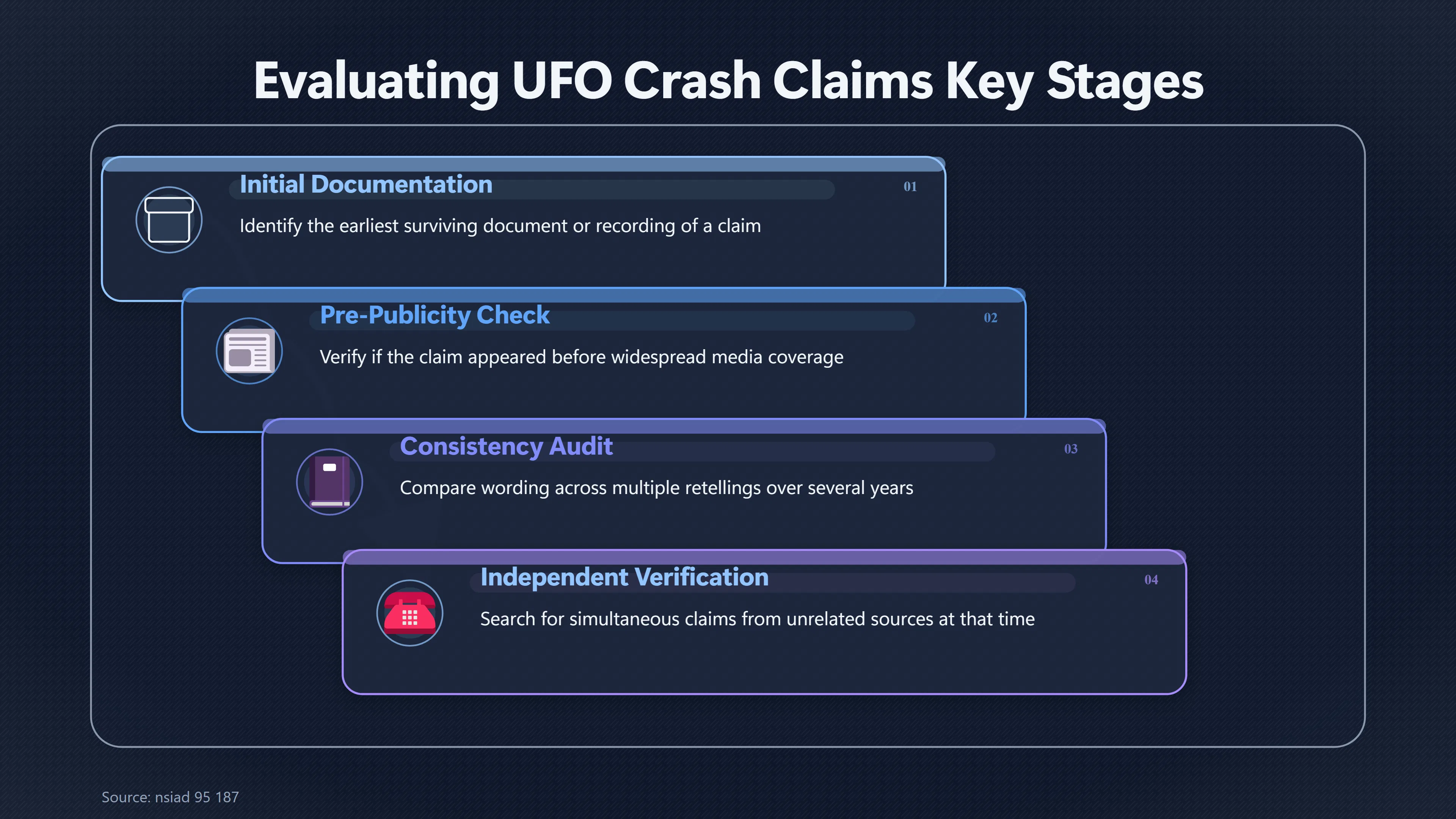
For each significant claim, it is useful to identify:
- the earliest surviving document or recording;
- whether it was made before widespread publicity;
- whether the wording has remained consistent across later retellings; and
- whether the claim appears independently elsewhere at roughly the same time.
Roswell provides a well-known example. Contemporary military documents, FBI communications and newspaper reports describe the recovery of unusual debris but do not mention alien bodies, intact craft, autopsies or multiple crash sites. Those more elaborate elements emerged primarily through interviews conducted decades later. That chronology does not automatically disprove later accounts, but it changes the evidential burden: investigators must explain why extraordinary details left no identifiable contemporary trace despite generating numerous records about the incident itself.[GAO]gao.govnsiadGovernment Records: Results of a Search for Records Concerning the 1947 Crash Near Roswell, New Mexico | U.S. GAOJuly 28, 1995…
Dating claims also prevents retrospective reasoning. Once a dramatic narrative becomes widely known, it becomes difficult to determine whether a witness independently remembered a detail or later incorporated it into memory after repeated exposure.
Checking Independence and Contamination Risks
Not all witness agreement has the same evidential value.
Two witnesses who never communicated, were interviewed separately and produced similar descriptions shortly after an event provide stronger evidence than numerous witnesses interviewed decades later after extensive media attention.
Questions worth asking include:
- Did witnesses know one another?
- Were they interviewed before popular books or documentaries appeared?
- Did investigators share information between interviews?
- Could later witnesses have encountered previous testimony through newspapers, television or UFO literature?
- Did interviewers use leading questions or reveal existing theories?
These issues are especially important in long-running UFO investigations because many witnesses were interviewed repeatedly over several decades. Later interviews sometimes occurred after researchers had already published detailed reconstructions of the alleged crash. Even sincere witnesses may unintentionally adopt terminology, timelines or interpretations introduced by investigators or other participants.
This process is known in cognitive psychology as memory contamination or post-event information. Experimental research has repeatedly shown that memories can be altered by information encountered after the original experience, while people often remain highly confident in the revised memory.[Office of Justice Programs]ojp.govOffice of Justice Programs EYEWITNESS TESTIMONYOffice of Justice ProgramsEYEWITNESS TESTIMONY - FINAL REPORT, SEPTEMBER 1975 | Office of Justice Programs…
Independence therefore deserves positive evidential weight. Similar testimony from genuinely isolated sources is more informative than agreement among witnesses who have shared information over many years.
Matching Testimony Against Physical and Archival Evidence
Witness testimony becomes substantially stronger when supported by independent evidence that was not created by the witness.
Useful forms of corroboration include:
- dated photographs;
- military reports;
- weather records;
- aircraft logs;
- radar data;
- newspaper coverage;
- correspondence created at the time;
- laboratory examinations of recovered material; and
- verified chains of custody for physical objects.
The key question is not simply whether a witness appears believable but whether external evidence independently supports specific factual claims.
For example, if a witness recalls recovering metallic debris, investigators should ask whether contemporary records mention debris, whether photographs are consistent with that description and whether any surviving material has been scientifically examined.
Conversely, if a witness recalls alien bodies decades after the event, researchers should seek hospital records, transportation documents, medical logs, burial records or other contemporaneous documentation expected from such an extraordinary occurrence. The absence of expected records does not conclusively falsify the claim, but it reduces its evidential weight unless a convincing explanation exists for their absence.
The 1995 Government Accountability Office review of Roswell illustrates this method. Investigators searched surviving government records across multiple agencies, identified the limited contemporaneous documentation that remained, noted that some records had been destroyed through routine disposal, and found no contemporaneous documentary support for later claims involving recovered extraterrestrial bodies.[GAO]gao.govnsiadGovernment Records: Results of a Search for Records Concerning the 1947 Crash Near Roswell, New Mexico | U.S. GAOJuly 28, 1995…
When Late Testimony Can Still Matter
Later testimony should not be discarded simply because it was recorded years after an event.
Delayed testimony may retain value when:
- the witness had limited opportunity to speak earlier because of military service, security concerns or personal circumstances;
- the account remained internally consistent over multiple interviews;
- independent witnesses reported similar information without apparent contact;
- previously unknown details are later confirmed by archival discoveries; or
- the testimony accurately predicts documentary evidence that was unavailable when the interview occurred.
In historical research generally, memoirs and oral histories often preserve information absent from official records. Their value depends on careful comparison with independent evidence rather than automatic acceptance or rejection.
Late testimony can also help explain ambiguous contemporary documents by providing context, provided that the explanation is not circular. The testimony should illuminate the documents, not simply reinterpret every document to fit the later narrative.

Recognising Narrative Expansion
One useful analytical technique is to separate a case into individual claims rather than treating the entire story as either true or false.
For example:
Claim typeTypical evidential assessmentSomething unusual was recoveredCompare with contemporary reports and official records.The material had unusual propertiesLook for surviving samples or documented laboratory examinations.Military personnel secured the areaCheck operational records, local reporting and multiple independent witnesses.Alien bodies were recoveredRequire correspondingly strong documentary, physical or independent corroboration because of the claim’s extraordinary nature.
This prevents stronger evidence for one aspect of a case from being incorrectly transferred to weaker aspects.
A documented debris recovery does not automatically support later claims about extraterrestrial occupants. Likewise, the absence of proof for bodies does not necessarily invalidate every report of an unusual recovery operation.
A Practical Framework for Weighing Competing Sources
A balanced assessment of UFO crash testimony can be organised around five questions:
- Timing: Was the account recorded close to the event?
- Independence: Was it produced before witnesses could influence one another?
- Stability: Has the core account remained consistent across time?
- Corroboration: Is it supported by physical evidence or contemporary records?
- Explanatory fit: Does it account for the available evidence more effectively than competing explanations without requiring unsupported assumptions?
No single factor determines credibility. An early document may be incomplete or mistaken. A late witness may preserve genuine information unavailable elsewhere. However, the strongest historical cases arise when these indicators point in the same direction: early documentation, independent testimony, stable accounts and objective corroboration reinforce one another. When later testimony stands largely alone and conflicts with the surviving contemporary record, it generally carries less evidential weight until additional independent evidence emerges.
Amazon book picks
Further Reading
Books and field guides related to Which UFO Evidence Deserves More Weight?. Use these as the next step if you want deeper reading beyond the article.
The Demon-Haunted World: Science as a Candle in the Dark
NEW YORK TIMES BESTSELLER • From the renowned astronomer and author of Cosmos comes a “powerful [and] stirring defense of informed ration...
The Seven Sins of Memory
Rating: 3.5/5 from 5 Google Books ratings
A New York Times Notable Book: A psychologist's "gripping and thought-provoking" look at how and why our brains sometimes fail us (Steven...
The Seven Sins of Memory: How the Mind Forgets and Remembers
Rating: 3.5/5 from 5 Google Books ratings
A New York Times Notable Book: A psychologist's "gripping and thought-provoking" look at how and why our brains sometimes fail us (Steven...

How to Think About Weird Things: Critical Thinking for a New Age
First published 1994. Subjects: Critical thinking, Curiosities and wonders, Mind, body, spirit: disciplines & techniques, Parapsychology,...
eBay marketplace picks
Marketplace Samples
Live-tested eBay searches with available results related to this page.
Selected fromUFO memorabilia oneBay.co.uk.


Endnotes
1.
Source: gao.gov
Title: nsiad 95 187
Link:https://www.gao.gov/products/nsiad
Source snippet
Government Records: Results of a Search for Records Concerning the 1947 Crash Near Roswell, New Mexico | U.S. GAOJuly 28, 1995...
Published: July 28, 1995
2.
Source: fbi.gov
Title: UFOs and the Guy Hottel Memo — FBI
Link:https://www.fbi.gov/news/stories/ufos-and-the-guy-hottel-memo
Source snippet
March 25, 2013 — UFOS AND THE GUY HOTTEL MEMO NEWS * Stories * News Blog * Press Releases * Podcasts * Videos * Speeches and Testimony *...
Published: March 25, 2013
3.
Source: gao.gov
Title: nsiad 95 187
Link:https://www.gao.gov/assets/nsiad-95-187.pdf
Source snippet
NSIAD-95-187 Government Records: Results of a Search for Records Concerning the 1947 Crash Near Roswell, New Mexico...
4.
Source: ojp.gov
Title: Office of Justice Programs EYEWITNESS TESTIMONY
Link:https://www.ojp.gov/ncjrs/virtual-library/abstracts/eyewitness-testimony-final-report-september-1975
Source snippet
Office of Justice ProgramsEYEWITNESS TESTIMONY - FINAL REPORT, SEPTEMBER 1975 | Office of Justice Programs...
Published: SEPTEMBER 1975
Additional References
5.
Source: tandfonline.com
Link:https://www.tandfonline.com/doi/abs/10.1080/09658219308258229
Source snippet
25, 2007 — Image: Publication Cover Memory Volume 1, 1993 - Issue 2 Submit an article Journal homepage 425 Views 33 CrossRef citations to...
6.
Source: youtube.com
Link:https://www.youtube.com/watch?v=H4AxRTzASxE
Source snippet
This selection features analyses of contemporary 1947 documentation versus late-emerging testimony, along with frameworks for evaluating...
7.
Source: gao.justia.com
Title: government records nsiad 95 187
Link:https://gao.justia.com/executive-office-of-the-president/1995/7/government-records-nsiad-95-187/
Source snippet
GAO Reports - NSIAD-95-187 - Government Records - Executive Office of the PresidentJuly 28, 1995 — GOVERNMENT RECORDS Results of a Search...
Published: July 28, 1995
8.
Source: youtube.com
Title: AP World History
Link:https://www.youtube.com/watch?v=n88CcvXgRTk
Source snippet
UFO Roswell Incident (Full Episode) | Undercover History Updates | National Geographic...
9.
Source: youtube.com
Title: Roswell’s First Witness Testimonial | History’s Greatest Mysteries
Link:https://www.youtube.com/watch?v=RCAHyclAmZs
Source snippet
AP World History - Claims & Evidence in Sources...
10.
Source: nationalacademies.org
Link:https://www.nationalacademies.org/read/18891/chapter/6
Source snippet
Read "Identifying the Culprit: Assessing Eyewitness Identification" at NAP.edu[Input: Add a note to your bookmark] Save Cancel small frac...
11.
Source: youtube.com
Title: The Roswell Incident Mystery Finally Solved
Link:https://www.youtube.com/watch?v=Pz0vYcc4KiI
Source snippet
Roswell's First Witness Testimonial | History's Greatest Mysteries...
12.
Source: nationalacademies.org
Link:https://www.nationalacademies.org/read/18891/chapter/6?page_hash=49
13.
Source: nationalacademies.org
Link:https://www.nationalacademies.org/read/18891
14.
Source: nationalacademies.org
Link:https://www.nationalacademies.org/read/18891/chapter/1