Within Media Retellings
When Roswell Reconstructions Looked Like Evidence
Staged scenes can make uncertain or second-hand testimony feel concrete, leaving viewers with images stronger than the original evidence.
On this page
- Why television needs visible scenes
- How qualifications disappear on screen
- What viewers are likely to remember
Page outline Jump by section
Introduction
Television reenactments have played a distinctive role in the evolution of Roswell and other alleged UFO crash stories because they convert disputed verbal accounts into vivid visual experiences. A witness might describe an uncertain memory with qualifications such as “I think”, “I heard”, or “it may have happened”. A television reconstruction, by contrast, must show something specific: soldiers lifting bodies, mysterious debris scattered across a ranch, or officials issuing threats. Even when programmes identify these sequences as dramatisations, the resulting images often become easier to remember than the uncertainty surrounding the original testimony.
This matters because Roswell’s best-known elements—including recovered alien bodies, secret medical examinations and military cover-ups—were largely developed through retrospective witness accounts rather than contemporary documentation. Television did not invent every claim, but it frequently gave those claims a concrete visual form that audiences could recall as if they had witnessed the events themselves. Research on memory suggests this is not merely a storytelling issue but a predictable consequence of how people remember information.[PubMed Central (PMC)]pmc.ncbi.nlm.nih.govPubMed Central (PMC)Stopping crime? The effect of crime re-enactments on eyewitness memory - PMCJune 17, 2020…
Why television needs visible scenes
Unlike books or interviews, television depends on pictures. Producers cannot film a 1947 event directly, so they rely on actors, sets, props and computer-generated imagery to fill the gap between evidence and narrative.
For UFO crash documentaries, this creates a structural tension. The historical record may contain only an interview in which a witness describes unusual debris or recounts something allegedly told by another person. Yet the programme requires footage that lasts several minutes. The result is often a sequence showing exactly what the witness described, even when the account is disputed, second-hand or decades removed from the event.
The visual language of documentaries reinforces this impression. Slow-motion photography, dramatic music, military vehicles, period costumes and cinematic lighting resemble the conventions viewers associate with historical reconstructions. Although narration may briefly state that “this is a recreation”, the emotional weight comes from the imagery rather than the disclaimer.
Roswell programming from the late 1980s onwards illustrates this pattern. Television specials and documentary series repeatedly staged military recovery operations, alien body transport and secret autopsies despite the absence of comparable descriptions in the surviving 1947 documentary record. Many of these scenes were based on witness accounts recorded forty years after the alleged events rather than contemporary reports.[Wikipedia]WikipediaRoswell incidentRoswell incident
How qualifications disappear on screen
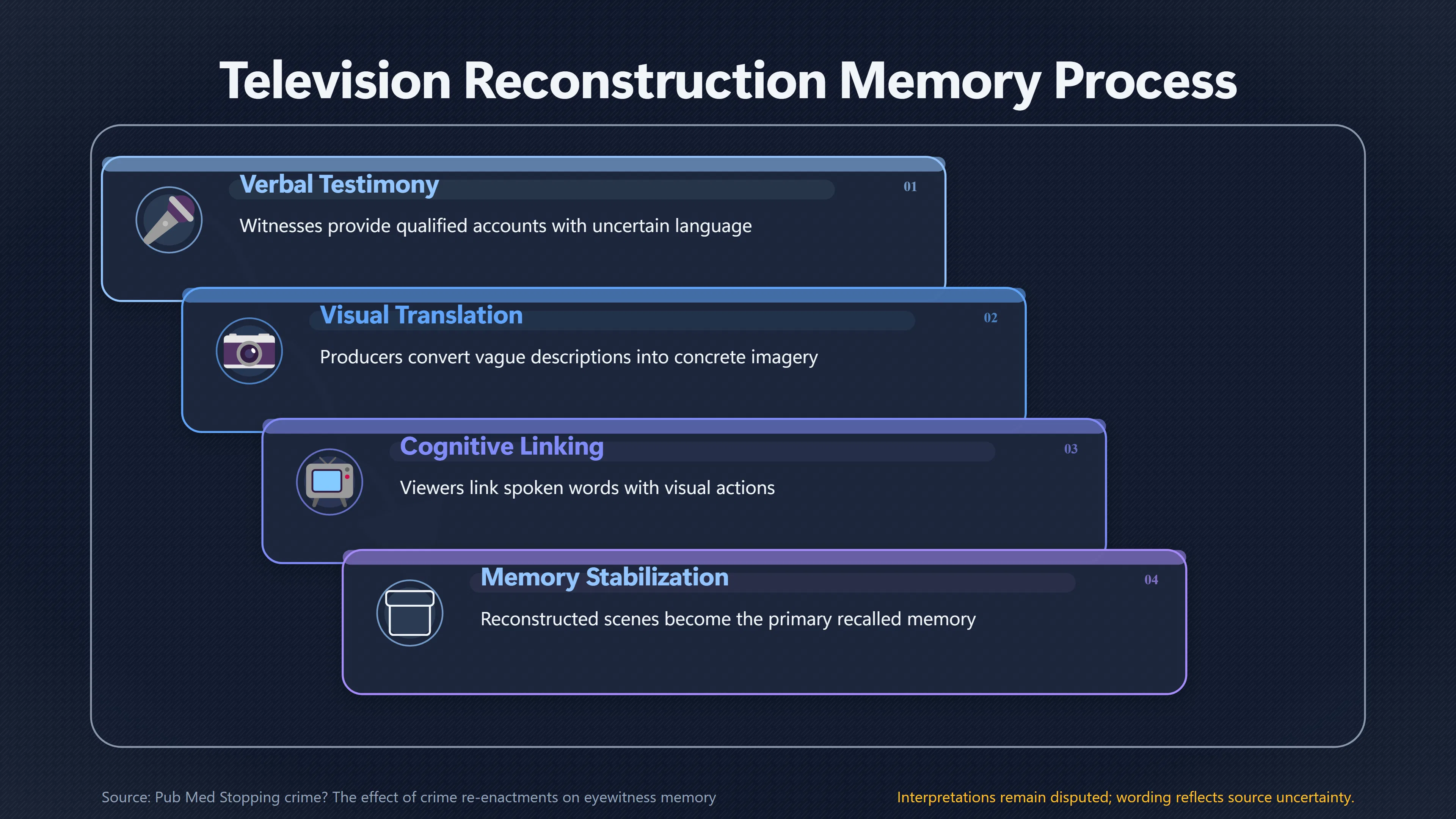
The most significant transformation occurs when uncertain language becomes definite imagery.
In an interview, uncertainty naturally appears through expressions such as:
- “I was told…”
- “Someone said they saw…”
- “It looked unusual…”
- “I cannot be certain…”
These qualifications help listeners judge the strength of the evidence. A television reconstruction, however, cannot easily depict uncertainty. Actors either carry alien bodies or they do not. Trucks either transport recovered wreckage or they remain absent. Once filmed, possibilities become apparent events.
Editing can amplify this effect. Interviews are frequently intercut with reconstructions so that viewers hear a witness speaking while simultaneously watching actors perform the described actions. Psychologically, the spoken testimony and visual imagery become linked into a single memory trace. Later, many viewers remember “seeing” the event rather than recalling that they watched a speculative reconstruction.
This mechanism is particularly important in Roswell because many famous details entered public discussion gradually over decades. Visual reconstructions often combined separate witness stories into one continuous sequence, presenting what had originally been fragmented and contested recollections as parts of a coherent historical narrative.
Why reconstructed images are so memorable
Modern memory research helps explain why television dramatisations can become more influential than verbal cautions.
Human memory is reconstructive rather than photographic. People combine original experiences with later information, repeated discussion and visual imagery when recalling past events. Psychologists refer to misleading later information as post-event information, which can alter how an event is remembered.
Experimental research on televised crime reenactments demonstrates this effect directly. Participants who viewed a reconstructed version of an earlier event did not remember the original event more accurately. Instead, they became significantly more likely to incorporate incorrect details introduced by the reenactment into their own recollections—even when they knew they were watching actors performing a reconstruction.[PubMed Central (PMC)]pmc.ncbi.nlm.nih.govPubMed Central (PMC)Stopping crime? The effect of crime re-enactments on eyewitness memory - PMCJune 17, 2020…
Although these studies examined crime appeals rather than UFO documentaries, the underlying cognitive mechanism is relevant. Once viewers repeatedly encounter detailed visual reconstructions, distinguishing between original evidence and later dramatisation becomes increasingly difficult.
Roswell as a cumulative visual story
Roswell demonstrates how repeated television portrayals can stabilise a narrative without necessarily producing new historical evidence.
Different documentaries often reconstructed remarkably similar sequences:
- military personnel surrounding a crash site;
- strange metallic debris resistant to damage;
- covered bodies loaded onto trucks;
- frightened witnesses warned into silence;
- secret laboratories conducting examinations.
Individual programmes frequently acknowledged that these scenes represented witness claims rather than verified historical footage. Yet across many years of broadcasting, similar imagery appeared repeatedly on documentary channels, network television and fictional adaptations.
Repetition matters because familiarity itself influences perceived credibility. Cognitive psychology has long shown that repeated statements become easier to process and therefore more likely to feel true—a phenomenon often called the illusory truth effect. Television reenactments can strengthen this process by repeating not merely sentences but emotionally powerful visual scenes that viewers recognise across multiple programmes.[PubMed Central (PMC)]pmc.ncbi.nlm.nih.govPubMed Central (PMC)Stopping crime? The effect of crime re-enactments on eyewitness memory - PMCJune 17, 2020…
What viewers are likely to remember
Long after watching a documentary, viewers often retain visual fragments rather than source information.
Instead of remembering that:
- a claim came from a witness interviewed decades later;
- another witness disputed the account;
- historians questioned the chronology;
- the reconstruction represented only one interpretation,
people may instead remember images of bodies under canvas, soldiers collecting debris or military convoys leaving the desert.
Psychologists describe this as a problem of source monitoring: people recall information but gradually lose track of where it originated. A reconstructed television scene may later feel like documentary evidence because the viewer remembers the image while forgetting that it was an actor’s performance rather than archival footage.[PubMed Central (PMC)]pmc.ncbi.nlm.nih.govPubMed Central (PMC)Stopping crime? The effect of crime re-enactments on eyewitness memory - PMCJune 17, 2020…
For Roswell, this distinction is particularly important because the visual vocabulary of the case—small grey bodies, guarded hangars and dramatic nighttime recoveries—owes far more to decades of media reconstruction than to surviving contemporary records from July 1947.
When reconstructions become part of the evidence
An additional complication arises when witnesses themselves have watched years of television coverage before giving interviews.
Many prominent Roswell witnesses first gave detailed public accounts decades after the incident, by which time books, documentaries and television specials had already established familiar imagery. This does not prove that later witnesses consciously borrowed details, but it does create a genuine historical challenge: researchers must distinguish between memories originating from personal experience and memories shaped by repeated exposure to later narratives.
The problem is not unique to UFO investigations. Memory researchers have consistently found that later information, discussion and visual suggestion can become integrated into genuine recollections without deliberate deception. Consequently, historians evaluating Roswell testimony generally examine not only what a witness claimed but also when the claim first appeared, whether earlier versions differed and whether independent contemporary records support the account.[PubMed Central (PMC)]pmc.ncbi.nlm.nih.govPubMed Central (PMC)Stopping crime? The effect of crime re-enactments on eyewitness memory - PMCJune 17, 2020…
The lasting effect of television reconstructions
Television reenactments did not determine whether extraordinary events occurred at Roswell. Their influence lies elsewhere: they transformed abstract, disputed testimony into memorable visual narratives.
Because television necessarily fills evidential gaps with images, viewers often leave with a stronger memory of reconstructed scenes than of the programme’s verbal qualifications. Over years of repeated broadcasts, these images helped establish a widely recognised version of the Roswell story that many people can picture in detail despite the scenes themselves being dramatic interpretations rather than historical recordings.
The result is a powerful mechanism by which uncertain claims can become culturally familiar memories—not because new evidence has emerged, but because repeated visual storytelling makes one version of events easier to imagine, recall and retell.

Amazon book picks
Further Reading
Books and field guides related to When Roswell Reconstructions Looked Like Evidence. Use these as the next step if you want deeper reading beyond the article.
Mirage Men: A Journey into Disinformation, Paranoia and UFOs
Seeking the truth about UFOs in America, Mark Pilkington and John Lundberg uncover a 60 year-old story stranger than any conspiracy thril...
Amusing Ourselves to Death: Public Discourse in the Age of Sh...
What happens when media and politics become forms of entertainment? As our world begins to look more and more like Orwell's 1984, Neil's...
Suspicious Minds: Why We Believe Conspiracy Theories
Suspicious Minds decodes the psychology of why we all believe in conspiracy theories--some of us just hide it better than others.
The Influencing Machine: Brooke Gladstone on the Media
New York Times Bestseller With a New Afterword “A comic book with zest and brains—one that just might help a reader understand the brave...
eBay marketplace picks
Marketplace Samples
Live-tested eBay searches with available results related to this page.
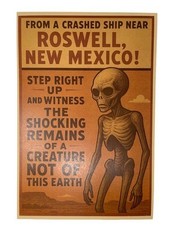
Selected fromRoswell UFO poster oneBay.co.uk.
Endnotes
1.
Source: pmc.ncbi.nlm.nih.gov
Link:https://pmc.ncbi.nlm.nih.gov/articles/PMC8547847/
Source snippet
PubMed Central (PMC)Stopping crime? The effect of crime re-enactments on eyewitness memory - PMCJune 17, 2020...
Published: June 17, 2020
2.
Source: pubmed.ncbi.nlm.nih.gov
Title: Pub Med Stopping crime? The effect of crime re-enactments on eyewitness memory
Link:https://pubmed.ncbi.nlm.nih.gov/34712097/
Source snippet
The effect of crime re-enactments on eyewitness memory - PubMedJune 17, 2020 —. 2020 Jun 17;28(2):286-309. doi: 10.1080/13218719.2020.17...
Published: June 17, 2020
3.
Source: Wikipedia
Title: Roswell incident
Link:https://en.wikipedia.org/wiki/Roswell_incident
4.
Source: pubmed.ncbi.nlm.nih.gov
Link:https://pubmed.ncbi.nlm.nih.gov/23085144/
Additional References
5.
Source: youtube.com
Link:https://www.youtube.com/watch?v=RCAHyclAmZs
Source snippet
History's Greatest Mysteries: Military Cleanup at Roswell Crash?! (S1, E6) | Full Episode...
6.
Source: tv.apple.com
Link:https://tv.apple.com/us/episode/roswell-the-first-witness—the-journal/umc.cmc.3pukqwtzxi9b42x9kx14bw69t?showId=umc.cmc.dty6d53ytbez51lt6rbsslv2
Source snippet
apple.comRoswell: The First Witness - The Journal - History's Greatest Mysteries (Season 1, Episode 5) - Apple TVDecember 12, 2020 — [Bu...
Published: December 12, 2020
7.
Source: youtube.com
Title: The Roswell Incident Mystery Finally Solved
Link:https://www.youtube.com/watch?v=Pz0vYcc4KiI
Source snippet
This selection is relevant because it features full documentary presentations and archival television broadcasts—such as the iconic 1995...
8.
Source: researchers.mq.edu.au
Title: mq.edu.au Stopping crime?
Link:https://researchers.mq.edu.au/en/publications/stopping-crime-the-effect-of-crime-re-enactments-on-eyewitness-me
Source snippet
The effect of crime re-enactments on eyewitness memory - Macquarie UniversityMarch 4, 2021 — STOPPING CRIME? THE EFFECT OF CRIME RE-ENACT...
Published: March 4, 2021
9.
Source: youtube.com
Title: Alien Autopsy: Fact or Fiction? Uncut | [Unexplained]({{ ‘unexplained/’ | relative_url }}) UFOs
Link:https://www.youtube.com/watch?v=QgxlWRcydRk
Source snippet
Roswell's First Witness Testimonial | History's Greatest Mysteries (S1, E5) | Full Episode...
10.
Source: psychologicalscience.org
Link:https://www.psychologicalscience.org/journals/psychological-science/1467-9280.00388/
11.
Source: imdb.com
Link:https://www.imdb.com/title/tt33381205/
Source snippet
"Unsolved Mysteries" The Roswell UFO Incident (TV Episode 2024) - IMDbOctober 2, 2024 — THE ROSWELL UFO INCIDENT * Episode aired Oct 2, 2...
Published: October 2, 2024
12.
Source: m.imdb.com
Link:https://m.imdb.com/title/tt33381205/
Source snippet
imdb.com"Unsolved Mysteries" The Roswell UFO Incident (TV Episode 2024) - IMDbOctober 2, 2024 — THE ROSWELL UFO INCIDENT * Episode aired...
Published: October 2, 2024
13.
Source: sciencedirect.com
Link:https://www.sciencedirect.com/science/article/pii/S0022103196900220
14.
Source: youtube.com
Link:https://www.youtube.com/watch?v=TywPwJSosgc
Source snippet
Roswell: Three Stories...