Within Material Testing
Why One Chemical Reading Cannot Prove Alien Metal
A convincing material assessment must connect overall composition with the exact location, form and structure of each element.
On this page
- What bulk chemistry can reveal
- What microscopic mapping adds
- How conflicting scales expose false interpretations
Page outline Jump by section
Introduction
A chemical analysis can show what an alleged UFO metal is made of, but it cannot by itself show how that material was manufactured or whether it is technologically extraordinary. The distinction between bulk chemistry (the average composition of a sample) and microscopic structure (how those elements are arranged within it) is one of the most important principles in laboratory assessment of alleged crash debris. A fragment may contain an unusual combination of elements, yet prove to be an ordinary industrial alloy once its internal structure is mapped. Conversely, a chemically common alloy can acquire unusual-looking local features through casting, welding, corrosion, heat damage or contamination. Modern materials science therefore treats composition and structure as complementary evidence rather than competing explanations. This distinction has become especially important in investigations of alleged UFO metals, where claims have often relied on isolated chemical readings without corresponding microscopic analysis.[ResearchGate]researchgate.netResearchGate(PDF) Isotope Ratios and Chemical Analysis of the 1957 Brazilian Ubatuba FragmentMay 22, 2022…
What bulk chemistry can reveal
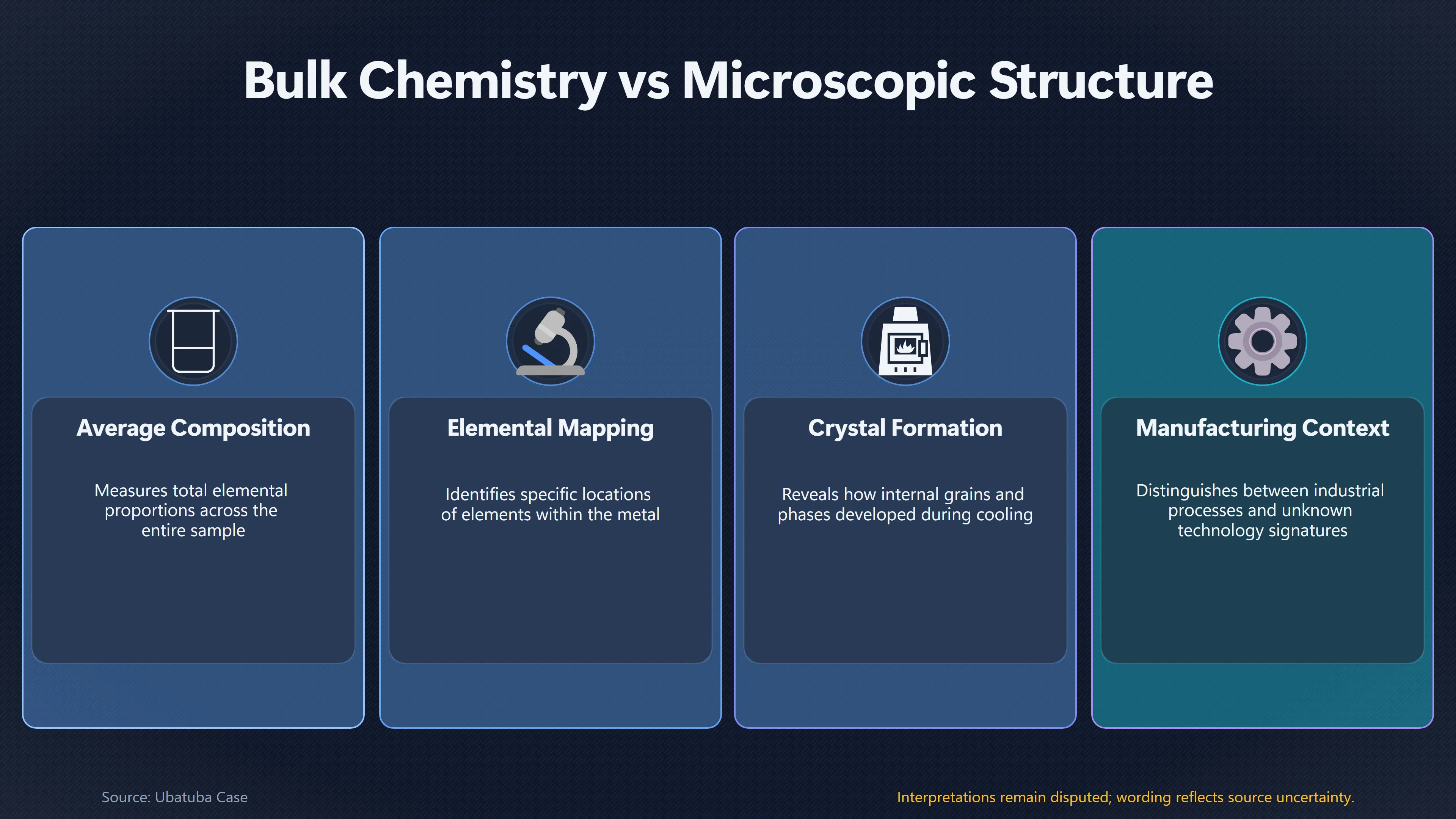
Bulk chemical analysis measures the average elemental composition of a specimen. Techniques such as inductively coupled plasma mass spectrometry (ICP-MS), inductively coupled plasma optical emission spectroscopy (ICP-OES), X-ray fluorescence (XRF) and related methods determine the proportions of major elements and detect trace impurities.
This information is valuable because it answers several basic questions:
- Does the material match a recognised commercial alloy?
- Are expected alloying elements present?
- Are unusual impurities distributed throughout the specimen or only on its surface?
- Does the chemistry resemble terrestrial engineering materials?
Bulk analysis often provides the first indication that an allegedly exotic sample is compatible with known metallurgy. For example, Oak Ridge National Laboratory’s examination of a widely discussed magnesium-based specimen associated with UFO claims identified a magnesium-zinc alloy containing lead, bismuth and trace elements consistent with terrestrial manufacturing rather than unknown materials.[Popular Mechanics]popularmechanics.comInitially thought to exhibit extraordinary properties suggestive of a technosignature—an indicator of intelligent extraterrestrial design…
However, bulk chemistry has important limitations. Dissolving a small portion of metal into solution averages together everything present. Distinct layers, inclusions, welds or contaminants disappear into one numerical result. A report stating that a sample contains “2% bismuth” says nothing about whether the bismuth exists as isolated particles, continuous sheets, microscopic droplets or contamination concentrated in cracks.
That distinction is often more important than the percentage itself.
What microscopic mapping adds
Microscopic examination determines where each element is located, how crystals formed, and whether different phases of the alloy developed during manufacture.
Common methods include:
- Optical metallography to examine polished cross-sections.[Scanning Electron Microscopy]nlr.govSource details in endnotes. py (SEM) for high-resolution imaging.
- Energy-dispersive X-ray spectroscopy (EDS) to map elemental distributions.
- Electron backscatter diffraction (EBSD) to identify crystal orientation.
- Transmission electron microscopy (TEM or STEM) for atomic-scale structure.[nlr.gov]nlr.govSource details in endnotes.
Rather than producing one average chemical value, these techniques generate spatial maps showing how chemistry changes over distances ranging from millimetres to nanometres.
This matters because manufacturing processes rarely distribute every element uniformly. During casting, cooling, rolling or heat treatment, different elements migrate into grain boundaries, segregate into separate phases or concentrate in microscopic inclusions. These are expected features of engineering alloys rather than evidence of unknown technology. Modern electron microscopy routinely combines crystallographic and chemical mapping precisely because neither dataset alone fully characterises a material.[arXiv]arxiv.orgAdvancing characterisation with statistics from correlative electron diffraction and X-ray spectroscopy, in the scanning electron mi…
Why chemistry alone can mislead
Several mechanisms can produce apparently remarkable chemistry without requiring an extraordinary origin.
Element segregation. During solidification, certain elements naturally accumulate between growing crystals instead of remaining evenly mixed. A bulk analysis simply reports their average abundance, while microscopy reveals whether they occupy predictable segregation patterns.
Surface contamination. Exposure to seawater, soil, polishing compounds or handling can enrich the outer few micrometres with sodium, calcium, iron or other elements. Bulk measurements using drilled interior material may differ substantially from surface-sensitive techniques.
Multiple manufacturing stages. A fragment may contain weld material, brazing alloy, plating or repair layers. Without microscopy these distinct regions merge into one averaged composition.
Mechanical damage. Heat, deformation and corrosion can redistribute elements after manufacture, creating concentration gradients that appear unusual until their physical context is understood.
These mechanisms explain why experienced metallurgists rarely interpret chemistry independently from microstructure.
The magnesium–bismuth example
One of the best-known examples concerns the layered magnesium alloy examined by Oak Ridge National Laboratory for the US All-domain Anomaly Resolution Office.
Earlier public discussion focused heavily on its unusual combination of magnesium, zinc and bismuth, with suggestions that alternating layers might represent advanced engineering or even a terahertz waveguide.
Microscopic analysis substantially changed that interpretation.
Rather than finding continuous, chemically pure bismuth sheets, investigators observed that the bismuth-rich regions also contained lead and displayed structural features consistent with terrestrial processing and later mechanical or thermal damage. The layered appearance therefore could not support the proposed waveguide hypothesis because the necessary purity and structural arrangement were absent. The crystalline structure likewise matched conventional magnesium alloys rather than an unknown form of matter.[Popular Mechanics]popularmechanics.comInitially thought to exhibit extraordinary properties suggestive of a technosignature—an indicator of intelligent extraterrestrial design…
This illustrates why the question is not merely “Is bismuth present?” but “Exactly where is the bismuth, what surrounds it, how pure is it, and how did that arrangement form?”
The Ubatuba fragment shows the same principle
The long-studied Ubatuba magnesium fragments from Brazil provide another illustration of the distinction between bulk composition and microscopic structure.
Recent work confirmed that the material consists predominantly of highly pure magnesium while examining trace elements and isotope ratios in greater detail than earlier studies. Although some impurity distributions were considered unusual enough to merit further investigation, the magnesium isotope ratios themselves remained within terrestrial limits, and the trace-element isotope evidence was not sufficient to demonstrate a non-terrestrial origin.[Journal of Scientific Exploration]journalofscientificexploration.orgJournal of Scientific ExplorationIsotope Ratios and Chemical Analysis of the 1957 Brazilian Ubatuba Fragment | Journal of Scientific Expl…
Equally important was the recognition that impurity distribution matters. Researchers distinguished between impurities likely introduced by environmental exposure and those appearing throughout the interior of the material. That distinction depends on combining bulk chemical measurements with microscopic examination rather than relying on average elemental concentrations alone.[NICAP]nicap.orgUbatuba CaseUbatuba Case - Composition Analysis Of The Brazilian Magnesium…
How conflicting scales expose false interpretations
The most reliable assessments compare observations made at different scales.
When bulk chemistry and microscopic mapping agree, confidence increases. For example, if both indicate a homogeneous aluminium-silicon casting alloy with expected grain structure, the interpretation is straightforward.
Greater insight often comes when the two scales appear to conflict.
Bulk chemistryMicroscopic structureLikely interpretationUnusual average compositionConventional grains and segregationRare but terrestrial alloy or specialised manufacturingOrdinary chemistryUnusual surface layer onlyCoating, corrosion or contaminationMixed chemistryDistinct welded or bonded regionsComposite engineering componentChemically pure alloyConventional crystal defects and grain boundariesHigh-purity industrial material rather than exotic technology
These comparisons frequently resolve claims that initially appear extraordinary because one analytical method captured only part of the specimen’s history.

Why both scales are required
No single laboratory instrument can determine whether an alleged UFO fragment represents unknown technology.
Bulk chemistry identifies which elements are present and in what proportions. Microscopic analysis explains how those elements are organised, whether their arrangement follows recognised metallurgical processes, and whether apparent anomalies result from manufacturing, damage or contamination.
Only by integrating both scales can investigators distinguish between a genuinely unusual material and an ordinary alloy with an unusual appearance. The published examinations of prominent alleged UFO metals have consistently demonstrated this principle: features that initially seemed remarkable from isolated chemical measurements became far less mysterious once their microscopic structure was analysed alongside their overall composition.[Popular Mechanics]popularmechanics.comInitially thought to exhibit extraordinary properties suggestive of a technosignature—an indicator of intelligent extraterrestrial design…
Amazon book picks
Further Reading
Books and field guides related to Why One Chemical Reading Cannot Prove Alien Metal. Use these as the next step if you want deeper reading beyond the article.
Materials Characterization: Introduction to Microscopic and S...
This book covers state-of-the-art techniques commonly used in modern materials characterization. Two important aspects of characterizatio...
Scanning Electron Microscopy and X-Ray Microanalysis
In the decade since the publication of the second edition of Scanning Electron Microscopy and X-Ray Microanalysis, there has been a great...
Physical Metallurgy Principles
This comprehensive, student friendly text is intended for use in an introductory course in physical metallurgy and is designed for all en...
Transmission Electron Microscopy: A Textbook for Materials Sc...
This profusely illustrated text on Transmission Electron Microscopy provides the necessary instructions for successful hands-on applicati...
eBay marketplace picks
Marketplace Samples
Live-tested eBay searches with available results related to this page.
Selected fromUFO collectible oneBay.co.uk.




Endnotes
1.
Source: researchgate.net
Link:https://www.researchgate.net/publication/360788800_Isotope_Ratios_and_Chemical_Analysis_of_the_1957_Brazilian_Ubatuba_Fragment
Source snippet
ResearchGate(PDF) Isotope Ratios and Chemical Analysis of the 1957 Brazilian Ubatuba FragmentMay 22, 2022...
Published: May 22, 2022
2.
Source: arxiv.org
Link:https://arxiv.org/abs/1908.04084
Source snippet
Advancing characterisation with statistics from correlative electron diffraction and X-ray spectroscopy, in the scanning electron mi...
3.
Source: nicap.org
Title: Ubatuba Case
Link:https://www.nicap.org/reports/ubatubanal.htm
Source snippet
Ubatuba Case - Composition Analysis Of The Brazilian Magnesium...
4.
Source: researchgate.net
Link:https://www.researchgate.net/figure/sotopic-composition-as-determined-by-Elemental-Research-Inc-using-high-resolution-mass_fig2_237233241
5.
Source: researchgate.net
Title: Bulk Composition Analysis tbl2 237233241
Link:https://www.researchgate.net/figure/Bulk-Composition-Analysis_tbl2_237233241
6.
Source: popularmechanics.com
Link:https://www.popularmechanics.com/science/a69821680/ufo-alien-tech/
Source snippet
Initially thought to exhibit extraordinary properties suggestive of a technosignature—an indicator of intelligent extraterrestrial design...
7.
Source: journalofscientificexploration.org
Link:https://journalofscientificexploration.org/index.php/jse/article/view/2415
Source snippet
Journal of Scientific ExplorationIsotope Ratios and Chemical Analysis of the 1957 Brazilian Ubatuba Fragment | Journal of Scientific Expl...
8.
Source: explorescu.org
Title: isotope ratios and chemical analysis of the 1957 brazilian ubatuba fragment
Link:https://www.explorescu.org/post/isotope-ratios-and-chemical-analysis-of-the-1957-brazilian-ubatuba-fragment
9.
Source: scribd.com
Title: Isotope Ratios and Chemical Analysis of the 1957 B
Link:https://www.scribd.com/document/718887137/Isotope-Ratios-and-Chemical-Analysis-of-the-1957-B
10.
Source: serc.carleton.edu
Link:https://serc.carleton.edu/research_education/geochemsheets/eds.html
11.
Source: nlr.gov
Link:https://www.nlr.gov/materials-science/scanning-electron-microscopy
12.
Source: wikidisc.org
Title: Ubatuba Magnesium Fragments | Wiki Disc
Link:https://www.wikidisc.org/wiki/Ubatuba_Magnesium_Fragments
Additional References
13.
Source: youtube.com
Title: Unlocking the Secrets of UFOs: How UAP Could Change Science Forever
Link:https://www.youtube.com/watch?v=rx2x_w5wimk
Source snippet
Gary Nolan UFO metal materials science analysis Professor Garry Nolan & Ross Coulthart: Full interview | UFO UAP News 7 News Spotlight...
14.
Source: hjkc.de
Title: Raumfahrt+Astronomie-Blog von CENAP
Link:https://www.hjkc.de/_blog/27064-ufo-forschung-the-pentagon-s-ufo-report-update-152-aaro-synopsis-analysis-of-an-aluminum-specimen/
Source snippet
Methods To identify the alloy family and probe claims of unusual behavior, ORNL combined multiple complemen‑ tary methods that analyze di...
15.
Source: uapedia.ai
Title: UAP Meta-materials Types Dossier
Link:https://uapedia.ai/wiki/uap-meta-materials-types-dossier/
Source snippet
December 21, 2025 — THE STATE OF THE FIELD: METHODS ARE CONVERGING EVEN WHEN INTERPRETATIONS DIVERGE A key shift in the last few y...
Published: December 21, 2025
16.
Source: unredacted.info
Title: “Alien Metal” Debunked?
Link:https://www.unredacted.info/ufo/alien-metal-debunked-pentagon-lab-says-mysterious-specimen-is-terrestrial/
Source snippet
Pentagon Says Mysterious Specimen Is Terrestrial - Unredacted.infoMay 17, 2025 — "ALIEN METAL" DEBUNKED? PENTAGON SAYS MYSTERIOUS SPECIME...
Published: May 17, 2025
17.
Source: youtube.com
Title: New UAP Materials Tests: What the Results Reveal | Dr. Garry Nolan
Link:https://www.youtube.com/watch?v=Mifx4nzPY68
Source snippet
Unlocking the Secrets of UFOs: How UAP Could Change Science Forever - w Garry Nolan...
18.
Source: youtube.com
Title: UFO explosion fragments from Ubatuba, Brazil | Garry Nolan and Lex Fridman
Link:https://www.youtube.com/watch?v=EBsUIj_UBBE
Source snippet
Metal Piece From 1947 [Roswell]({{ 'roswell/' | relative_url }}) Incident Analyzed By a Government Lab...
19.
Source: youtube.com
Link:https://www.youtube.com/watch?v=J6xtxZwrGLY
Source snippet
New UAP Materials Tests: What the Results Reveal | Dr. Garry Nolan...
20.
Source: ornl.gov
Link:https://www.ornl.gov/publication/advancing-elemental-and-isotopic-analysis-uranium-mineral-inclusions-rapid-screening
21.
Source: ornl.gov
Link:https://www.ornl.gov/group/nacil/cims
22.
Source: youtube.com
Title: Garry Nolan, Ph.D. on The Material Science of UAP
Link:https://www.youtube.com/watch?v=7UW1jyN2o8A
Source snippet
UFO explosion fragments from Ubatuba, Brazil | Garry Nolan and Lex Fridman...