Within Aircraft Accidents
When UFO Witnesses Are Not Independent Sources
Retold military stories can appear to be independent confirmation even when several witnesses are repeating the same misunderstood event.
On this page
- How second hand claims multiply across interviews
- Why genuine military activity can be sincerely misread
- How source tracing tests apparent corroboration
Page outline Jump by section
Introduction
One of the most persistent problems in historical UFO crash claims is not necessarily false memories, but false corroboration: the appearance that many independent witnesses are confirming the same event when, on closer examination, they are repeating information that originated from a much smaller number of sources. Within accounts of alleged UFO crash retrievals, this effect can make a single misunderstood military incident seem supported by dozens of separate testimonies. Modern reviews of crash-retrieval allegations have repeatedly identified this pattern, noting that sincere witnesses often pass on stories heard from colleagues, relatives or retired military personnel without knowing where the information first originated. As these accounts spread across interviews, books and documentaries, they can create the illusion of independent confirmation even when they ultimately trace back to one underlying event or rumour.[U.S. Department of War]defense.govOpen source on defense.gov.(https://www.defense.gov/News/Transcripts/Transcript/Article/3702219/media-engagement-with-acting-aaro-director-tim-phillips-on-the-historical-recor/)
How second-hand claims multiply across interviews
Investigators often distinguish between first-hand testimony—what a witness personally observed—and second-hand testimony, in which someone reports what another person supposedly experienced. In UFO crash literature, these categories frequently become blurred.
Several mechanisms contribute to this process:
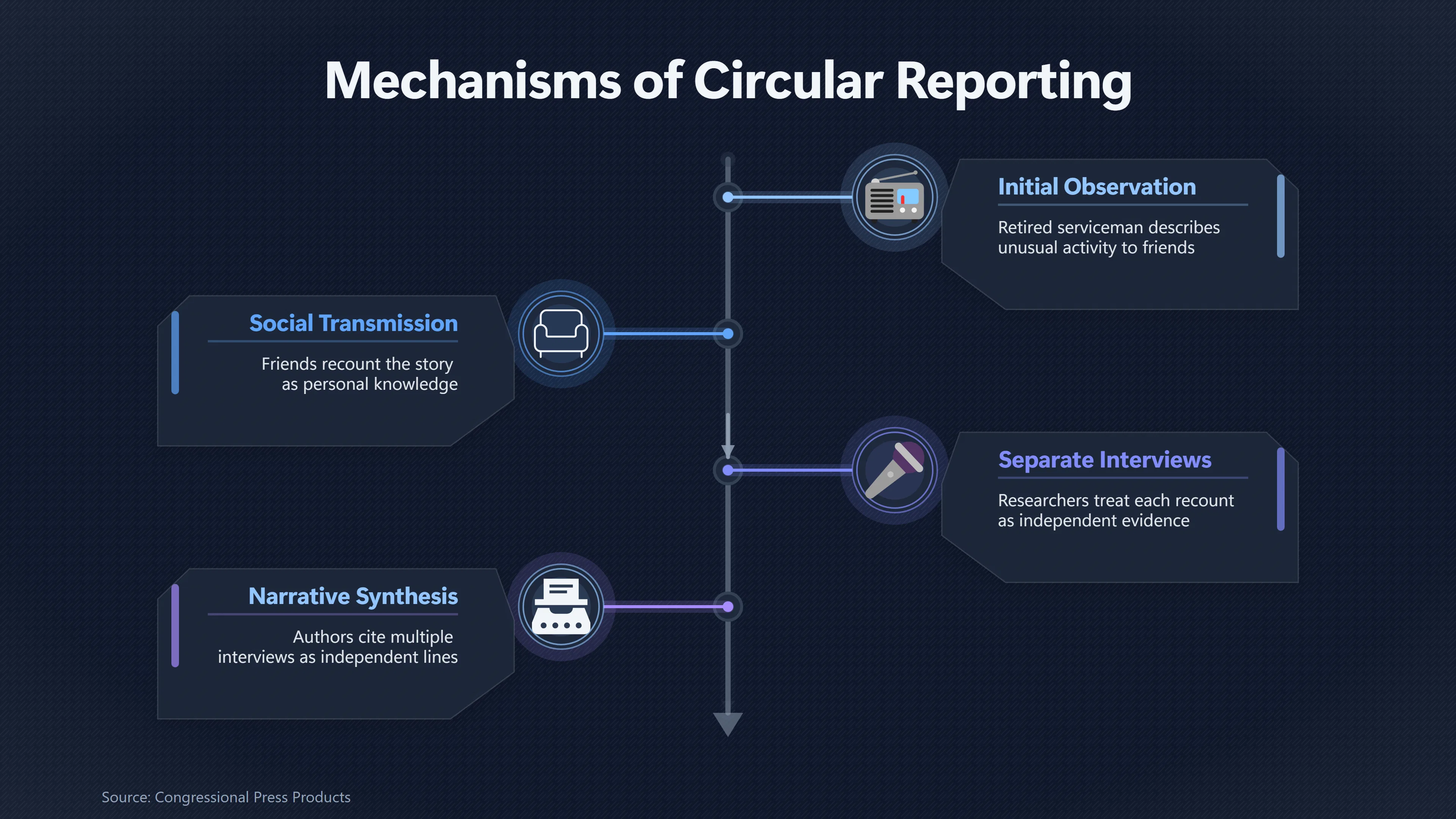
- A retired serviceman tells friends about unusual activity on a military base.
- Those friends later recount the story as something they “know happened”.
- Researchers interview each person separately, treating each account as another witness.
- Later authors cite multiple interviews as though they represent independent lines of evidence.
Although the number of accounts grows, the number of original observations does not. The apparent weight of evidence increases without any increase in genuinely independent information.
The Pentagon’s All-domain Anomaly Resolution Office (AARO) highlighted exactly this problem during its historical review of alleged crash-retrieval programmes. According to the office, many longstanding allegations developed through circular reporting, in which a relatively small group of people repeatedly shared stories they had themselves heard from others over many years. The office emphasised that most participants appeared to be acting in good faith rather than deliberately spreading false information.[U.S. Department of War]defense.govOpen source on defense.gov.(https://www.defense.gov/News/Transcripts/Transcript/Article/3702219/media-engagement-with-acting-aaro-director-tim-phillips-on-the-historical-recor/)
This distinction matters because multiple retellings can easily be mistaken for multiple eyewitnesses.
Why repeated interviews can exaggerate confidence
Historical UFO investigations often rely on oral testimony collected decades after the events. During that time, witnesses may encounter books, television programmes, newspaper articles and discussions with other participants. Their own memories can gradually become intertwined with information acquired later.
This creates several common patterns:
- Shared vocabulary. Independent interviewees begin using nearly identical descriptions because they have absorbed the same published narrative.
- Merged timelines. Separate military operations become remembered as occurring on the same day.
- Borrowed detail. Witnesses add elements they never personally observed because they have repeatedly heard them from trusted acquaintances.
- Source confusion. Individuals sincerely forget whether they personally witnessed something or only heard about it years earlier.
Psychological research has long shown that people can accurately remember the existence of information while losing track of its original source. In historical investigations, this “source monitoring” problem makes repeated second-hand accounts particularly difficult to evaluate.

Why genuine military activity can be sincerely misread
Military installations naturally generate unusual sights that encourage speculation: restricted areas, guarded transport, emergency responses, aircraft accidents and classified testing. Most personnel only observe a small part of what is happening, leaving gaps that are often filled by inference.
A mechanic may genuinely remember security tightening after an accident. Another employee may recall ambulances arriving. Someone else may remember rumours circulating that evening. None of these observations necessarily concern the same incident, yet later retellings can combine them into a single dramatic narrative involving an alleged UFO recovery.
Because each participant remembers a real piece of military activity, the resulting story often feels internally convincing. The error lies not in the individual observations but in assuming they all describe one hidden event.
AARO concluded that many crash-retrieval allegations appear to reflect precisely this process: authentic military or national security activities were misunderstood, retold and eventually interpreted as evidence for concealed extraterrestrial programmes despite the absence of verifiable supporting documentation.[U.S. Department of War]defense.govOpen source on defense.gov.(https://www.defense.gov/News/Transcripts/Transcript/Article/3702219/media-engagement-with-acting-aaro-director-tim-phillips-on-the-historical-recor/)
How source tracing tests apparent corroboration
Professional historical investigation places considerable emphasis on determining whether witnesses are genuinely independent. Rather than counting testimonies, researchers attempt to reconstruct how information travelled.
Useful questions include:
- Who first reported the specific claim? If numerous accounts ultimately derive from one individual, the evidence is only as strong as that original source.
- Could witnesses have influenced one another? Shared workplaces, military units, family relationships or UFO research communities increase the likelihood of information exchange.
- What did each witness personally observe? Separating direct observation from later interpretation often reduces apparently dramatic testimony to a much narrower factual core.
- Are there contemporaneous records? Documents created at the time generally carry greater evidential weight than recollections collected decades later.
- Do independent records converge? Strong corroboration comes from evidence produced through separate channels—for example, official documents, photographs, physical records and unrelated eyewitnesses—not merely multiple retellings of the same story.
This approach explains why historians are cautious about witness counts alone. Ten interviews may represent ten genuinely independent observers—or ten repetitions of one rumour.
Why witness numbers alone can be misleading
UFO crash narratives sometimes emphasise that “dozens” or even “hundreds” of people have spoken about recovery operations. By itself, however, the number of interviewees says little about evidential strength.
A large collection of testimonies can still depend on:
- one influential storyteller;
- one misunderstood military accident;
- one widely circulated rumour;
- or one published account repeatedly echoed by later witnesses.
Conversely, a much smaller number of demonstrably independent sources can provide stronger corroboration if they were unable to influence one another and each contributes distinct, verifiable information.
For this reason, modern historical reviews evaluate the independence of evidence rather than simply the quantity of testimony. Within the broader history of aircraft accidents becoming absorbed into UFO crash lore, repeated second-hand reporting illustrates how sincere recollections, military secrecy and decades of retelling can collectively transform one underlying event into what appears to be a broad body of mutually confirming evidence—even when careful source tracing reveals a far less extensive foundation.[defense.gov]defense.govOpen source on defense.gov.
Amazon book picks
Further Reading
Books and field guides related to When UFO Witnesses Are Not Independent Sources. Use these as the next step if you want deeper reading beyond the article.
Eyewitness Testimony
By shedding light on the many factors that can intervene and create inaccurate testimony, Elizabeth Loftus illustrates how memory can be...
The Seven Sins of Memory: How the Mind Forgets and Remembers
Examines what the author terms "common memory vices," including absent-mindedness, transcience, blocking, misattribution, suggestibility,...
The Demon-Haunted World
Rating: 4.5/5 from 43 Google Books ratings
NEW YORK TIMES BESTSELLER • From the renowned astronomer and author of Cosmos comes a “powerful [and] stirring defense of informed ration...
Suspicious Minds: Why We Believe Conspiracy Theories
Suspicious Minds decodes the psychology of why we all believe in conspiracy theories--some of us just hide it better than others.
eBay marketplace picks
Marketplace Samples
Live-tested eBay searches with available results related to this page.
Selected fromUFO poster oneBay.co.uk.

Current eBay listing
VINTAGE UFO FLYING SAUCERS COMIC ADVERTISING A2 POSTER PRINT


Current eBay listing
I Want To Believe UFO Poster Giclée Fine Art Heavyweight Print

Endnotes
1.
Source: aaro.mil
Link:https://www.aaro.mil/Submit-A-Report/
2.
Source: aaro.mil
Title: Congressional Press Products
Link:https://www.aaro.mil/Congressional-Press-Products/
3.
Source: defense.gov
Link:https://www.defense.gov/News/Transcripts/Transcript/Article/3702219/media-engagement-with-acting-aaro-director-tim-phillips-on-the-historical-recor/
4.
Source: [uap-archive]({{ ‘uap-archive/’ | relative_url }}). org
Link:https://uap-archive.org/uap/records/aaro-historical-record-report-vol1/
Additional References
5.
Source: wsj.com
Link:https://www.wsj.com/politics/national-security/ufo-us-disinformation-45376f7e
Source snippet
military deliberately spread disinformation about UFOs, contributing to decades of conspiracy theories. The probe, prompted by congressio...
6.
Source: skyledger.space
Title: government investigations and records; it should be read as an agency assessment
Link:https://skyledger.space/articles/aaros-historical-record-report.html
Source snippet
AARO’s Historical Record Report: What Its First Volume Reviewed | SkyledgerJuly 7, 2026 — AARO’S HISTORICAL RECORD REPORT: WHAT ITS FIRST...
Published: July 7, 2026
7.
Source: legalclarity.org
Title: Government Involvement with [Unidentified]({{ ‘unidentified/’ | relative_url }}) Anomalous Phenomena,” which
Link:https://legalclarity.org/uap-crash-retrieval-hearings-whistleblowers-and-legislation/
Source snippet
UAP Crash Retrieval: Hearings, Whistleblowers, and Legislation - LegalClarityJuly 1, 2026 — AARO’S HISTORICAL RECORD REPORT In February 2...
Published: July 1, 2026
8.
Source: youtube.com
Link:https://www.youtube.com/watch?v=DF9PprPybbI
Source snippet
Breaking Down UAP Footage with the Head of The Pentagon's UAP Taskforce, Dr. Jon Kosloski...
9.
Source: youtube.com
Title: Solving Colombia’s Shocking UFO (UAP) Blue Beam
Link:https://www.youtube.com/watch?v=hpsN2WUkYRQ
Source snippet
This collection provides video reports and discussions detailing how second-hand stories, circular reporting, and misidentified phenomena...
10.
Source: wikidisc.org
Title: AAR O Historical Report Vol
Link:https://www.wikidisc.org/wiki/AARO_Historical_Report_Vol._1
Source snippet
1 | WikiDiscJune 12, 2026 — REPORT SCOPE AND METHODOLOGY[EDIT | EDIT SOURCE] AARO's Historical Report Volume 1 examined U.S. government r...
Published: June 12, 2026
11.
Source: youtube.com
Title: Pentagon: Most UAP (UFO) sightings likely ‘ordinary objects’ | News Nation Live
Link:https://www.youtube.com/watch?v=vTxyjRsm6RE
Source snippet
UFOs: A Scientist Explains The Phenomenon | Robert Powell...
12.
Source: psychologicalscience.org
Link:https://www.psychologicalscience.org/journals/psychological-science/1467-9280.00388/
13.
Source: anomalydesk.com
Title: aaro historical report
Link:https://anomalydesk.com/aaro-historical-report.html
Source snippet
government UAP involvement 1945–2023; report released early 2024 Location All-domain Anomaly Re...
14.
Source: youtube.com
Title: UFOs: A Scientist Explains The Phenomenon | Robert Powell
Link:https://www.youtube.com/watch?v=twpdYHwkCIs
Source snippet
Solving Colombia's Shocking UFO (UAP) Blue Beam...