Within Satellite Debris
Does This Mystery Sphere Come From Space?
Rounded tanks, valves, carbon-fibre wrapping and heat damage can distinguish spacecraft hardware from supposedly exotic metal.
On this page
- Why pressure vessels survive re entry
- Visible clues in tanks, valves and composite wrapping
- What laboratory testing can and cannot prove
Page outline Jump by section
Introduction
When a metallic sphere or scorched cylindrical tank is recovered after a bright object crosses the sky, it is often described as possible “UFO debris”. In practice, one of the most common explanations is far less exotic: a surviving pressure vessel from a satellite, rocket stage or spacecraft. These components are designed to withstand enormous internal pressures and, unlike lightweight aluminium structures, they frequently survive atmospheric re-entry with much of their shape intact. NASA, aerospace engineers and space-debris specialists consistently identify pressure vessels as among the spacecraft parts most likely to reach the ground.[NASA]nasa.govDeceptively Complex: Composite Overwrapped Pressure Vessels (COPV) Remain a Challenge for Engineers to Unravel - NASAAugust 27, 2021…
Within reports of alleged UFO recoveries linked to suspected satellite debris, recognising the distinctive features of spacecraft tanks is therefore an important first step. Appearance alone cannot prove an object’s origin, but certain combinations of shape, materials, fittings and manufacturing details strongly favour a conventional aerospace explanation over claims of unknown technology.
Why pressure vessels survive re-entry
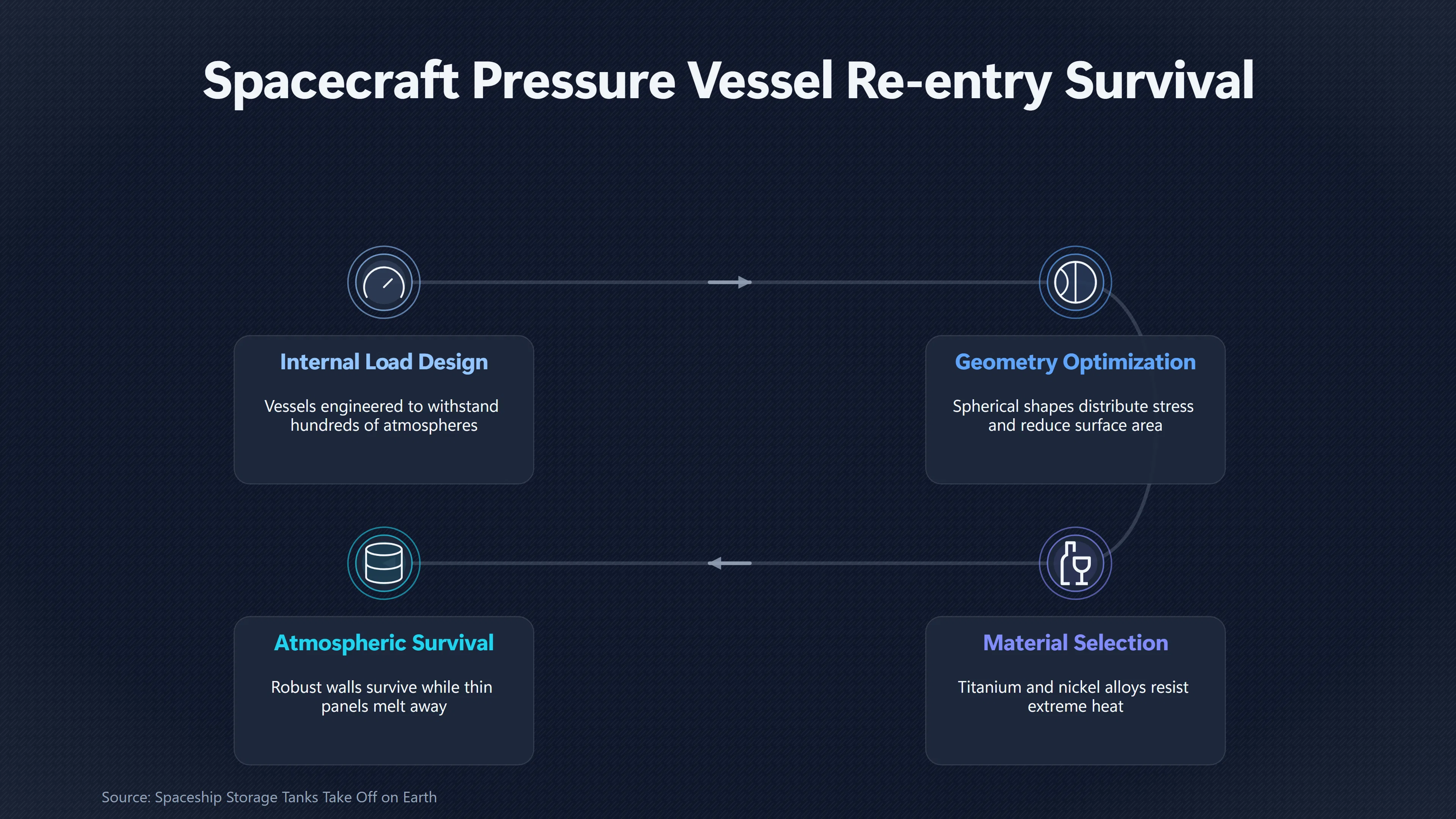
A spacecraft contains many components that are destroyed long before reaching the ground. Solar panels, electronics, insulation and thin structural panels usually melt, fragment or burn away. Pressure vessels are different because they are engineered to contain gases or liquids at extremely high pressure throughout a mission.
Several factors increase their chances of surviving:
- High-strength construction. Many tanks are made from titanium, stainless steel or nickel-based alloys chosen for strength rather than minimum melting point.
- Compact geometry. Spheres and cylinders distribute stress efficiently and expose relatively little surface area compared with large flat panels.
- Thick walls. Pressure vessels must tolerate internal loads that can exceed hundreds of atmospheres, making them far more robust than surrounding spacecraft structures.
- Reduced aerodynamic heating. Their rounded shapes generate less local structural failure than thin sheet-metal assemblies.
Modern launch vehicles also use Composite Overwrapped Pressure Vessels (COPVs)—metal or polymer liners wrapped with high-strength carbon-fibre composite. NASA describes these as critical hardware used to store propellants, pressurising gases and life-support fluids on spacecraft.[NASA]nasa.govDeceptively Complex: Composite Overwrapped Pressure Vessels (COPV) Remain a Challenge for Engineers to Unravel - NASAAugust 27, 2021…
This combination of strength and compactness explains why recovered “mystery spheres” are disproportionately likely to be pressure vessels rather than random spacecraft fragments.
Visible clues in tanks, valves and composite wrapping
Most genuine spacecraft pressure vessels display manufacturing features that are difficult to mistake once recognised.
Rounded pressure-tank shapes
Pressure vessels commonly appear as:
- Nearly perfect metal spheres.[space.com]space.comBelieved to be pressure vessels from space launch vehicles, their recovery has reignited conversations about the hazards of falling space…
- Short cylinders with rounded ends.
- Spherical tanks supported by welded brackets.
- Composite-wrapped cylinders with metal end fittings.
The symmetry is deliberate. Spherical vessels minimise stress concentrations and are widely used for storing helium, nitrogen and propellants aboard spacecraft.
Objects promoted as mysterious because they are “too perfectly round” may actually resemble standard aerospace pressure tanks more closely than unusual technology.
Valves and plumbing
One of the strongest indicators of spacecraft origin is the presence of engineered plumbing.
Typical features include:
- threaded ports;
- welded pipe stubs;
- pressure-relief valves;
- fill-and-drain fittings;
- machined bosses surrounding openings;
- fractured stainless-steel tubing.
These attachments often survive even when surrounding structures have disappeared.
An apparently featureless sphere that later reveals broken valve mounts or pipe connections usually fits the profile of a spacecraft pressure vessel rather than an unknown manufactured object.
Carbon-fibre overwrap
Composite pressure vessels may retain distinctive black or dark grey filament windings.
Instead of smooth cast metal, investigators may observe:
- crossed winding patterns;
- resin-coated carbon fibres;
- peeled composite layers;
- burnt but recognisable fibre bundles;
- exposed metallic liner beneath damaged wrapping.
NASA notes that COPVs consist of an inner liner surrounded by a carefully wound composite overwrap that carries much of the structural load. Even after severe heating, remnants of this wrapping can remain identifiable.[NASA]nasa.govDeceptively Complex: Composite Overwrapped Pressure Vessels (COPV) Remain a Challenge for Engineers to Unravel - NASAAugust 27, 2021…
Heat damage looks dramatic—but familiar
Re-entry rarely leaves an object looking pristine.
Recovered tanks may show:
- blue, purple or straw-coloured oxidation;
- black soot deposits;
- local melting around attachments;
- pitted surfaces;
- ablated paint;
- cracked composite resin.
These effects reflect extreme heating followed by rapid cooling, not necessarily unusual metallurgy.
Why exotic-looking metal is often ordinary aerospace hardware
Witnesses frequently describe recovered objects as being made from “unknown metal” because the material behaves differently from common household alloys.
Several perfectly ordinary aerospace materials contribute to this impression.
Titanium, for example:
- is unexpectedly light for its strength;
- resists corrosion;
- develops colourful oxide layers after heating;
- remains structurally sound after temperatures that would destroy aluminium components.
Similarly, nickel alloys, stainless steels and specialised aerospace composites can feel unfamiliar outside industrial settings.
A rounded titanium tank with scorched composite remnants may therefore appear extraordinary to someone encountering aerospace hardware for the first time, even though it matches known spacecraft construction.
What laboratory testing can—and cannot—prove
Scientific examination can establish much more than visual inspection, but laboratory analysis has limits.
Useful laboratory methods include:
- alloy composition by spectroscopy;
- microscopy of fracture surfaces;
- composite fibre identification;
- weld examination;
- machining-mark analysis;
- comparison with known aerospace manufacturing techniques.
Such testing may demonstrate that an object is made from aerospace-grade titanium or carbon-fibre composite and that it was manufactured using conventional industrial processes.
However, laboratory testing alone usually cannot determine:
- the exact spacecraft;
- launch date;
- country of origin;
- specific mission.
Many space programmes use similar alloys and manufacturing methods. Chemical composition alone rarely identifies a unique vehicle.
Instead, investigators combine laboratory evidence with other information such as:
- surviving serial numbers;
- stamped part numbers;
- manufacturer markings;
- orbital re-entry predictions;
- debris trajectory modelling;
- launch records.
Only this combination can reliably associate a recovered tank with a particular spacecraft.
Why identification sometimes remains uncertain
Even experienced investigators occasionally cannot identify a recovered pressure vessel with complete confidence.
Several factors contribute:
- intense heating can erase markings;
- valves and mounting hardware may detach during breakup;
- recovered objects may have spent months or years in seawater;
- uncontrolled re-entries often produce debris fields spanning hundreds of kilometres.
Recent recoveries of metal spheres found in Australia illustrate this challenge. Experts identified them as highly probable spacecraft pressure vessels based on their construction and geometry, yet determining their precise origin required comparison with launch records and engineering databases rather than appearance alone.[Space]space.comBelieved to be pressure vessels from space launch vehicles, their recovery has reignited conversations about the hazards of falling space…
This uncertainty should not be confused with evidence for unknown technology. An unidentified spacecraft component is simply that: hardware whose precise provenance has not yet been established.
Practical checklist when assessing a mystery sphere
When an alleged UFO recovery includes a metallic sphere or cylindrical tank, investigators should look for several converging indicators rather than relying on one unusual characteristic.
Strong evidence favouring spacecraft hardware includes:
- a spherical or rounded cylindrical pressure-vessel shape;
- titanium or stainless-steel construction;
- carbon-fibre filament wrapping or remnants of composite overwrap;
- welded valve bosses or plumbing connections;
- aerospace-quality machining and welds;
- oxidation and heat damage consistent with atmospheric re-entry;
- compatibility with a documented satellite or rocket re-entry in the relevant time frame.
No single feature proves an object’s origin. Taken together, however, these characteristics closely match the pressure vessels routinely used on satellites, upper stages and crewed spacecraft, making them one of the most common explanations for supposedly mysterious metallic wreckage recovered after reported UFO crash events.
Amazon book picks
Further Reading
Books and field guides related to Does This Mystery Sphere Come From Space?. Use these as the next step if you want deeper reading beyond the article.
Spacecraft Systems Engineering
Following on from the hugely successful previous editions, the third edition of Spacecraft Systems Engineering incorporates the most rece...

Spacecraft Structures and Mechanisms: From Concept to Launch
Spacecraft Structures and Mechanisms describes the integral process of developing cost-effective, reliable structures and mechanical prod...
Space Debris: Models and Risk Analysis
In Space Debris Models and Risk Analysis the authors will provide the reader with a comprehensive background to understand the various so...
eBay marketplace picks
Marketplace Samples
Live-tested eBay searches with available results related to this page.
Selected fromsatellite model oneBay.co.uk.

Endnotes
1.
Source: nasa.gov
Link:https://www.nasa.gov/centers-and-facilities/nesc/deceptively-complex-composite-overwrapped-pressure-vessels-copv-remain-a-challenge-for-engineers-to-unravel/
Source snippet
Deceptively Complex: Composite Overwrapped Pressure Vessels (COPV) Remain a Challenge for Engineers to Unravel - NASAAugust 27, 2021...
Published: August 27, 2021
2.
Source: space.com
Link:https://www.space.com/space-exploration/launches-spacecraft/metal-spheres-found-in-australia-show-how-little-we-still-know-about-falling-space-debris-experts-say
Source snippet
Believed to be pressure vessels from space launch vehicles, their recovery has reignited conversations about the hazards of falling space...
3.
Source: nasa.gov
Title: Spaceship Storage Tanks Take Off on Earth
Link:https://www.nasa.gov/technology/tech-transfer-spinoffs/spaceship-storage-tanks-take-off-on-earth/
Source snippet
Spaceship Storage Tanks Take Off on Earth - NASA...
4.
Source: nasa.gov
Title: COP V Damage Tolerance Life Demonstration Guidelines
Link:https://www.nasa.gov/centers-and-facilities/nesc/copv-damage-tolerance-life-demonstration-guidelines/
Source snippet
COPV Damage Tolerance Life Demonstration Guidelines - NASAMarch 10, 2026 — 3 min read COPV DAMAGE TOLERANCE LIFE DEMONSTRATION GUIDELINES...
Published: March 10, 2026
5.
Source: nasa.gov
Title: T B 26-02 Effects of Large Grain Size in Composite Overwrapped Pressure Vessel
Link:https://www.nasa.gov/centers-and-facilities/nesc/tb-26-02-effects-of-large-grain-size-in-composite-overwrapped-pressure-vessel/
Source snippet
TB 26-02 Effects of Large Grain Size in Composite Overwrapped Pressure Vessel - NASAFebruary 18, 2026 — 1 min read TB 26-02 EFFECTS OF LA...
Published: February 18, 2026
6.
Source: nasa.gov
Title: Advances in Understanding COPV Structural Life
Link:https://www.nasa.gov/centers-and-facilities/nesc/advances-in-understanding-copv-structural-life/
Source snippet
April 4, 2024 — 7 min read ADVANCES IN UNDERSTANDING COPV STRUCTURAL LIFE Image: The headshot image of Meagan Chappell Meagan Chappel...
Published: April 4, 2024
7.
Source: standards.nasa.gov
Title: JSC 66901
Link:https://standards.nasa.gov/standard/JSC/JSC-66901
8.
Source: ntrs.nasa.gov
Link:https://ntrs.nasa.gov/archive/nasa/casi.ntrs.nasa.gov/20110008406.pdf
9.
Source: ntrs.nasa.gov
Link:https://ntrs.nasa.gov/archive/nasa/casi.ntrs.nasa.gov/20070011614.pdf
10.
Source: ntrs.nasa.gov
Link:https://ntrs.nasa.gov/archive/nasa/casi.ntrs.nasa.gov/20060020264.pdf
11.
Source: ntrs.nasa.gov
Link:https://ntrs.nasa.gov/citations/20060020264
12.
Source: spinoff.nasa.gov
Link:https://spinoff.nasa.gov/Spinoff2019/ps_4.html
13.
Source: aerospace.org
Link:https://aerospace.org/ssi-launch-and-reentry-safety
14.
Source: youtube.com
Link:https://www.youtube.com/watch?v=9eVPKKpyk1w
Source snippet
Space debris COPV pressure vessel landed Is falling space debris really a concern?...
Additional References
15.
Source: resilience.esa.int
Title: int Demisable High Pressure Tanks for LEO Satcoms
Link:https://resilience.esa.int/archives/projects/demisable-high-pressure-tanks-leo-satcoms
Source snippet
High Pressure Tanks for LEO Satcoms - ESA CSC: Connectivity & Secure CommunicationsMarch 25, 2024 — DEMISABLE HIGH PRESSURE TANKS FOR LEO...
Published: March 25, 2024
16.
Source: youtube.com
Title: [Strange wreckage]({{ ‘strange-wreckage/’ | relative_url }}) discovered on farmer’s field in Saskatchewan
Link:https://www.youtube.com/watch?v=8JvJsoRBL_4
Source snippet
Mystery Space Object Washed Up On A Beach Believed To Be Part Of An Indian Rocket...
17.
Source: indico.esa.int
Link:https://indico.esa.int/event/471/contributions/9591/
Source snippet
esa.intATD3 Workshop 2024 (6-7 June 2024): Demise study of miniaturized and representative Composite Overwrapped Pressure Vessels (COPV)...
Published: June 2024
18.
Source: youtube.com
Link:https://www.youtube.com/watch?v=5Y8SYiY9m_4
Source snippet
Is falling space debris really a concern?...
19.
Source: deepdyve.com
Link:https://www.deepdyve.com/browse/journals/1868-2502/2026/v18/i2
20.
Source: sciencedirect.com
Link:https://www.sciencedirect.com/science/article/abs/pii/S2468896720301452
21.
Source: youtube.com
Title: The Insane Engineering of Re-Entry
Link:https://www.youtube.com/watch?v=ivLX9o6Ayl8
Source snippet
Strange wreckage discovered on farmer's field in Saskatchewan...
22.
Source: sciencedirect.com
Title: Key parameters governing the ground risk from reentering pressure vessel debris
Link:https://www.sciencedirect.com/science/article/abs/pii/S2468896722000362
23.
Source: sciencedirect.com
Title: Key parameters governing the ground risk from reentering pressure vessel debris
Link:https://www.sciencedirect.com/science/article/pii/S2468896722000362
24.
Source: youtube.com
Title: Is falling space debris really a concern?
Link:https://www.youtube.com/watch?v=tU9yfvwZ5ew
Source snippet
The Insane Engineering of Re-Entry...