Within UFO Crashes
Why Emergency Crews Appear in UFO Crash Stories
Police, military and rescue activity may look secretive because responders first treat an unknown event as an aircraft accident or public hazard.
On this page
- How authorities respond to unknown impacts
- Perimeters, searches and hazardous debris
- When normal caution becomes conspiracy evidence
Page outline Jump by section
Introduction
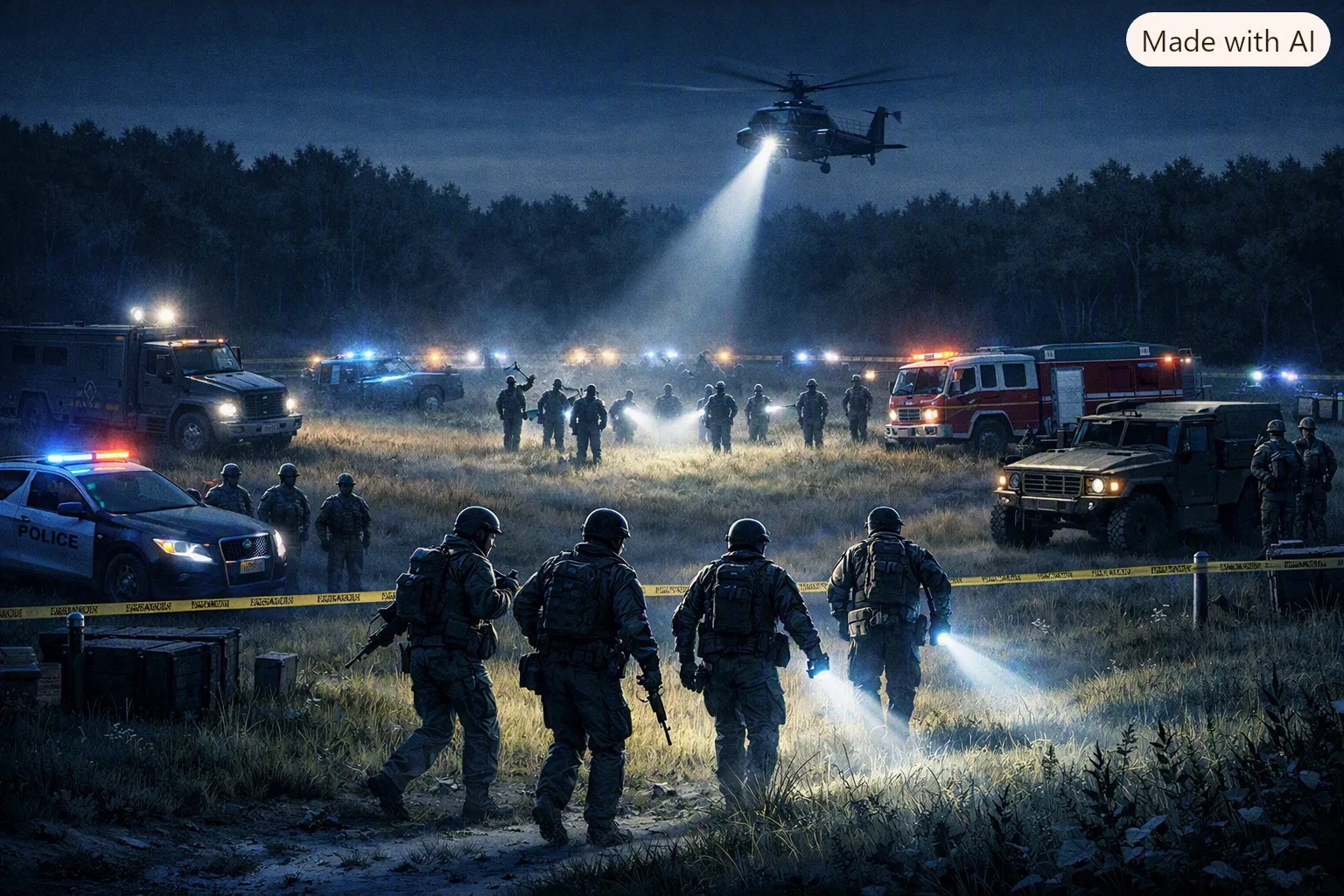
Emergency vehicles, armed personnel, roadblocks and hurried debris removal can make an alleged UFO crash look like a concealment operation. In practice, those same features are standard responses to an unknown impact, suspected aircraft accident or public hazard. Responders do not need to know what fell before acting: the possibility of survivors, fire, toxic material, explosives or a second accident is enough to justify a cordon and a multi-agency search.
This distinction matters because many UFO crash stories treat the official response as evidence about the object’s identity. A large response proves that authorities considered the report potentially serious; it does not prove that they found an extraterrestrial craft. Modern accident guidance explicitly tells police and emergency services to restrict access, protect debris and ground marks, record everyone entering the site and withhold premature conclusions while specialists examine the evidence. From outside the perimeter, prudent emergency procedure can therefore resemble secrecy almost perfectly.[NTSB]ntsb.govResponding to a Transportation AccidentResponding to a Transportation Accident…
How authorities respond to an unknown impact
When witnesses report a fireball, explosion or object descending behind trees, emergency services must initially work from possibilities rather than conclusions. The event could involve a light aircraft, military equipment, a balloon payload, satellite or rocket debris, a meteorite, an electrical incident or a false alarm. The first operational question is not “Was it alien?” but “Is anyone injured, and what hazards might be present?”
A typical response may bring together police, firefighters, ambulance crews, aviation authorities, landowners and, where military equipment is possible, defence personnel. Their tasks overlap but are not identical. Firefighters deal with rescue and combustion hazards; police control access and preserve the scene; technical specialists identify components; accident investigators document wreckage distribution, impact marks and witness evidence. Several uniforms and vehicle types at one rural location may therefore reflect divided responsibilities rather than an unusually secret mission.
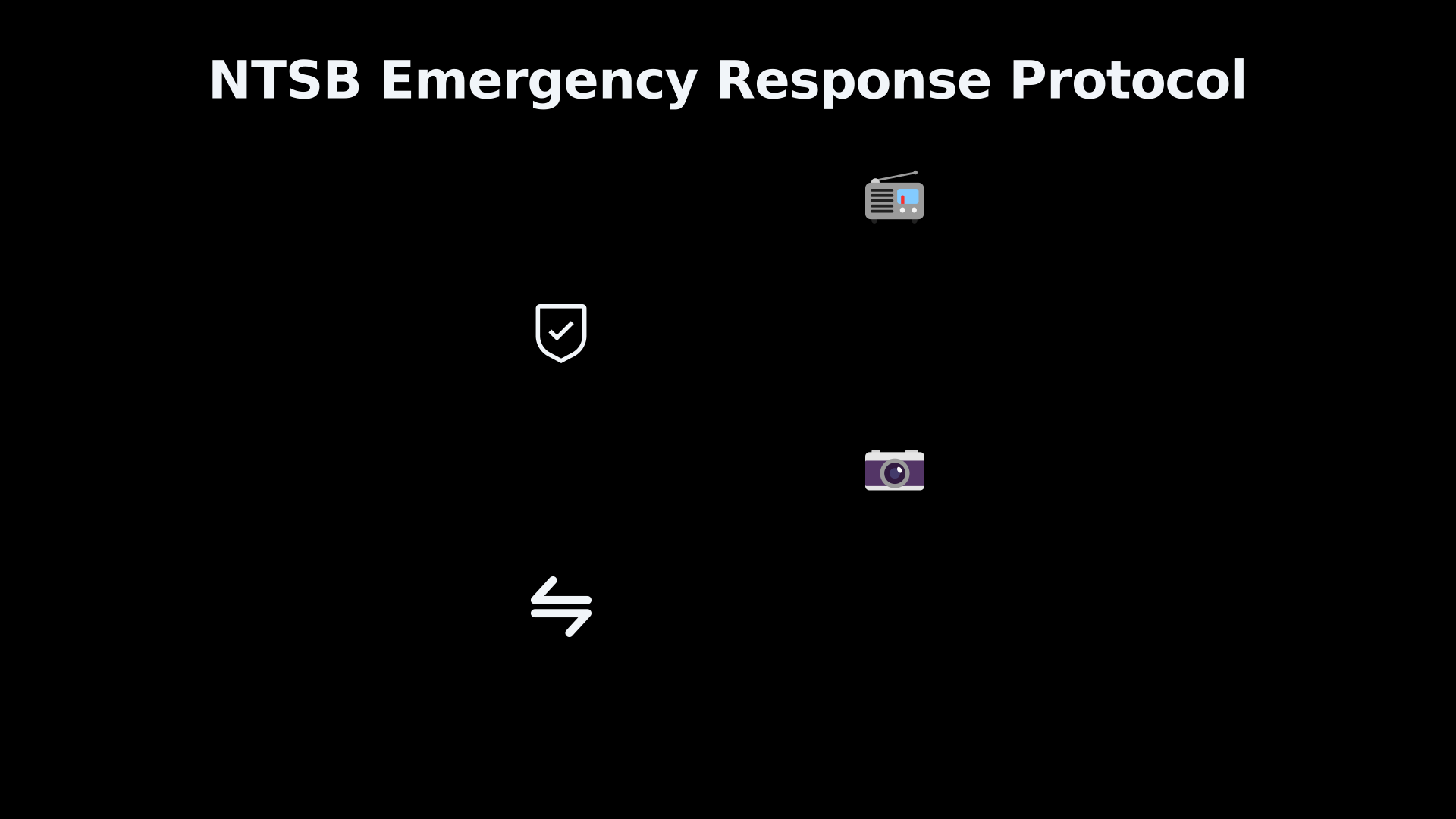
The National Transportation Safety Board’s guidance for public-safety personnel instructs responders to establish a security perimeter, admit authorised personnel, prevent disturbance of wreckage, preserve ground scars and photograph evidence. It also recommends keeping a record of personnel entering the site. These actions are designed to protect life and reconstruct what happened, yet each can later be retold in more ominous language: “the area was sealed”, “civilians were ordered away”, “officials photographed everything” or “names were taken”.[NTSB]ntsb.govResponding to a Transportation AccidentResponding to a Transportation Accident…
Uncertainty itself can enlarge the response. A bright object may appear to land nearby even when it burns up much farther away. Search teams may then comb woods, fields or watercourses on the basis of conflicting witness bearings. Helicopters, searchlights and military vehicles do not establish that wreckage was found; they may show only that authorities were trying to determine whether there was a crash at all.
This pattern is visible in accounts of the 1965 Kecksburg incident in Pennsylvania. A widely observed fireball prompted reports that something had fallen near the village, followed by police, firefighters and Air Force personnel searching the area. Contemporary reporting also stated that the search found no object. Later versions increasingly treated the size and official character of the response as proof that something had been recovered, even though mobilising a search and successfully locating wreckage are separate propositions.[Wikipedia]WikipediaKecksburg UFO incidentKecksburg UFO incident
Why perimeters and restricted access are normal
A crash site is both a rescue area and a fragile evidence field. Footprints, tyre tracks, displaced fragments and well-intentioned souvenir collecting can destroy information needed to reconstruct an impact. Restricting entry is therefore not merely a security preference. It protects investigators’ ability to distinguish wreckage thrown by the accident from objects moved afterwards.
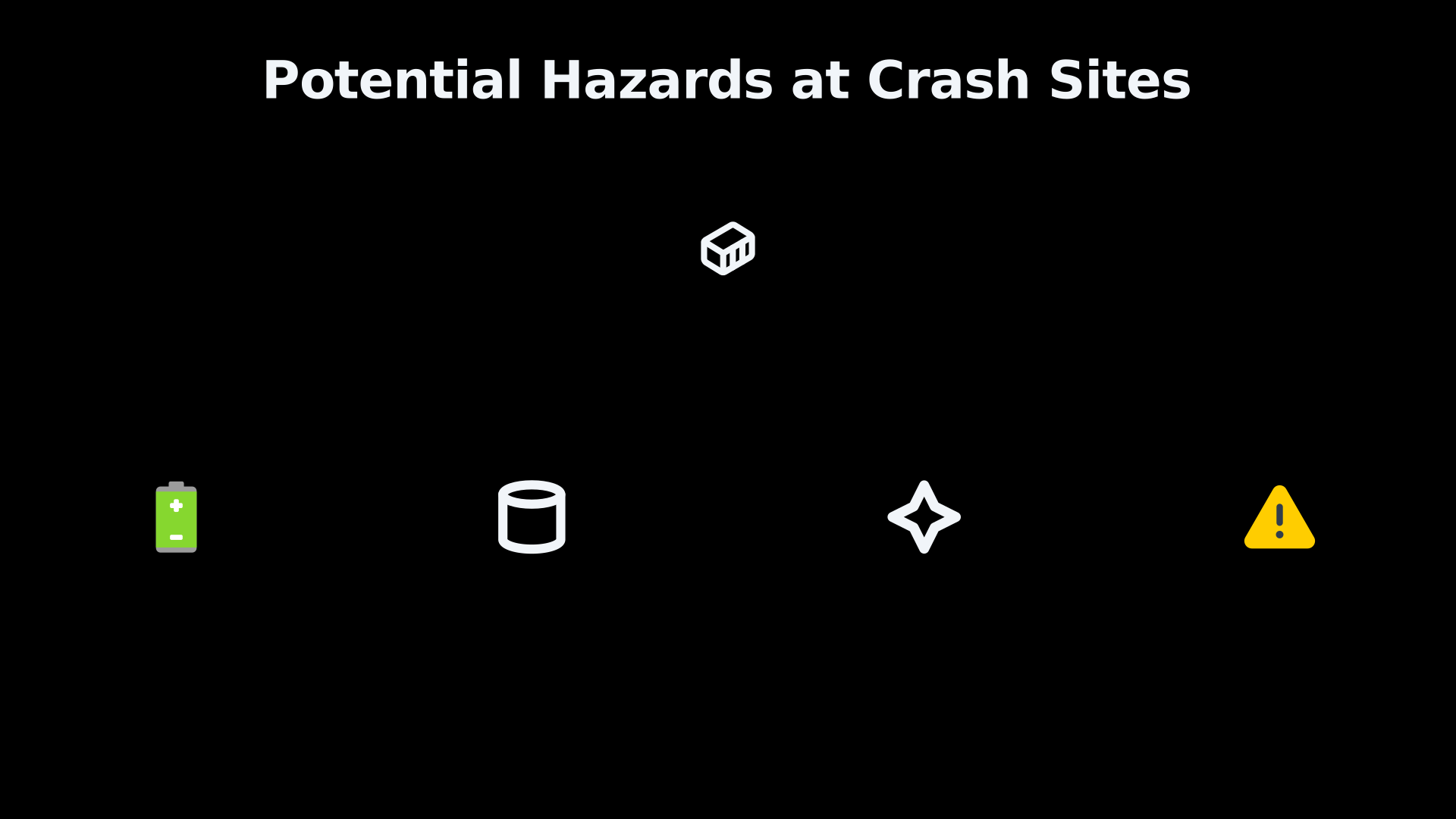
Even apparently harmless debris can be dangerous. Aircraft and aerospace equipment may contain fuel, hydraulic fluid, battery acid, oxygen bottles, pressurised components, flares, radioactive sources or explosive devices. The NTSB lists these among the potential hazards that first responders should anticipate at transportation accident scenes. Until an object is identified, crews may reasonably treat unfamiliar cylinders, wiring or metallic fragments as hazardous rather than invite residents to inspect them.[NTSB]ntsb.govResponding to a Transportation AccidentResponding to a Transportation Accident…
Military aircraft require still greater caution. British Air Accidents Investigation Branch guidance warns that military and former military aircraft may contain ejector seats, explosive canopy-release mechanisms, equipment-jettison systems, pyrotechnics and weapons. It advises bringing trained defence personnel to the scene to make such systems safe. A witness who sees soldiers handling debris while firefighters stand back may infer that the material is highly classified; the immediate reason may instead be that only specialist personnel can approach it safely.[GOV.UK]assets.publishing.service.gov.ukUK Guidance for the Police, Emergency Services and Airfield Operatorsfor the Police, Emergency Services and Airfield Operators…
The same principle applies when nobody can initially confirm whether an aircraft was armed. Emergency planners must assume the more dangerous possibility until it is ruled out. That can produce a broad cordon, evacuation orders and terse instructions to the public. Caution is most visible precisely during the period when officials know the least.
Debris removal can protect evidence rather than erase it
Removing wreckage quickly is often interpreted as an attempt to make evidence disappear. Yet investigators commonly transfer debris to a secure facility because detailed examination cannot be performed in an exposed field. Pieces may need to be laid out, photographed, tested for residue or matched to known components. Custody also prevents theft, weather damage and contamination.
The critical question is therefore not simply whether officials removed material, but whether there is a documented trail showing who collected it, where it went and what specialists concluded. Recovery vehicles leaving at night may look dramatic, but darkness can reflect the timing of the incident, pressure to reopen a road or the need to secure hazardous wreckage before weather or crowds interfere.
Conversely, removal is not automatically innocent merely because it is routine. Authorities can mishandle evidence, give contradictory explanations or classify information for reasons unrelated to extraterrestrial claims. The useful distinction is between restricted handling, which is expected at a crash scene, and evidence of falsification, which would require proof that records, samples or findings were deliberately altered to hide the object’s nature.
Why officials say little at first
Early official statements after an uncertain incident are frequently incomplete. That gap is fertile ground for UFO crash rumours, particularly when witnesses are already convinced that something extraordinary has happened.
Accident investigators limit preliminary disclosures because initial impressions are often wrong. The NTSB’s investigation rules restrict information released from a field investigation to factual developments communicated through designated officials. Participants are expected to pass information through the investigator-in-charge rather than brief outsiders independently. Such controls reduce contradictory speculation, protect the integrity of the inquiry and help ensure that families are not learning sensitive details from unofficial sources.[NTSB]ntsb.govMicrosoft WordMicrosoft Word - MIM-appendices_Sep-02.doc…
To observers, however, disciplined communication may look like a gag order. A firefighter who says that only a commanding officer can speak, or a technician who refuses to identify a fragment before laboratory examination, may be behaving exactly as procedure requires. The absence of an immediate explanation is then converted into a positive claim: officials “must know” more than they admit.
Final answers may also take far longer than public attention allows. Transport investigations commonly proceed through preliminary factual reporting, laboratory work and later publication of analysis and probable cause. During the interval, rumours can acquire detail and emotional force while the official account remains cautious and provisional.[NTSB]ntsb.govInformation for survivors, families & friendsInformation for survivors, families & friends…September 24, 2018 — The report or brief replaces the preliminary report and is typi…
There is an additional complication in military cases: some information may genuinely be secret. The identity, sensor capability or purpose of a fallen device can be classified even when the object itself is entirely terrestrial. Project Mogul, the programme associated with the Roswell debris in later US Air Force assessments, concerned high-altitude balloon equipment used in an effort to detect evidence of Soviet nuclear testing. Concealment of that programme’s purpose helped create an information vacuum, but secrecy about a defence project is not equivalent to secrecy about extraterrestrial material.

Roswell shows how procedure becomes part of the legend
Roswell demonstrates how ordinary recovery activity, genuine military sensitivity and poor public communication can merge into a crash-concealment story. Army Air Forces personnel collected scattered material from ranch land in July 1947. The base initially announced recovery of a “flying disc”, then senior officers identified the material publicly as balloon-related. That abrupt reversal became more memorable than the physical characteristics of the debris itself.
A later investigation by the US Government Accountability Office found two contemporary records: a unit history referring to the “flying disc” recovery and an FBI message describing an object resembling a high-altitude balloon with a radar reflector. It also found that some Roswell Army Air Field administrative records and outgoing messages from the surrounding period had been destroyed, without surviving documentation specifying who destroyed them or under what authority.[GAO]gao.govnsiadNSIAD-95-187 Government Records: Results of a Search for Records Concerning the 1947 Crash Near Roswell, New Mexico…
Missing records understandably encourage suspicion, but they do not specify what the missing pages contained. The same GAO inquiry found that reporting rules did not require an aircraft-accident report for a weather-balloon crash and did not locate documentation establishing recovery of a spacecraft. This is an important evidential limit: archival absence can prevent a complete reconstruction, but it cannot by itself identify the missing event as extraterrestrial.[GAO]gao.govnsiadNSIAD-95-187 Government Records: Results of a Search for Records Concerning the 1947 Crash Near Roswell, New Mexico…
Later stories added military convoys, guarded hangars, threatened witnesses and alien bodies. Some of these claims appeared decades after the original recovery and are disputed. What can be established is more modest but still instructive: military personnel really did recover unfamiliar-looking material, the programme behind it had classified significance, and officials gave the public an initially confused account. Those conditions were sufficient for routine military control of debris to become retrospectively interpreted as the machinery of a far greater cover-up.
When normal caution becomes conspiracy evidence
Emergency behaviour tends to be reinterpreted through a recurring chain of inference:
- Officials arrive quickly, so they must have expected the object.
- They establish a perimeter, so the public must be kept from seeing it.
- Specialists or military personnel attend, so the material must be exotic.
- Debris is removed, so evidence is being destroyed.
- Officials decline to speculate, so they are repeating a cover story.
- Records are incomplete, so the true records must have been suppressed.
Each step is possible, but none follows automatically from the one before it. Rapid attendance may reflect an emergency call; a perimeter may protect people and evidence; military technicians may be needed for explosives; debris removal may preserve the wreckage; restrained statements may follow investigation rules; and missing records may result from ordinary retention schedules, poor administration or the fact that no particular report was required.
This does not mean official conduct should be accepted without scrutiny. Governments have concealed defence programmes, made inaccurate early statements and destroyed records. The All-domain Anomaly Resolution Office’s historical review acknowledges that US authorities sometimes pursued active “debunking” of UFO reports and prioritised concerns such as Soviet technology and defence readiness. The same review reported finding no evidence of a policy to conceal extraterrestrial material and noted that investigations of alleged physical evidence had not established foreign or off-world origins.[AARO]aaro.milUnclassified Final DSD AARO Historical ReportUnclassified Final DSD AARO Historical Report…
The fair conclusion is therefore not that every cordon is innocent or that every witness is mistaken. It is that emergency activity has low diagnostic value by itself. It shows that responders treated a report as a potential accident, hazard or security concern. Determining whether concealment occurred requires additional evidence: contemporary records, independently documented debris, consistent witness accounts, a traceable chain of custody and proof that officials knowingly substituted a false explanation.
How to assess a “sealed crash site” claim
A reader evaluating a UFO crash account should separate the response from the alleged discovery. The following questions are more revealing than the mere presence of police or military vehicles:
- What prompted the deployment? Look for the original call, fireball reports, radar alert, missing-aircraft notice or wildfire report.
- Was wreckage actually found? A search operation is not evidence of a successful recovery.
- Who controlled the scene, and when? Local police may establish the first cordon before aviation or military specialists arrive.
- What hazards were suspected? Fuel, pressurised equipment, explosives and unknown cargo can justify unusually strict exclusion.
- Was the material documented contemporaneously? Photographs, inventories and laboratory records carry more weight than later recollections of covered trucks.
- Did the explanation change because evidence changed? Revision can indicate confusion, technical identification, institutional embarrassment or deception; the change alone does not decide which.
- Is there evidence beyond official behaviour? A convincing concealment case needs more than guards, silence and removed debris.
In UFO crash narratives, the emergency response is often the most visible part of the event and the easiest part to dramatise. It is also the least specific. Fire engines, roadblocks, searches and controlled information are exactly what an unknown impact can be expected to produce, whether the final cause is an aircraft, balloon, meteor, military device or nothing found at all. The decisive evidence lies not in how secretive the scene appeared, but in what was recovered, how it was documented and whether independent examination supports the extraordinary conclusion.
Amazon book picks
Further Reading
Books and field guides related to Why Emergency Crews Appear in UFO Crash Stories. Use these as the next step if you want deeper reading beyond the article.
The UFO Experience: A Scientific Inquiry
Cited by the New York Review of Books as "the best brief for visitation," this classic study presents an analysis of UFO reports and conc...
UFOs: Generals, Pilots, and Government Officials Go on the Re...
NEW YORK TIMES BESTSELLER • Impeccably researched, this riveting journalistic investigation separates fact from fiction, and documents th...
Aircraft Accident Investigation
Beskrivelse af situationer omkring flyvehavarier samt gennemgang af forhold i f.m. undersøgelser og udfærdigelse af rapporter.
Managing the Unexpected
Since the first edition of Managing the Unexpected was published in 2001, the unexpected has become a growing part of our everyday lives....
eBay marketplace picks
Marketplace Samples
Live-tested eBay searches with available results related to this page.
Selected fromUFO poster oneBay.co.uk.

Current eBay listing
I Want To Believe UFO Poster Giclée Fine Art Heavyweight Print


Current eBay listing
VINTAGE UFO FLYING SAUCERS COMIC ADVERTISING A2 POSTER PRINT

Endnotes
1.
Source: ntsb.gov
Title: Responding to a Transportation Accident
Link:https://www.ntsb.gov/Documents/2023%20Transportation%20Accident%20Response%20Guide.pdf
Source snippet
Responding to a Transportation Accident...
2.
Source: ntsb.gov
Title: Microsoft Word
Link:https://www.ntsb.gov/about/Documents/MajorInvestigationsManualApp.pdf
Source snippet
Microsoft Word - MIM-appendices_Sep-02.doc...
3.
Source: Wikipedia
Title: Kecksburg UFO incident
Link:https://en.wikipedia.org/wiki/Kecksburg_UFO_incident
4.
Source: assets.publishing.service.gov.uk
Title: UK Guidance for the Police, Emergency Services and Airfield Operators
Link:https://assets.publishing.service.gov.uk/media/5f69d1b2e90e077f603512f2/Guidance_Pub_version_High_amend.pdf
Source snippet
for the Police, Emergency Services and Airfield Operators...
5.
Source: ntsb.gov
Title: media resources.aspx
Link:https://www.ntsb.gov/news/Pages/media_resources.aspx
Source snippet
Media Resources10 Mar 2025 — Roughly a month after an accident a preliminary report will be issued. Preliminary reports can be found...
6.
Source: ntsb.gov
Title: Information for survivors, families & friends
Link:https://www.ntsb.gov/tda/Documents/TDA-Trifold_GENERIC.pdf
Source snippet
Information for survivors, families & friends...September 24, 2018 — The report or brief replaces the preliminary report and is typi...
Published: September 24, 2018
7.
Source: ntsb.gov
Link:https://www.ntsb.gov/investigations/process/Pages/default.aspx
Source snippet
The Investigative ProcessOnce the final accident investigation report has been adopted, the final copy of the report will be prepared...
8.
Source: gao.gov
Title: nsiad 95 187
Link:https://www.gao.gov/assets/nsiad-95-187.pdf
Source snippet
NSIAD-95-187 Government Records: Results of a Search for Records Concerning the 1947 Crash Near Roswell, New Mexico...
9.
Source: aaro.mil
Title: Unclassified Final DSD AARO Historical Report
Link:https://www.aaro.mil/Portals/136/PDFs/AARO_Historical_Record_Report_Vol_1_2024.pdf
Source snippet
Unclassified Final DSD AARO Historical Report...
10.
Source: ntsb.gov
Link:https://www.ntsb.gov/tda/TDADocuments/SPC2001.pdf
11.
Source: ntsb.gov
Link:https://www.ntsb.gov/investigations/AccidentReports/Reports/AAR0102.pdf
12.
Source: ntsb.gov
Link:https://www.ntsb.gov/safety/safety-recs/recletters/A01_49_70.pdf
13.
Source: ntsb.gov
Link:https://www.ntsb.gov/investigations/accidentreports/reports/aar9606.pdf
14.
Source: ntsb.gov
Link:https://www.ntsb.gov/investigations/AccidentReports/Reports/AAR0707.pdf
15.
Source: ntsb.gov
Link:https://www.ntsb.gov/investigations/accidentreports/reports/hzm0202.pdf
16.
Source: data.ntsb.gov
Title: doc BLOB
Link:https://data.ntsb.gov/Docket/Document/docBLOB?FileExtension=pdf&FileName=Survival+Factors-Exhibit+O-Sections+from+SFO+Emergency+Procedures+Manual-Master.pdf&ID=398667
17.
Source: data.ntsb.gov
Title: doc BLOB
Link:https://data.ntsb.gov/Docket/Document/docBLOB?FileExtension=.PDF&FileName=Airports%2FARFF+-+Exhibit+No.+16G+-+Guam+International+Airport+Authority+Airport+Emergency+Plan-Master.PDF&ID=40076735
18.
Source: ntsb.gov
Link:https://www.ntsb.gov/investigations/AccidentReports/Pages/Reports.aspx
19.
Source: ntsb.gov
Link:https://www.ntsb.gov/investigations/process/Documents/NTSB%20Party%20Guidance.pdf
20.
Source: ntsb.gov
Link:https://www.ntsb.gov/about/Documents/MajorInvestigationsManual.pdf
21.
Source: ntsb.gov
Link:https://www.ntsb.gov/tda/Documents/TDA-Trifold_MARINE.pdf
22.
Source: ntsb.gov
Link:https://www.ntsb.gov/Pages/aviationreport.aspx
23.
Source: ntsb.gov
Link:https://www.ntsb.gov/tda/TDADocuments/General%20Aviation%20Family%20Assistance%20Brochure%202023.pdf
24.
Source: nationalarchives.gov.uk
Link:https://www.nationalarchives.gov.uk/explore-the-collection/explore-by-time-period/postwar/ufo-reports/
25.
Source: cdn.nationalarchives.gov.uk
Title: nationalarchives.gov.uk UF O files
Link:https://cdn.nationalarchives.gov.uk/documents/ufo-transcript-aug-09.pdf
26.
Source: assets.publishing.service.gov.uk
Link:https://assets.publishing.service.gov.uk/media/6a26a5692cdcfdb7436ac07f/gra-4-3_-_withdrawn.pdf
27.
Source: assets.publishing.service.gov.uk
Link:https://assets.publishing.service.gov.uk/media/5a74c9d9ed915d502d6cb041/20569401.pdf
28.
Source: assets.publishing.service.gov.uk
Link:https://assets.publishing.service.gov.uk/media/6a26aba38e85b4e5346ac0a1/GRA_Hazmatt_Manual_COMBINED_-_withdrawn.pdf
29.
Source: assets.publishing.service.gov.uk
Link:https://assets.publishing.service.gov.uk/media/6a1949c5916cd732dcdaacd0/MAPCIM_Issue_8.pdf
30.
Source: assets.publishing.service.gov.uk
Link:https://assets.publishing.service.gov.uk/media/6a19494bc7335e2ca6daace4/APCIM_Aide_Memoire_Issue_7.pdf
31.
Source: assets.publishing.service.gov.uk
Link:https://assets.publishing.service.gov.uk/media/6a26ac4a8e85b4e5346ac0a2/GRA_Hazmat_Manual_part_2_-_withdrawn.pdf
32.
Source: assets.publishing.service.gov.uk
Link:https://assets.publishing.service.gov.uk/media/5a80a0ede5274a2e8ab513d4/20141216_-_JSP498__-_FOI2015-10901.pdf
33.
Source: assets.publishing.service.gov.uk
Title: DSA 03.OM E Part 4 DCOP 406
Link:https://assets.publishing.service.gov.uk/media/68beae67626205fb47f01d73/DSA_03.OME_Part_4DCOP__406.pdf
34.
Source: assets.publishing.service.gov.uk
Title: 20150511 FOI2015 03810 Rendlesham Redacted Final Response
Link:https://assets.publishing.service.gov.uk/media/5a7f599240f0b6230268ef6d/20150511-FOI2015-03810-Rendlesham-Redacted-Final-Response.pdf
35.
Source: assets.publishing.service.gov.uk
Title: AAIB Bulletin 03 2021
Link:https://assets.publishing.service.gov.uk/media/602cdf5ee90e0709e0ffab7f/AAIB_Bulletin_03-2021.pdf
36.
Source: gao.gov
Title: nsiad 95 187
Link:https://www.gao.gov/products/nsiad
37.
Source: gao.gov
Link:https://www.gao.gov/assets/a301955.html
38.
Source: gao.gov
Link:https://www.gao.gov/assets/a320675.html
39.
Source: gao.gov
Link:https://www.gao.gov/products/154832
40.
Source: gao.gov
Link:https://www.gao.gov/assets/a235613.html
41.
Source: gao.gov
Link:https://www.gao.gov/assets/a95137.html
42.
Source: gao.gov
Link:https://www.gao.gov/assets/b-164500.pdf
43.
Source: gao.gov
Link:https://www.gao.gov/assets/b-152600-087419.pdf
44.
Source: gao.gov
Link:https://www.gao.gov/assets/b-133361-a88924.pdf
45.
Source: mycouncil.oxford.gov.uk
Title: APPENDIX TWO
Link:https://mycouncil.oxford.gov.uk/documents/s85508/APPENDIX%20TWO.pdf
46.
Source: Wikipedia
Title: Roswell incident
Link:https://en.wikipedia.org/wiki/Roswell_incident
47.
Source: Wikipedia
Title: Rendlesham Forest incident
Link:https://en.wikipedia.org/wiki/Rendlesham_Forest_incident
48.
Source: cumbria.gov.uk
Link:https://www.cumbria.gov.uk/eLibrary/Content/Internet/535/600/41457111131.pdf
49.
Source: youtube.com
Link:https://www.youtube.com/watch?v=TV0Xm9ZgiKQ
Source snippet
Roswell - UFO Crash in New Mexico | Free Documentary History...
Published: July 1947
50.
Source: youtube.com
Link:https://www.youtube.com/watch?v=sbtvxBXEHVw
Source snippet
The Roswell Incident...
Additional References
51.
Source: faa.gov
Link:https://www.faa.gov/sites/faa.gov/files/2022-11/BritishAirways38_Accident_Report.pdf
52.
Source: faa.gov
Link:https://www.faa.gov/sites/faa.gov/files/2022-11/Final%20CIAIAC%20Rpt%20Spanair%205022.pdf
53.
Source: archives.gov
Link:https://www.archives.gov/files/research/military/navy/navy-filing-manual-1950.pdf
54.
Source: archives.gov
Link:https://www.archives.gov/files/research/foreign-policy/state-dept/finding-aids/inventory15-part2.pdf
55.
Source: faa.gov
Link:https://www.faa.gov/sites/faa.gov/files/2022-11/UPS6_Accident_Report.pdf
56.
Source: archives.gov
Link:https://www.archives.gov/files/research/guides/war-dept/decimal-file.pdf
57.
Source: youtube.com
Title: The Roswell UFO Crash (Overview)
Link:https://www.youtube.com/watch?v=ZltLHh_WsZs
Source snippet
8th July 1947: First flying saucer as Roswell Army Air Base reports debris of a 'flying disc'...
Published: July 1947
58.
Source: instagram.com
Link:https://www.instagram.com/reel/DVoSI4XlLah/
59.
Source: facebook.com
Link:https://www.facebook.com/wwj950/posts/on-march-21-1966-dozens-of-students-and-staff-at-hillsdale-college-in-michigan-r/1529912072477281/
60.
Source: archives.gov
Title: 2004 intelligence reform and terrorism prevention act
Link:https://www.archives.gov/files/cui/documents/2004-intelligence-reform-and-terrorism-prevention-act.pdf