Within Field Protocol
What Safety Actions Changed the Crash Scene?
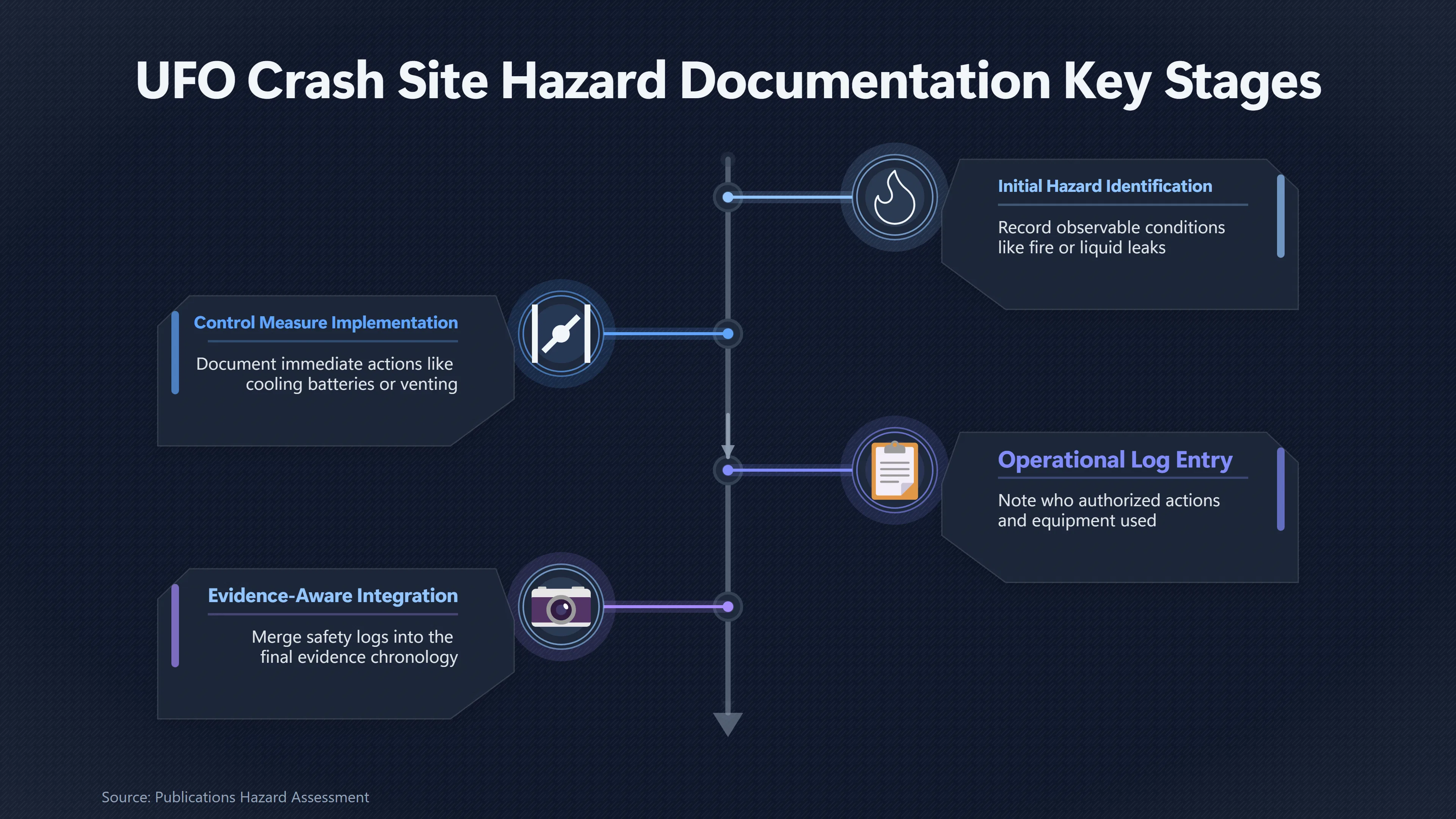
A credible record begins by showing which dangers were identified, who controlled them and what rescue actions altered the scene.
On this page
- Recording hazards before evidence work
- Documenting rescue and emergency movement
- Separating safety decisions from later interpretation
Page outline Jump by section
Introduction
When a reported UFO crash is treated as a possible accident scene, the first documentation priority is not the object itself but the safety measures that changed the site. Regardless of later conclusions about the origin of any wreckage, investigators need a reliable record of which hazards were identified, who made safety decisions, what emergency actions altered the scene, and when those changes occurred. Without that record, later investigators may struggle to distinguish genuine evidence from changes introduced during rescue, firefighting or hazard-control operations.
This approach follows established accident-investigation and forensic practice. Unknown wreckage may contain conventional aviation fuels, lithium batteries, composite fibres, pressurised vessels, electrical hazards or other dangerous materials. Even if the reported object ultimately proves to be conventional, documenting hazard controls allows later analysis to reconstruct the scene accurately while demonstrating that life safety remained the overriding priority.[ojp.gov]nij.ojp.govNational Institute of JusticeCrime Scene Investigation: A Guide for Law Enforcement | National Institute of JusticeSeptember 1, 2013…
Recording Hazards Before Evidence Work Begins
The first formal record should identify hazards that existed before detailed evidence recovery started. This creates a timeline showing what responders encountered rather than what investigators saw after the site had already been stabilised.
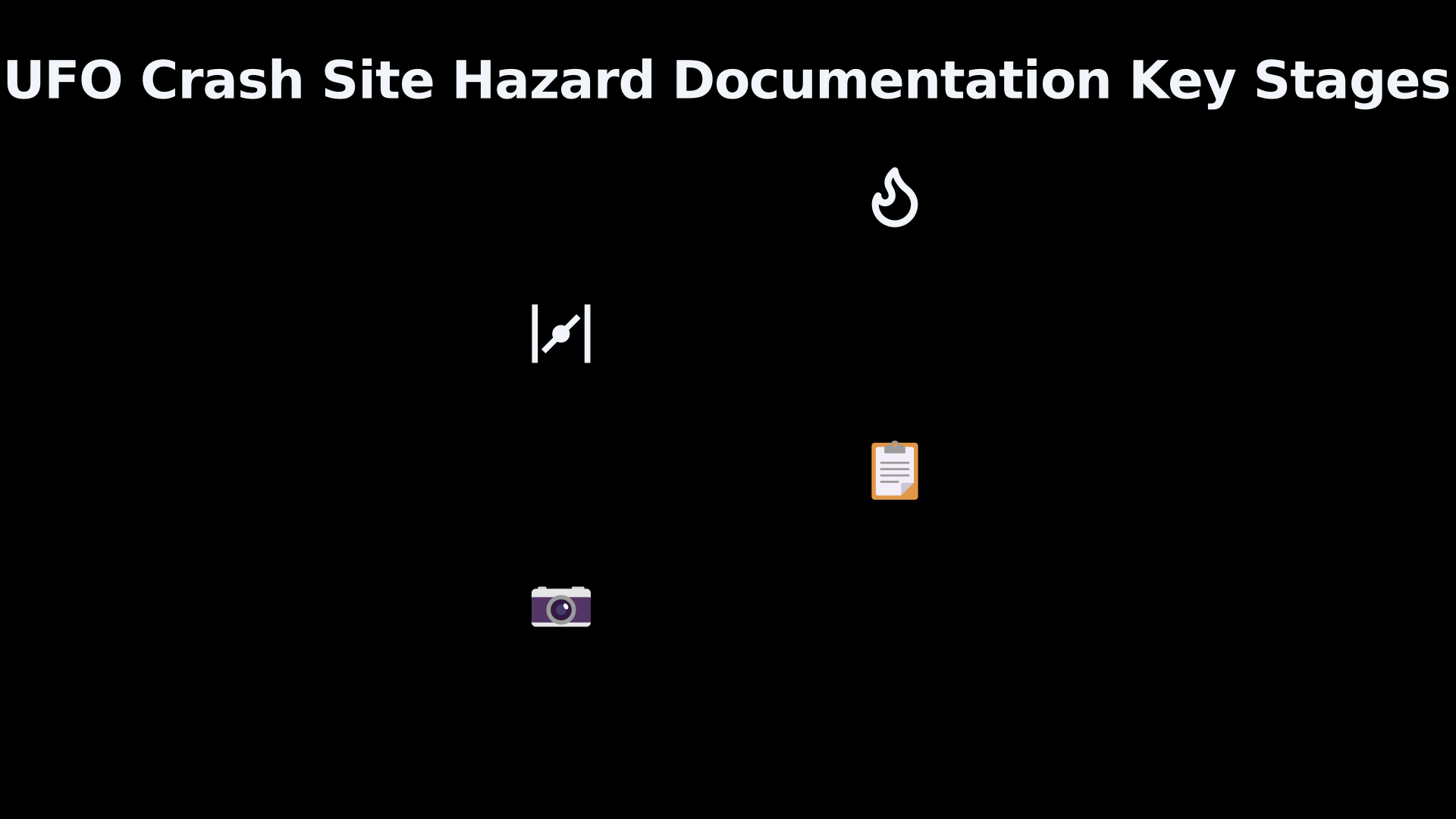
The documentation should describe observable conditions rather than assumptions about their cause. For example:
- Visible fire, smoke or excessive heat.
- Fuel, hydraulic fluid or other liquid leaks.
- Damaged battery systems or electrical arcing.
- Pressurised cylinders or vessels.
- Sharp composite fragments or exposed fibres.
- Suspicious containers or unexplained radiation alarms if present.
- Unstable terrain, damaged structures or falling hazards.
Each hazard entry should include:
- The time it was identified.
- Who identified it.
- The area affected.
- The immediate control measures introduced.
- Whether the hazard prevented access to any portion of the scene.
Accident and crime-scene guidance consistently recommends documenting safety observations and actions from the moment responders arrive, since these decisions influence every later stage of scene processing.[National Institute of Justice]nij.ojp.govNational Institute of JusticeCrime Scene Investigation: A Guide for Law Enforcement | National Institute of JusticeSeptember 1, 2013…
What Safety Actions Changed the Crash Scene?
Many emergency measures necessarily alter physical evidence. The important point is not to avoid these actions—they may be essential—but to record them in sufficient detail that later investigators can reconstruct the original circumstances.
Documenting Rescue and Emergency Movement
Every significant intervention should be logged alongside its operational reason.
Examples include:
- Cutting vehicle or structural components to reach casualties.
- Moving debris to establish rescue routes.
- Extinguishing fires using water, foam or dry chemical agents.
- Disconnecting electrical systems.
- Cooling overheated batteries.
- Venting pressurised equipment.
- Removing hazardous containers.
- Creating safe access routes through debris.
For each intervention, investigators should record:
- Who authorised the action.
- Which organisation carried it out.
- The exact time, where practical.
- The equipment used.
- Which objects were moved.
- Where displaced items were relocated.
- Whether photographs or video exist showing the condition immediately beforehand.
This creates an auditable distinction between accident effects and responder effects. Transportation accident guidance similarly stresses recording all necessary disturbance caused by lifesaving or hazard-mitigation activities before evidence interpretation begins.[National Institute of Justice]nij.ojp.govNational Institute of JusticeCrime Scene Investigation: A Guide for Law Enforcement | National Institute of JusticeSeptember 1, 2013…

Recording Temporary Hazard Controls
Many controls are temporary rather than permanent. They may include:
- Exclusion zones.
- Barrier tape or fencing.
- Fire suppression systems.
- Ventilation equipment.
- Air-quality monitoring.
- Radiation surveys.
- Gas detection.
- Protective coverings placed over unstable wreckage.
Rather than simply noting that controls existed, investigators benefit from documenting why each measure was introduced, when it began, when it ended, and what hazard justified it.
This timeline helps later reviewers understand why investigators may have delayed entering certain parts of the scene or why particular evidence was recovered later than other material.[IAEA Publications]www-pub.iaea.orgPublications Hazard AssessmentIAEA PublicationsHazard Assessment - IAEA Portable Digital Assistant for First Responders to a Radiological Emergency…
Separating Safety Decisions from Later Interpretation
One of the most important principles is keeping operational decisions separate from interpretive conclusions.
A safety log should state observable facts such as:
- “Fire service established a 100-metre exclusion zone after detecting a flammable vapour.”
- “Responders relocated metal fragments to permit casualty extraction.”
- “Battery cooling operations continued for three hours.”
It should not record unsupported conclusions such as:
- “Area isolated because the craft emitted unknown energy.”
- “Debris moved due to extraterrestrial hazard.”
If the reason for a precaution is uncertainty rather than confirmed danger, that uncertainty should be stated plainly. For example:
“Area isolated pending hazardous-material assessment.”
This distinction prevents precautionary measures from later being mistaken for evidence supporting extraordinary claims.
Recording Who Controlled Each Hazard
Hazard documentation is stronger when every major safety decision can be traced to the responsible authority.
Typical records identify:
- The incident commander.
- Fire and rescue services.
- Hazardous materials specialists.[ntsb.gov]ntsb.govSafety RecommendationsJuly 10, 2026 — SAFETY RECOMMENDATIONS Page Content The NTSB issues safety recommendations to address specific safety conc…
- Bomb disposal personnel, where relevant.
- Medical responders.
- Police scene managers.
- Technical specialists called to evaluate specific hazards.
Changes in command should also be documented, including the time responsibility transferred from emergency responders to investigators. Maintaining this chain of operational responsibility reduces uncertainty about who authorised significant scene alterations and why.[National Institute of Justice]nij.ojp.govOpen source on ojp.gov.
Why Hazard Documentation Matters Later
Accident investigations often revisit a scene weeks or months after the event using photographs, maps and responder notes. If hazard-control actions were poorly documented, investigators may incorrectly interpret moved debris, extinguishing residues, vehicle tracks or cut structures as features produced by the original incident.
Conversely, a detailed hazard record allows analysts to distinguish between:
- Original impact damage.
- Damage caused during rescue.
- Material displaced for safety.
- Contamination introduced by suppression agents.
- Areas that remained untouched until formal examination.
This distinction becomes particularly important in any claimed UFO crash because public attention may encourage speculation about unusual materials or altered evidence. A carefully documented hazard-control record demonstrates which changes resulted from ordinary emergency response and which observations genuinely pre-dated intervention.
Maintaining an Evidence-Aware Safety Record
The strongest crash documentation treats safety records as part of the evidential record rather than administrative paperwork. Hazard assessments, exclusion-zone changes, emergency movements and responder decisions should be integrated into the same chronology as photographs, scene sketches and evidence logs.
Doing so preserves a transparent history of how the scene evolved from the first emergency response through formal investigation. Whether the reported crash ultimately proves to involve a conventional aircraft, space debris, a hoax or an unexplained object, documenting hazard controls provides investigators with a clear account of what safety actions changed the scene and why those changes occurred.
Amazon book picks
Further Reading
Books and field guides related to What Safety Actions Changed the Crash Scene?. Use these as the next step if you want deeper reading beyond the article.
Techniques of Crime Scene Investigation
"Techniques of Crime Scene Investigation is a staple for any forensic science library and is routinely referenced by professional organiz...
Aircraft Accident Investigation
Beskrivelse af situationer omkring flyvehavarier samt gennemgang af forhold i f.m. undersøgelser og udfærdigelse af rapporter.
Practical Crime Scene Processing and Investigation
All too often, the weakest link in the chain of criminal justice is the crime scene investigation. Improper collection of evidence blocks...
Introduction to Emergency Management
Introduction to Emergency Management, Fourth Edition, offers a practical guide to the discipline of emergency management. It focuses on t...
eBay marketplace picks
Marketplace Samples
Live-tested eBay searches with available results related to this page.
Selected fromcrash rescue model oneBay.co.uk.


Endnotes
1.
Source: www-pub.iaea.org
Title: Publications Hazard Assessment
Link:https://www-pub.iaea.org/mtcd/publications/pdf/epr-first_res-pda/html/hazard-assessment.htm
Source snippet
IAEA PublicationsHazard Assessment - IAEA Portable Digital Assistant for First Responders to a Radiological Emergency...
2.
Source: iaea.org
Link:https://www.iaea.org/newscenter/news/new-iaea-operations-manual-for-stronger-global-emergency-preparedness-and-response
3.
Source: iaea.org
Title: safety standards on emergency preparedness and response
Link:https://www.iaea.org/topics/iaea-safety-standards-on-emergency-preparedness-and-response
4.
Source: iaea.org
Title: emergency preparedness
Link:https://www.iaea.org/newscenter/focus/fukushima/emergency-preparedness
5.
Source: gnssn.iaea.org
Link:https://gnssn.iaea.org/CSN/Scrap/Publications/Publication8.aspx
6.
Source: www-pub.iaea.org
Title: qg ind2
Link:https://www-pub.iaea.org/mtcd/publications/pdf/epr-first_res-pda/html/qg-ind2.htm
7.
Source: gnssn.iaea.org
Title: Prevention and Response.aspx
Link:https://gnssn.iaea.org/CSN/Scrap/SitePages/Prevention%20and%20Response.aspx
8.
Source: iaea.org
Link:https://www.iaea.org/publications/search/4614/topics/response
9.
Source: nij.ojp.gov
Link:https://nij.ojp.gov/library/publications/crime-scene-investigation-guide-law-enforcement
Source snippet
National Institute of JusticeCrime Scene Investigation: A Guide for Law Enforcement | National Institute of JusticeSeptember 1, 2013...
Published: September 1, 2013
10.
Source: nij.ojp.gov
Link:https://nij.ojp.gov/topics/articles/crime-scene-investigation-guides-law-enforcement
11.
Source: nij.ojp.gov
Link:https://nij.ojp.gov/library/publications/crime-scene-investigation-reference-law-enforcement-training
12.
Source: nij.ojp.gov
Link:https://nij.ojp.gov/nij-hosted-online-training-courses/crime-scene-and-dna-basics-forensic-analysts/evidence-crime-scene/documentation-chain-custody
Source snippet
National Institute of JusticeArchived | Crime Scene and DNA Basics for Forensic Analysts | Documentation - [Chain of Custody]({{ 'chain-of-custody/' | relative_url }}) | National In...
13.
Source: nij.ojp.gov
Link:https://nij.ojp.gov/library/publications/guide-explosion-and-bombing-scene-investigation
14.
Source: GOV.UK
Title: www.gov.uk Contamination controls: scene of crime (accessible)
Link:https://www.gov.uk/government/publications/crime-scene-dna-anti-contamination-guidance/contamination-controls-scene-of-crime-accessible
15.
Source: bja.ojp.gov
Title: crime scene investigation guide law enforcement
Link:https://bja.ojp.gov/library/publications/crime-scene-investigation-guide-law-enforcement
16.
Source: nij.ojp.gov
Title: guide investigating fire and arson
Link:https://nij.ojp.gov/topics/articles/guide-investigating-fire-and-arson
17.
Source: nij.ojp.gov
Title: fire and arson scene evidence guide public safety personnel
Link:https://nij.ojp.gov/library/publications/fire-and-arson-scene-evidence-guide-public-safety-personnel
18.
Source: ojp.gov
Link:https://www.ojp.gov/library/publications/crime-scene-investigation-guide-law-enforcement-0
20.
Source: catalog.freelibrary.org
Link:https://catalog.freelibrary.org/Record/586868
21.
Source: chemm.hhs.gov
Link:https://chemm.hhs.gov/transportation.htm
Additional References
22.
Source: youtube.com
Title: UFO Reverse Engineering, Crash Retrievals, and the Pentagon’s New Files
Link:https://www.youtube.com/watch?v=ecEY2xNFzPw
Source snippet
UFO crash retrieval documentation hazard safety site control Scientists Reveal How to Survive a Plane Crash Frontier Science...
23.
Source: ntsb.gov
Title: Safety Recommendations
Link:https://www.ntsb.gov/investigations/Pages/safety-recommendations.aspx
Source snippet
July 10, 2026 — SAFETY RECOMMENDATIONS Page Content The NTSB issues safety recommendations to address specific safety conc...
Published: July 10, 2026
24.
Source: ntsb.gov
Link:https://www.ntsb.gov/Pages/aviationreport.aspx/1000
Source snippet
Report an [Aircraft Accident]({{ 'aircraft-accidents/' | relative_url }}) to the NTSBApril 9, 2025 — REPORT AN AIRCRAFT ACCIDENT TO THE NTSB Page Content If you are an air...
Published: April 9, 2025
25.
Source: ntsb.gov
Title: Media Resources
Link:https://www.ntsb.gov/news/Pages/media_resources.aspx
Source snippet
March 10, 2025 — MEDIA RESOURCES Page Content NTSB COMMUNICATIONS DURING MAJOR ACCIDENTS The NTSB is communicating investigative inf...
Published: March 10, 2025
26.
Source: ntsb.gov
Link:https://www.ntsb.gov/investigations/process/Pages/goteam.aspx
27.
Source: youtube.com
Title: Inside the Pentagon’s Secret UFO Program
Link:https://www.youtube.com/watch?v=OnZhfv7wbCs
Source snippet
UFO Reverse Engineering, Crash Retrievals, and the Pentagon's New Files...
28.
Source: youtube.com
Title: How to Do: Incident Investigations and Reporting
Link:https://www.youtube.com/watch?v=Akpv4h1ddFw
Source snippet
Workplace Safety – Accident Investigation Tips...
29.
Source: youtube.com
Title: Workplace Safety – Accident Investigation Tips
Link:https://www.youtube.com/watch?v=PM9-hJAjbJk
Source snippet
Inside the Pentagon's Secret UFO Program...
30.
Source: youtube.com
Title: Aircraft Accident Forensics Lab
Link:https://www.youtube.com/watch?v=mU-1qvYqvOE
Source snippet
How to Do: Incident Investigations and Reporting...
31.
Source: asprtracie.hhs.gov
Title: manual for first responders to a radiological emncy
Link:https://asprtracie.hhs.gov/technical-resources/resource/1489/manual-for-first-responders-to-a-radiological-emncy