Within Material Testing
What Would Convincing Proof of Alien Material Require?
Alien-material claims become credible only when reserved samples, independent laboratories and openly reported methods produce consistent results.
On this page
- Why a reserve sample matters
- How independent laboratories should cross check findings
- What transparent publication must disclose
Page outline Jump by section
Introduction
Within the debate over alleged UFO crash materials, laboratory analysis is only persuasive if independent researchers can obtain the same results from the same object. A single striking measurement, however unusual, is not enough. Extraordinary claims require an evidence standard designed to rule out contamination, instrument error, selective reporting and mistaken interpretation before they can be considered credible. This principle is not unique to UFO research: it reflects the broader norms of analytical chemistry, forensic science and materials science, where confidence comes from reproducibility rather than novelty.[astm.org]astm.orgform style for astm stdsForm and Style for ASTM Standards | ASTMApril 1, 2023…
For alleged alien materials, the burden of proof is even higher because the claim challenges established scientific understanding. The more extraordinary the conclusion, the more rigorous the verification process must become. That means preserving untouched material for future testing, sending blinded samples to independent laboratories, publishing methods in sufficient detail for replication, and allowing competing explanations to be examined openly rather than relying on proprietary analyses or unpublished reports.
What Would Convincing Proof of Alien Material Require?
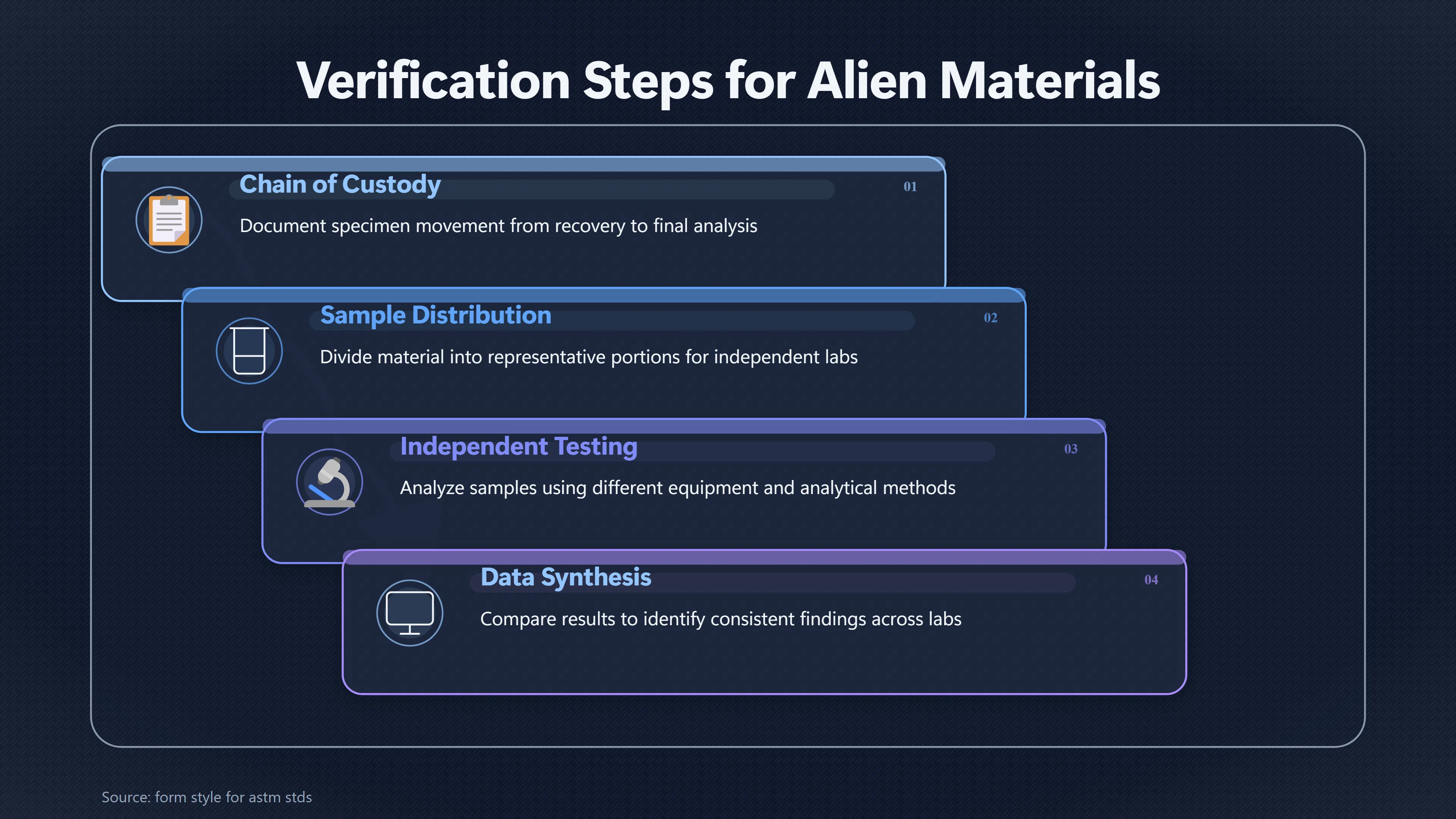
A genuinely convincing case would not depend on one laboratory announcing an astonishing discovery. Instead, it would require multiple independent groups, using different equipment and analytical methods, to arrive at the same conclusions while working from authenticated portions of the same specimen.
Several conditions would need to be met simultaneously:
- The specimen’s provenance and chain of custody must be documented from recovery to analysis.
- A reserve portion must remain untouched so future investigators can repeat the work.
- Independent laboratories should receive representative samples without influencing one another’s analyses.
- Different analytical techniques should converge on compatible conclusions.
- Complete methods, uncertainties and raw measurements should be publicly available for scrutiny.
- Alternative terrestrial explanations should be systematically evaluated before extraordinary conclusions are proposed.
Failure of any one step does not automatically invalidate a specimen, but it substantially weakens confidence in extraordinary interpretations.
Why a Reserve Sample Matters
The most common weakness in controversial material claims is irreversible consumption of the available evidence. If nearly all of a fragment is destroyed during initial testing, later investigators cannot determine whether the original findings resulted from contamination, sampling bias or analytical error.
Maintaining a protected reserve sample serves several important purposes:
- Verification of unexpected findings. If an isotope ratio or microscopic structure appears unprecedented, another laboratory can test untouched material rather than relying on the first laboratory’s preparation.
- Protection against contamination. Sample preparation itself can introduce contaminants through cutting tools, polishing compounds, adhesives or laboratory environments. Untouched material provides an independent reference.
- Future technological improvements. Analytical instruments continually improve. A specimen tested today may reveal additional information decades later using techniques that do not yet exist or require far less destructive sampling.
- Resolution of scientific disputes. Independent researchers can evaluate competing hypotheses without relying solely on published descriptions.
This approach resembles established practice in forensic science, museum conservation and analytical chemistry, where preserving original evidence allows later re-examination if questions arise. Standards governing laboratory evidence management similarly emphasise documentation, controlled storage and preservation of specimen integrity.[ASTM Store]store.astm.orge1492 11r17ASTM StoreE1492 Standard Practice for Receiving, Documenting, Storing, and Retrieving Evidence in a Forensic Science Laboratory…
How Independent Laboratories Should Cross-Check Findings
Independent replication means far more than asking another laboratory to repeat the same measurement after being told what result to expect. A stronger design reduces unconscious bias and demonstrates that the conclusion survives different investigators, equipment and analytical approaches.
Representative sample distribution
Before any destructive analysis, the material should be divided under controlled conditions into representative portions whose relationship to the parent specimen is fully documented.
If the material is heterogeneous—containing multiple layers, inclusions or phases—each laboratory must receive samples known to represent the same structure. Otherwise, conflicting results may simply reflect different parts of the specimen rather than analytical disagreement. Guidance for interlaboratory studies therefore stresses confirming sample homogeneity before comparing laboratory performance.[ASTM Store]store.astm.orgASTM StoreE3264 Standard Guide for Homogeneity of Samples and Reference Materials Used for Inter- and Intra-Laboratory Studies…
Independent analytical approaches
Convincing replication is strengthened when laboratories use different methods to answer the same question.
For example:
- bulk elemental chemistry measured by independent mass spectrometry systems;
- microscopic structure examined with electron microscopy;
- crystal structure confirmed through diffraction methods;
- isotope measurements repeated using separate instrumentation;
- physical properties measured independently rather than inferred.
Agreement across different techniques is generally more persuasive than repeated use of one instrument type.
Blind or partially blind testing
Whenever practical, laboratories should not be informed that a specimen is alleged to originate from a UFO crash. Knowledge of extraordinary claims can unintentionally influence interpretation of ambiguous observations.
Instead, laboratories should receive coded samples together with ordinary control materials. Only after analyses are complete should identities be revealed and compared.
Replication Is Stronger Than Repeatability
A single laboratory may demonstrate that its own measurements are internally consistent, but this establishes repeatability rather than independent confirmation.
Scientific testing distinguishes between:
StandardWhat it demonstratesRepeatabilityThe same laboratory obtains similar results using the same methods and equipment.ReproducibilityDifferent laboratories, operators and equipment obtain comparable results from equivalent samples.
ASTM standards for analytical methods explicitly distinguish these concepts because agreement within one laboratory cannot eliminate laboratory-specific biases, calibration problems or systematic errors. Robust test methods are expected to report both repeatability and reproducibility where possible.[astm.org]astm.orgform style for astm stdsForm and Style for ASTM Standards | ASTMApril 1, 2023…
For extraordinary material claims, reproducibility is the more demanding—and more important—standard.
What Transparent Publication Must Disclose
Even if several laboratories report unusual findings, credibility depends on whether other scientists can understand exactly how those conclusions were reached.
A transparent publication should disclose:
- complete chain of custody;
- sampling procedures;
- specimen preparation methods;
- instruments and calibration procedures;
- analytical settings;
- measurement uncertainty;
- raw numerical data;
- statistical treatment;
- photographs and microscopy images;
- reasons for excluding any observations;
- funding sources and potential conflicts of interest.
Without these details, independent researchers cannot determine whether the conclusions follow from the evidence or from undocumented analytical choices.
Research integrity guidance across scientific institutions likewise emphasises preserving original records, accurately documenting methodology and enabling others to reproduce published work.[Oak Ridge National Laboratory]ornl.govOak Ridge National Laboratory Research Integrity | ORNLOak Ridge National Laboratory Research Integrity | ORNL
Lessons from Publicly Examined Alleged UFO Materials
The recent public analyses performed for the US All-domain Anomaly Resolution Office (AARO) illustrate why replication standards matter.
Oak Ridge National Laboratory analysed specimens promoted as possible anomalous materials using multiple complementary analytical techniques. The laboratory concluded that the examined specimens were consistent with terrestrial manufactured alloys rather than evidence of non-human technology. Importantly, the report also noted that the materials’ chain of custody and claimed origins could not be independently verified. This distinction is crucial: laboratory analysis could characterise the specimens themselves, but it could not establish that they genuinely originated from an alleged UFO crash.[Oak Ridge National Laboratory]ornl.govOak Ridge National Laboratory Research Integrity | ORNLOak Ridge National Laboratory Research Integrity | ORNL
These investigations demonstrate that even sophisticated laboratory work cannot compensate for uncertain provenance or missing opportunities for independent replication.
The Threshold for an Extraordinary Claim
A material would become genuinely compelling only if multiple independent laboratories, working from authenticated reserve samples with transparent methods, consistently reported the same highly unusual characteristics while conventional explanations failed repeated testing.
Such evidence would likely include:
- reproducible chemistry inconsistent with known terrestrial manufacturing or natural processes;
- independently confirmed isotope measurements resistant to contamination explanations;
- identical findings across multiple accredited laboratories;
- complete public documentation allowing outside experts to verify every stage of analysis;
- preserved reserve material remaining available for future re-testing.
Until these conditions are met simultaneously, isolated laboratory results—however intriguing—remain insufficient to establish that an alleged UFO fragment represents extraterrestrial technology. Independent replication is therefore not merely an additional safeguard but the central test separating extraordinary claims from extraordinary evidence.
Amazon book picks
Further Reading
Books and field guides related to What Would Convincing Proof of Alien Material Require?. Use these as the next step if you want deeper reading beyond the article.

The Craft of Research
Rating: 4.3/5 from 6 Google Books ratings
Since 1995, students, researchers, and professionals have turned to The Craft of Research for clear and helpful guidance on how to conduc...
Bad Science
Ben Goldacre takes us on a journey through the bad science we are fed daily by hacks and quacks.
The Demon-Haunted World: Science as a Candle in the Dark
NEW YORK TIMES BESTSELLER • From the renowned astronomer and author of Cosmos comes a “powerful [and] stirring defense of informed ration...
Forensic Materials Engineering: Case Studies
Most books on forensic engineering focus on civil engineering failures rather than consumer or general mechanical products. Unique both i...
eBay marketplace picks
Marketplace Samples
Live-tested eBay searches with available results related to this page.
Selected fromUFO poster oneBay.co.uk.



Current eBay listing
I Want To Believe UFO Poster Giclée Fine Art Heavyweight Print

Current eBay listing
VINTAGE UFO FLYING SAUCERS COMIC ADVERTISING A2 POSTER PRINT
Endnotes
1.
Source: astm.org
Title: form style for astm stds
Link:https://www.astm.org/form-style-for-astm-stds.html
Source snippet
Form and Style for ASTM Standards | ASTMApril 1, 2023...
Published: April 1, 2023
2.
Source: store.astm.org
Link:https://store.astm.org/e0691-13.html
Source snippet
ASTM StoreE691 Standard Practice for Conducting an Interlaboratory Study to Determine the Precision of a Test Method...
3.
Source: store.astm.org
Title: e1492 11r17
Link:https://store.astm.org/e1492-11r17.html
Source snippet
ASTM StoreE1492 Standard Practice for Receiving, Documenting, Storing, and Retrieving Evidence in a Forensic Science Laboratory...
4.
Source: store.astm.org
Link:https://store.astm.org/e3264-21.html
Source snippet
ASTM StoreE3264 Standard Guide for Homogeneity of Samples and Reference Materials Used for Inter- and Intra-Laboratory Studies...
5.
Source: astm.org
Title: AST M Interlaboratory Study Program | ASTM
Link:https://www.astm.org/membership-participation/technical-committees/interlaboratory-studies-program
6.
Source: store.astm.org
Link:https://store.astm.org/e1323-26.html
Source snippet
astm.orgE1323 Standard Guide for Evaluating Laboratory Measurement Practices and the Statistical Analysis of the Resulting DataFebruary 5...
7.
Source: store.astm.org
Link:https://store.astm.org/d6956-17.html
8.
Source: store.astm.org
Title: e0177 90ar96
Link:https://store.astm.org/e0177-90ar96.html
9.
Source: ornl.gov
Title: Oak Ridge National Laboratory Research Integrity | ORNL
Link:https://www.ornl.gov/content/research-integrity
10.
Source: GOV.UK
Title: Foreword 2. Executive
Link:https://www.gov.uk/government/publications/framework-for-integrity-and-independence-of-ukhsas-science-and-research/framework-for-integrity-and-independence-of-ukhsas-science-and-research
Source snippet
for integrity and independence of UKHSA’s science and research - GOV.UKJanuary 28, 2026 — FRAMEWORK FOR INTEGRITY AND INDEPENDENCE OF UKH...
Published: January 28, 2026
Additional References
11.
Source: fda.gov
Title: U.S. Food and Drug Administration Field Science
Link:https://www.fda.gov/science-research/field-science-and-laboratories/field-science-laboratory-manual
Source snippet
U.S. Food and Drug AdministrationField Science - Laboratory Manual | FDA...
12.
Source: youtube.com
Title: How To Scientifically Test & Analyze Potential UAP/UFO Material
Link:https://www.youtube.com/watch?v=SbAtCzZIIsk
Source snippet
Garry Nolan: UFOs and Aliens | Lex Fridman Podcast #262...
13.
Source: youtube.com
Title: Garry Nolan: UFOs and Aliens | Lex Fridman Podcast #262
Link:https://www.youtube.com/watch?v=uTCc2-1tbBQ
Source snippet
UFO Crash Debris! (Art's Parts) - Jimmy Akin's Mysterious World...
14.
Source: youtube.com
Title: UFO Crash Debris! (Art’s Parts)
Link:https://www.youtube.com/watch?v=v4HWxOel7zw
Source snippet
Understanding UAP: Science Panel with Dr. Avi Loeb...
15.
Source: youtube.com
Title: Understanding UAP: Science Panel with Dr. Avi Loeb
Link:https://www.youtube.com/watch?v=3tGDbvadoP0
Source snippet
Replication: The Challenge of Reproducing Research...
16.
Source: youtube.com
Title: Replication: The Challenge of Reproducing Research
Link:https://www.youtube.com/watch?v=kPI1-DA3KZU
Source snippet
Scientific Research and Writing: Peer Review...
17.
Source: youtube.com
Title: Scientific Research and Writing: Peer Review
Link:https://www.youtube.com/watch?v=WkK7KPaie1Q
18.
Source: iso.org
Link:https://www.iso.org/standard/71614.html