Within Missing Records
When Does a Missing UFO File Look Suspicious?
The difference between scheduled disposal and unexplained destruction determines how much suspicion a missing UFO file can reasonably support.
On this page
- How federal retention schedules work
- Warning signs of improper destruction
- What missing files still cannot prove
Page outline Jump by section
Introduction
Missing UFO records often attract immediate suspicion, especially in discussions of alleged crash retrievals such as Roswell or Kecksburg. However, the mere absence of a file is not, by itself, evidence that officials destroyed proof of an extraordinary event. Federal records may disappear for several legitimate reasons, including routine disposal under approved retention schedules, accidental loss, administrative reorganisation or later digitisation. The critical question is not simply whether a file is missing, but how it disappeared and whether its destruction complied with legal records-management procedures.
For investigators examining alleged UFO crashes, distinguishing routine disposal from suspicious destruction is therefore essential. A documented destruction authorised under federal records schedules generally supports an administrative explanation. By contrast, evidence that records known to exist were removed without authority, selectively destroyed or disappeared during an active investigation raises legitimate questions about governance and accountability. Even then, it demonstrates a records-management problem before it demonstrates a UFO cover-up.
How federal retention schedules work
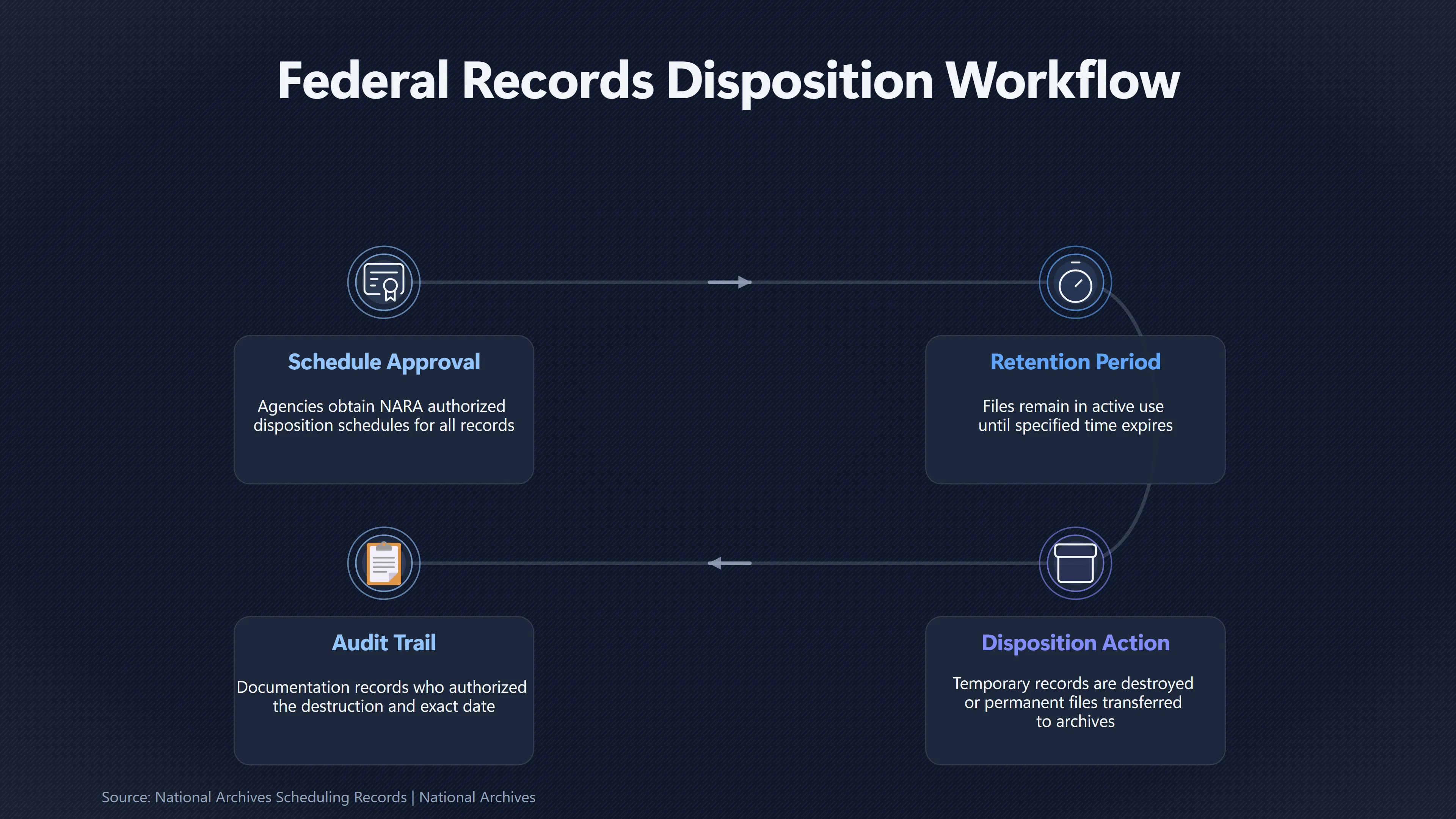
Federal agencies in the United States cannot legally destroy records whenever they choose. Under the Federal Records Act, records must be covered by an approved disposition schedule authorised by the National Archives and Records Administration (NARA). Those schedules determine whether records are temporary—eligible for destruction after a specified period—or permanent, requiring preservation and eventual transfer to the National Archives.[National Archives]archives.govNational Archives Scheduling Records | National ArchivesNational ArchivesScheduling Records | National ArchivesSeptember 9, 2025…
This distinction matters because many documents associated with military installations or intelligence activities are not automatically permanent historical records. Examples include:
- Routine administrative correspondence.
- Duplicate working files.
- Temporary operational logs.
- Budget and procurement paperwork.
- Local office copies retained for short periods.
Such records may be destroyed entirely lawfully once their retention period expires. Their absence decades later therefore says little about the underlying events.
Conversely, permanent records documenting major agency functions, policy decisions or historically significant activities should ultimately be preserved. If records that should have been permanent are missing, investigators must first determine whether they were ever properly scheduled, transferred or accessioned before concluding they were improperly destroyed.[National Archives]archives.govNational Archives Scheduling Records | National ArchivesNational ArchivesScheduling Records | National ArchivesSeptember 9, 2025…
When routine disposal becomes suspicious
A missing file becomes more concerning when the circumstances differ from normal records-management practice rather than merely because the file cannot be found.
Indicators consistent with routine disposal
Several features generally support an ordinary administrative explanation:
- The records fall within an approved temporary records schedule.[archives.gov]archives.govNAR A Records Schedule | National ArchivesNARA Records Schedule | National ArchivesOctober 20, 2021 — NARA Records Schedule Image: National Archives Logo NARA RECORDS SCHEDULE The…
- Disposal occurred after the authorised retention period.
- Documentation records who authorised the destruction and when.
- Similar categories of records were destroyed across an entire office or programme rather than only material connected with one incident.
These characteristics indicate that records disappeared because established policy required it, not because officials were attempting to conceal a particular event.
Warning signs of possible improper destruction
By contrast, investigators become more concerned when evidence points towards unauthorised disposition rather than scheduled destruction. Potential warning signs include:
- Records known to have existed disappear without documented disposal authority.
- Agencies cannot explain what happened to specific files.
- Only records relating to one sensitive incident vanish while comparable files survive.
- Destruction appears to occur after public controversy, litigation or Freedom of Information Act (FOIA) requests begin.
- Internal inventories reference files that later cannot be located.
None of these factors proves concealment of UFO evidence, but together they strengthen the case for investigating whether records-management rules were violated.
What counts as unauthorised destruction?
Federal regulations distinguish clearly between authorised destruction and unlawful disposal.
Agencies are required to prevent accidental or unlawful removal or destruction of federal records. Records may only be destroyed under approved NARA schedules, and suspected unauthorised destruction must be reported to the Archivist. NARA maintains formal procedures for investigating allegations of “unauthorised disposition”, including situations involving accidental loss, unauthorised deletion or improper destruction.[cornell.edu]law.cornell.eduElectronic Code of Federal Regulations (e-CFR) | US Law | LII / Legal Information Institute…
Importantly, an unauthorised disposal investigation does not automatically imply criminal intent. Cases may involve:
- Poor records management.[foia.state.gov]foia.state.govRecords Disposition2.aspxDisposition SchedulesMay 23, 2025 — FOIA Home > Records Management > Records Disposition Schedules RECORDS DISPOSITION SCHEDULES RECORDS…
- Office relocations.
- Mislabelled storage.
- Accidental destruction.
- Failure to follow retention procedures.
NARA’s published case files demonstrate that unauthorised disposition investigations occur across many federal agencies—including the U.S. Air Force—for records entirely unrelated to UFOs. Some cases involve missing permanent records, while others concern temporary records destroyed incorrectly. This broader context shows that record losses occur within ordinary government administration and are not unique to controversial subjects.[National Archives]archives.govOpen source on archives.gov.
UFO cases often cited in destruction debates
Discussions surrounding alleged UFO crashes frequently reference missing documentation rather than documented destruction.
For example, researchers examining Roswell have identified incomplete archival collections, inconsistencies between agencies and missing administrative records from the late 1940s. Similar issues arise in discussions of the Kecksburg incident, where investigators have argued that some expected military documentation has not been located.
These examples demonstrate genuine archival gaps. However, in most cases researchers cannot establish one of the key facts necessary to demonstrate suspicious destruction: evidence that a specific file unquestionably existed and was later destroyed outside authorised procedures.
Instead, the available evidence often supports more limited conclusions, such as:
- records cannot now be located;
- agencies produced inconsistent responses over time;
- documentation may have been lost through ordinary archival processes; or
- retention decisions made decades earlier cannot now be reconstructed.
That uncertainty limits what historical conclusions can responsibly be drawn.
The role of FOIA and archival searches
Freedom of Information Act requests often reveal that agencies no longer possess responsive records. This outcome is sometimes interpreted as evidence of concealment, but several different explanations are possible.
An agency may report that:
- records never existed;
- records were transferred elsewhere;
- records were destroyed under an approved schedule;[archives.gov]archives.govNAR A Records Schedule | National ArchivesNARA Records Schedule | National ArchivesOctober 20, 2021 — NARA Records Schedule Image: National Archives Logo NARA RECORDS SCHEDULE The…
- records cannot presently be located; or
- records were improperly lost.
Each response has a different evidential value.
If an agency states that responsive records were destroyed pursuant to an approved records schedule, that generally indicates routine disposal rather than suspicious destruction. If an agency instead reports that records are missing without explanation or that NARA has opened an unauthorised disposition inquiry, the governance issue becomes more significant—but still concerns records management rather than the substantive content of the missing files.[National Archives]archives.govOpen source on archives.gov.
What missing files still cannot prove
Even if investigators established that records relating to an alleged UFO crash were improperly destroyed, several important conclusions would still remain unsupported.
Improper destruction alone cannot demonstrate:
- that the records described an extraterrestrial spacecraft;
- that officials recovered non-human technology;
- that witnesses’ recollections were accurate;
- that later government statements were knowingly false; or
- that a coordinated decades-long cover-up existed.
Those claims require independent corroborating evidence, such as surviving documents, physical material, authenticated photographs, contemporaneous witness testimony or multiple independent archival sources.
In other words, suspicious destruction may strengthen the case for questioning official record-keeping, but it does not establish what the missing records contained.
A balanced standard for judging missing UFO files
The strongest historical approach is to separate three increasingly serious questions:
- Did records once exist? Independent evidence such as inventories, file indexes or correspondence can sometimes establish this.
- Were they destroyed properly? Records schedules, disposal documentation and NARA guidance help answer this question.
- What did they contain? This requires surviving evidence beyond the fact that the records disappeared.
Only the first two questions concern records management. The third concerns historical proof.
For debates over alleged UFO crashes, this distinction is crucial. Routine disposal generally reflects ordinary federal administration. Unauthorised destruction may indicate failures in governance or accountability. Neither outcome, standing alone, demonstrates that missing files concealed evidence of an extraterrestrial crash.
Amazon book picks
Further Reading
Books and field guides related to When Does a Missing UFO File Look Suspicious?. Use these as the next step if you want deeper reading beyond the article.
UFOs and Government: A Historical Inquiry
Governments around the world have had to deal with the UFO phenomenon for a good part of a century. How and why they did so is the subjec...
Records and Information Management
Benefiting LIS students and professionals alike, Franks presents complete coverage of the records and information lifecycle model.
Managing Records: A Handbook of Principles and Practice
Many organizations do not yet have a formal programme of records management, but increasingly they are recognizing the benefits of well m...
The Art of Access: Strategies for Acquiring Public Records
NEW TO THIS EDITION: 40 additional experts and practitioners offer tips and record ideas for opening new doorways into FOI and open data....
eBay marketplace picks
Marketplace Samples
Live-tested eBay searches with available results related to this page.
Selected fromUFO poster oneBay.co.uk.


Current eBay listing
I Want To Believe UFO Poster Giclée Fine Art Heavyweight Print

Current eBay listing
VINTAGE UFO FLYING SAUCERS COMIC ADVERTISING A2 POSTER PRINT

Endnotes
1.
Source: archives.gov
Title: National Archives Scheduling Records | National Archives
Link:https://www.archives.gov/records-mgmt/scheduling/sch-records
Source snippet
National ArchivesScheduling Records | National ArchivesSeptember 9, 2025...
Published: September 9, 2025
2.
Source: archives.gov
Link:https://www.archives.gov/records-mgmt/resources/unauthorizeddispositionoffederalrecords
3.
Source: archives.gov
Link:https://www.archives.gov/records-mgmt/policy/protecting-federal-records.html
4.
Source: archives.gov
Title: NAR A Records Schedule | National Archives
Link:https://www.archives.gov/about/records-schedule
Source snippet
NARA Records Schedule | National ArchivesOctober 20, 2021 — NARA Records Schedule Image: National Archives Logo NARA RECORDS SCHEDULE The...
Published: October 20, 2021
5.
Source: archives.gov
Link:https://www.archives.gov/records-mgmt/faqs/records-mgmt/faqs/scheduling-appraisal
6.
Source: law.cornell.edu
Link:https://www.law.cornell.edu/cfr/text/36/1225.16
Source snippet
Legal Information Institute36 CFR § 1225.16 - How do agencies schedule temporary records? | Electronic Code of Federal Regulations (e-CFR...
7.
Source: law.cornell.edu
Link:https://www.law.cornell.edu/cfr/text/36/1230.10
Source snippet
Electronic Code of Federal Regulations (e-CFR) | US Law | LII / Legal Information Institute...
8.
Source: law.cornell.edu
Link:https://www.law.cornell.edu/cfr/text/36/1226.24
Additional References
9.
Source: congress.gov
Link:https://www.congress.gov/crs-product/R48423
Source snippet
February 12, 2025 — * a General Records Schedule (GRS) issued by NARA, which authorizes, after specified periods of time, the destruction...
Published: February 12, 2025
10.
Source: foia.state.gov
Title: Records Disposition2.aspx
Link:https://foia.state.gov/RecordsManagement/RecordsDisposition2.aspx
Source snippet
Disposition SchedulesMay 23, 2025 — FOIA Home > Records Management > Records Disposition Schedules RECORDS DISPOSITION SCHEDULES RECORDS...
Published: May 23, 2025
11.
Source: youtube.com
Title: NASA Claim To Have “Lost” Important Wreckage From The Kecksburg UFO Incident
Link:https://www.youtube.com/watch?v=9HZl2Nl1h5U
Source snippet
The Roswell Incident Explained: Crash, Cover-Up, Witnesses & What We Know...
12.
Source: youtube.com
Title: The Roswell Incident Explained: Crash, Cover-Up, Witnesses & What We Know
Link:https://www.youtube.com/watch?v=vRnOUO7TMJo
Source snippet
Explosive Proof the Government Hid UFOs for 80 Years...
13.
Source: gao.gov
Link:https://www.gao.gov/assets/a310938.html
14.
Source: youtube.com
Link:https://www.youtube.com/watch?v=s1o7m9JCBjg
Source snippet
NASA Claim To Have “Lost” Important Wreckage From The Kecksburg UFO Incident...
15.
Source: congress.gov
Title: Federal Records: Types and Treatments | Congress.gov | Library of Congress
Link:https://www.congress.gov/crs-product/IF11119
16.
Source: youtube.com
Title: Explosive Proof the Government Hid UFOs for 80 Years
Link:https://www.youtube.com/watch?v=X7gh-4gM-AE
17.
Source: youtube.com
Link:https://www.youtube.com/watch?v=dzv6nRpMX24
Source snippet
W. Glenn Dennis Interview, 11/19/1990...