Within Proof Standard
Could Another Lab Get the Same Result?
A persuasive debris claim needs repeatable results from independent laboratories using preserved samples and disclosed methods.
On this page
- What repeatable testing requires
- How sample sharing and blind analysis reduce bias
- Which findings would justify extraordinary claims
Page outline Jump by section
Introduction
A claim that alleged UFO crash debris is extraordinary cannot become persuasive because a single laboratory reports unusual results. The decisive test is whether independent laboratories, working from well-documented samples and using transparent methods, reach the same conclusions without relying on the original investigators. Reproducibility is a cornerstone of modern science because it helps distinguish genuine discoveries from contamination, measurement error, analytical bias or overinterpretation. NASA’s UAP independent study likewise emphasised that credible conclusions depend on high-quality, well-characterised data that other researchers can evaluate and reproduce rather than isolated observations or unsupported claims.[NASA Science]science.nasa.govScience NASAUNIDENTIFIED ANOMALOUS PHENOMENA…

Within the broader question of what would constitute real proof of a UFO crash, laboratory replication serves as the practical checkpoint between an intriguing specimen and convincing physical evidence. If a remarkable material truly represents unknown technology, qualified laboratories using different instruments should repeatedly observe the same unusual properties.
What Repeatable Testing Requires
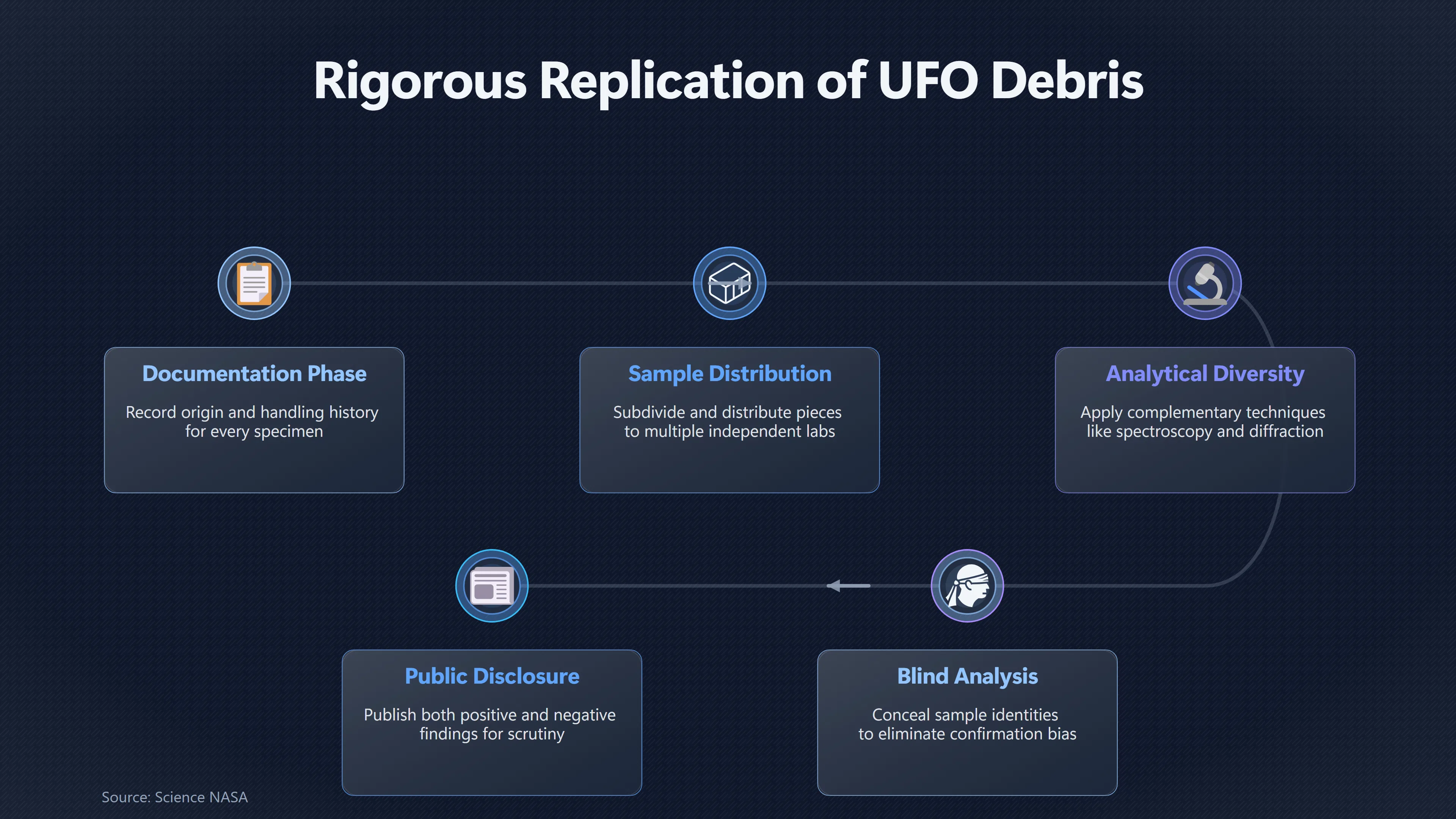
Independent verification begins long before any instrument is switched on. Every participating laboratory must receive specimens whose origin, handling history and preparation are fully documented. Any uncertainty about contamination, storage conditions or previous destructive testing limits what later analyses can prove.
A rigorous replication programme would normally include:
- Multiple specimens from different locations within the alleged debris field rather than a single fragment.
- Preserved reference samples that remain untouched for future testing.
- Detailed documentation describing how pieces were subdivided and distributed.
- Standardised analytical protocols so different laboratories examine comparable material.
- Full disclosure of calibration methods, instrument settings and uncertainty estimates.
- Publication of both positive and negative findings.
Replication also benefits from analytical diversity. Different laboratories should employ complementary techniques rather than repeating exactly the same measurement. For example, elemental composition might be confirmed through independent spectroscopic methods, while crystal structure could be examined using diffraction techniques and microscopic imaging. Agreement across different analytical approaches generally provides stronger evidence than repeated measurements using one instrument alone.
How Sample Sharing and Blind Analysis Reduce Bias
Extraordinary claims are especially vulnerable to unconscious confirmation bias. Researchers who know a specimen is alleged to be “alien debris” may, despite their best intentions, interpret ambiguous measurements differently from those examining an anonymous engineering sample.
Blind testing reduces this risk by concealing sample identities until analyses are complete. A robust study could include:
- Genuine debris specimens.
- Control samples from known aerospace alloys.
- Meteorites.
- Industrial metals with similar appearances.
- Duplicate specimens labelled under different identifiers.
If laboratories consistently identify the same unusual characteristics without knowing which samples are alleged UFO material, confidence in the results increases substantially.
Sharing material among several independent institutions is equally important. If every unusual finding comes from one laboratory, readers cannot easily determine whether the observation reflects the specimen itself, the analytical method or laboratory-specific practices. Independent confirmation by universities, government laboratories and commercial materials laboratories using separate equipment provides a much stronger foundation.
Why One Spectacular Result Is Not Enough
Modern analytical instruments are remarkably sensitive. They can detect trace contaminants, manufacturing defects, corrosion products and microscopic inclusions that might initially appear unusual. Without replication, an apparently extraordinary measurement may simply reflect:
- Laboratory contamination.
- Sample mix-ups.
- Instrument calibration errors.
- Statistical outliers.
- Misidentified industrial materials.
- Damage introduced during recovery or storage.
Scientific history contains many examples in which surprising measurements disappeared once independent laboratories repeated the work under controlled conditions. This is why reproducibility carries greater weight than novelty.
NASA’s UAP study similarly argued that scientific progress depends on calibrated instruments, transparent methodologies and data that other investigators can independently analyse rather than isolated reports that cannot be reproduced.[NASA Science]science.nasa.govScience NASAUNIDENTIFIED ANOMALOUS PHENOMENA…
A Practical Example: Testing Claimed UFO Materials
One frequently discussed example involves a layered magnesium–bismuth specimen claimed by some proponents to possess unusual technological properties. Rather than accepting or dismissing the claim based on appearance, researchers subjected the material to detailed materials-characterisation techniques.
Oak Ridge National Laboratory analysed the specimen for the US All-domain Anomaly Resolution Office (AARO). According to the published synopsis, investigators concluded the material was terrestrial, lacked the proposed exotic layered structure and did not support claims of advanced electromagnetic functionality. AARO likewise concluded the evidence did not demonstrate extraterrestrial technology.[ODNI]dni.govDOD AARO Consolidated Annual Report on UAP Nov2024ODNIUNCLASSIFIEDApril 20, 2026…
The significance of this case is methodological rather than rhetorical. The specimen underwent scientific testing, produced documented results and generated conclusions that other specialists could examine and critique. Whether one agrees with every interpretation, the process illustrates how extraordinary claims should be investigated: through transparent materials science rather than visual inspection or anecdotal testimony.
Which Findings Would Justify Extraordinary Claims?
Independent laboratories would not need to identify “alien technology” directly. Instead, they would need to establish a series of reproducible observations that cannot reasonably be explained by known natural or industrial processes.
Findings that would warrant sustained international scientific attention include:
- Previously unknown isotopic ratios that survive repeated verification and cannot be explained by contamination, fractionation or terrestrial manufacturing.
- Stable crystal structures or engineered materials beyond documented materials science despite exhaustive comparison with known technologies.
- Identical anomalous properties measured independently by multiple laboratories using different instruments.
- Reproducible physical behaviour inconsistent with established materials science after experimental artefacts have been excluded.
- Consistent association between multiple independently recovered specimens sharing documented provenance from the same crash site.
Any single result would require extensive scrutiny before supporting extraordinary conclusions. Science generally advances through converging evidence rather than one decisive experiment.
Transparency Determines Credibility
Replication is impossible without openness. Laboratories must disclose enough information for others to repeat the work, including sample preparation, analytical procedures, software processing where relevant, uncertainty calculations and the limitations of each technique.
Equally important is publishing unsuccessful attempts to confirm unusual findings. Negative results help identify analytical errors and prevent isolated observations from being mistaken for established facts. Scientific credibility grows when independent groups can disagree openly, compare methods and eventually determine why results differ.
This emphasis on transparency aligns with NASA’s recommendation that future UAP research prioritise high-quality data, documented sensor performance and scientific practices that permit independent verification rather than reliance on inaccessible or poorly characterised evidence.[NASA Science]science.nasa.govScience NASAUNIDENTIFIED ANOMALOUS PHENOMENA…
The Current Position
No publicly documented alleged UFO debris has yet satisfied the standard of repeated, independent laboratory confirmation while also possessing an unbroken, well-documented chain of custody from an alleged crash site. Government reviews, including those by AARO, report that they have not found verified evidence of recovered extraterrestrial technology, while continuing to stress that materials claims should be evaluated through established scientific methods rather than assumption or speculation.[U.S. Department of War]defense.govU.S. Department of WarDOD Report Discounts Sightings of Extraterrestrial Technology > U.S. Department of Defense > Defense Department New…(https://www.defense.gov/News/News-Stories/Article/Article/3701297/dod-report-discounts-sightings-of-extraterrestrial-technology/)
For that reason, laboratory replication is not a bureaucratic formality but one of the strongest tests any alleged UFO crash evidence could face. If remarkable debris truly exists, independent laboratories examining preserved samples with transparent methods should be able to reach the same conclusions repeatedly. Until that happens, unusual laboratory results remain interesting observations rather than convincing proof of a non-human spacecraft.
Amazon book picks
Further Reading
Books and field guides related to Could Another Lab Get the Same Result?. Use these as the next step if you want deeper reading beyond the article.

The Craft of Research
Rating: 4.3/5 from 6 Google Books ratings
Since 1995, students, researchers, and professionals have turned to The Craft of Research for clear and helpful guidance on how to conduc...
Statistics Done Wrong
Scientific progress depends on good research, and good research needs good statistics. But statistical analysis is tricky to get right, e...
Bad Science
Ben Goldacre takes us on a journey through the bad science we are fed daily by hacks and quacks.
Reproducibility and Replicability in Science
"One of the pathways by which the scientific community confirms the validity of a new scientific discovery is by repeating the research t...
eBay marketplace picks
Marketplace Samples
Live-tested eBay searches with available results related to this page.
Selected fromlaboratory wall sign oneBay.co.uk.


Endnotes
1.
Source: science.nasa.gov
Title: Science NASA
Link:https://science.nasa.gov/wp-content/uploads/2023/09/uap-independent-study-team-final-report.pdf
Source snippet
[UNIDENTIFIED]({{ 'unidentified/' | relative_url }}) ANOMALOUS PHENOMENA...
2.
Source: science.nasa.gov
Title: Science UAP
Link:https://science.nasa.gov/uap/
Source snippet
NASA ScienceFebruary 23, 2026 — Explore This Section UAP CONTENTS * NASA Unidentified Anomalous Phenomena Independent Study * Final Repor...
Published: February 23, 2026
3.
Source: dni.gov
Title: DOD AARO Consolidated Annual Report on UAP Nov2024
Link:https://www.dni.gov/files/ODNI/documents/assessments/DOD-AARO-Consolidated-Annual-Report-on-UAP-Nov2024.pdf
Source snippet
ODNIUNCLASSIFIEDApril 20, 2026...
Published: April 20, 2026
4.
Source: defense.gov
Link:https://www.defense.gov/News/News-Stories/Article/Article/3701297/dod-report-discounts-sightings-of-extraterrestrial-technology/
Source snippet
U.S. Department of WarDOD Report Discounts Sightings of Extraterrestrial Technology > U.S. Department of Defense > Defense Department New...
5.
Source: defense.gov
Link:https://www.defense.gov/News/Releases/Release/Article/3700894/statement-by-pentagon-press-secretary-maj-gen-pat-ryder-on-the-historical-recor/
6.
Source: defense.gov
Link:https://www.defense.gov/News/Transcripts/Transcript/Article/3702219/media-engagement-with-acting-aaro-director-tim-phillips-on-the-historical-recor/
Additional References
7.
Source: ufopress.com
Link:https://www.ufopress.com/articles/aaro-releases-four-information-papers-on-uap-classification-satellite-flaring-se/
Source snippet
AARO Releases Four Information Papers on UAP Classification, Satellite Flaring, Sensor Distortion, and Narrative Data — UFOPressJune 29...
8.
Source: ufouap.net
Title: NAS A UAP Study: Findings and Remaining Questions | Global UFO Archive
Link:https://www.ufouap.net/en/explainers/nasa-uap-study
Source snippet
NASA UAP Study: Findings and Remaining Questions | Global UFO ArchiveJuly 23, 2026 — Science / Updated 2026-07-23 / 9 min read NASA AND U...
Published: July 23, 2026
9.
Source: nist.gov
Title: implications bullet black box study
Link:https://www.nist.gov/publications/implications-bullet-black-box-study
Source snippet
Implications of the Bullet Black Box Study | NISTJune 5, 2025 — IMPLICATIONS OF THE BULLET BLACK BOX STUDY Published June 5, 2025 AUTHOR(...
Published: June 5, 2025
10.
Source: youtube.com
Link:https://www.youtube.com/watch?v=EEMJoZvN-dQ
Source snippet
Watch: NASA holds news conference on Unidentified Anomalous Phenomena report...
11.
Source: youtube.com
Title: Garry Nolan: UFOs and Aliens | Lex Fridman Podcast #262
Link:https://www.youtube.com/watch?v=uTCc2-1tbBQ
Source snippet
The CIA's UAP & Alien Research! 'Their Brains Looked Fried' | Stanford's Garry Nolan...
12.
Source: youtube.com
Title: How To Scientifically Test & Analyze Potential UAP/UFO Material
Link:https://www.youtube.com/watch?v=SbAtCzZIIsk
Source snippet
Garry Nolan: UFOs and Aliens | Lex Fridman Podcast #262...
13.
Source: nist.gov
Link:https://www.nist.gov/publications/assessing-microscale-heterogeneity-candidate-standard-reference-material-4600-surrogate
14.
Source: ornl.gov
Link:https://www.ornl.gov/news/uranium-science-researchers-investigate-feasibility-intentional-nuclear-forensics
15.
Source: [uap-archive]({{ ‘uap-archive/’ | relative_url }}). org
Link:https://uap-archive.org/uap/records/aaro-historical-record-report-vol1/
16.
Source: youtube.com
Title: Watch: NASA holds news conference on Unidentified Anomalous Phenomena report
Link:https://www.youtube.com/watch?v=zjwrzHJA3PI
Source snippet
The ADAM Research Project Begins...