Within Fireballs
Why Fireballs Look Like They Hit Nearby
A fireball can vanish behind a ridge while remaining tens or hundreds of kilometres beyond the apparent crash site.
On this page
- How the horizon removes distance cues
- Why terrain creates a false impact point
- What separated witnesses reveal about the path
Page outline Jump by section
Introduction
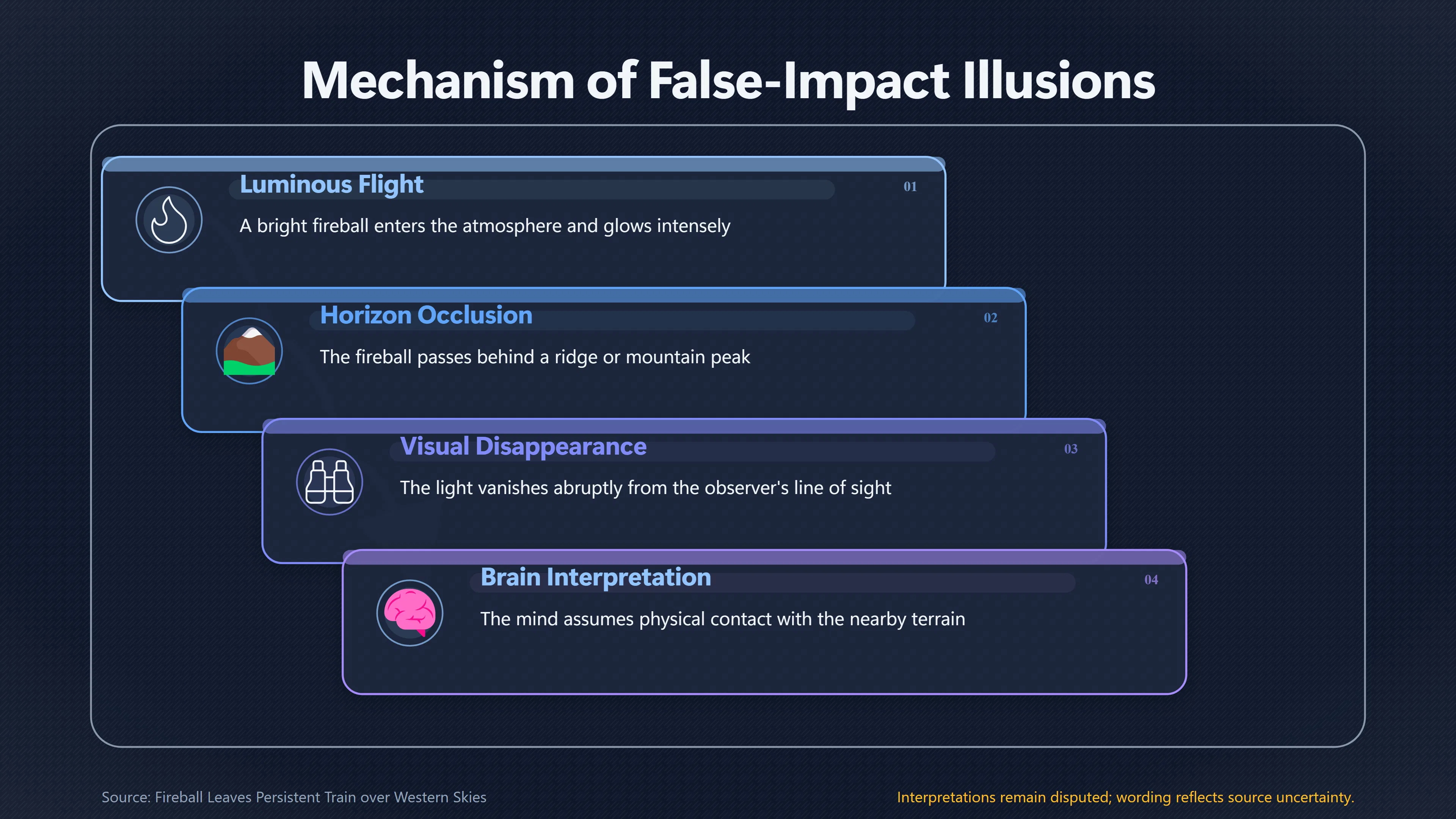
Reports of a brilliant object apparently crashing behind a nearby hill are a recurring feature of UFO crash stories. In many cases, however, the apparent impact point is an illusion created by perspective rather than evidence of an object striking the ground. A bright fireball can disappear behind a ridge while still tens or even hundreds of kilometres beyond the location where observers believe it landed. The night sky provides few reliable distance cues, and the horizon encourages the brain to treat a disappearing light as though it has reached the landscape.
This false-impact effect helps explain why sincere witnesses may launch searches in completely the wrong place, why several communities can simultaneously report a crash “just beyond the hills”, and why later investigations often fail to find wreckage. Understanding the mechanism requires looking not at whether the fireball was real—it almost certainly was—but at how human vision interprets its final moments.
How the horizon removes distance cues
The strongest source of the illusion is the absence of depth information in the night sky.
When people judge the distance of familiar objects, they rely on size, texture, shadows and overlapping features. A fireball provides almost none of these clues. It is simply a brilliant moving light against a dark background. Because observers do not know its true size or altitude, the brain cannot estimate its distance accurately.
This problem becomes particularly pronounced near the horizon. The International Meteor Organization notes that a fireball ending roughly 50 km above the Earth’s surface can appear only about five degrees above the horizon to an observer approximately 600 km away. From that viewpoint, the meteor seems almost level with distant hills despite remaining extremely high above the atmosphere.[International Meteor Organization]imo.netInternational Meteor Organization Fireballs | IMOInternational Meteor Organization Fireballs | IMO
Brightness also misleads. Many people intuitively assume that a very bright object must be nearby, yet large meteors can remain dazzling even when observed from hundreds of kilometres away. Their luminosity reflects the enormous energy released during atmospheric entry rather than their proximity to the observer.[NASA Jet Propulsion Laboratory (JPL)]jpl.nasa.govNASA Jet Propulsion Laboratory (JPL)Meteor Likely Cause of Southwest U.S. Light Show | NASA Jet Propulsion Laboratory (JPL)September 15…
Why terrain creates a false impact point
Once a fireball approaches the apparent skyline, local terrain supplies a convincing but incorrect ending to its path.
A hill, forested ridge or mountain blocks the observer’s line of sight. The instant the meteor passes behind that foreground feature, its light disappears completely. Human perception naturally interprets the disappearance as physical contact with the landscape because the visible motion and the terrain boundary coincide.
In reality, the observer has witnessed only an occultation: the hill has hidden an object that is still far beyond it. The meteor may continue glowing for several seconds while passing over distant countryside or ocean, entirely invisible from the original viewpoint.
The illusion becomes especially persuasive because the disappearance is abrupt. Unlike aircraft, which normally remain visible as they pass beyond distant terrain, meteors are already approaching the end of their luminous flight. Their natural fading can occur almost simultaneously with the horizon crossing, reinforcing the impression of a sudden collision.
This explains why witnesses often report remarkably precise crash locations—such as “behind the second ridge” or “just over the next valley”—despite the actual atmospheric event occurring vastly farther away.
Why separated witnesses reveal the real path
The easiest way to expose the illusion is to compare reports from widely separated observers.
Each witness sees the fireball disappear behind a different section of their own horizon. One town may report a crash beyond western hills, while another reports the same object disappearing behind eastern mountains. These accounts seem contradictory only if each observer assumes the object was nearby.
When investigators combine observations from multiple locations, the geometry usually reconstructs a high-altitude atmospheric trajectory rather than several separate impacts. NASA’s Meteoroid Environment Office has shown that meaningful trajectory reconstruction depends on combining numerous eyewitness reports with camera records or dedicated fireball networks, since a single observer provides only a direction rather than a reliable location. Studies comparing eyewitness reconstructions with instrumented observations found that accuracy improves substantially as the number of independent reports increases.[NASA Technical Reports Server]ntrs.nasa.govNASA Technical Reports ServerComparing Eyewitness-Derived Trajectories of Bright Meteors to Instrumentally-Observed Data - NASA Technical…
This is why organised meteor investigations collect observations from many towns instead of relying on the person who believed the object landed nearest.
Why the illusion is especially convincing during spectacular fireballs
Several features common to bright fireballs strengthen the false-impact impression without indicating an actual ground strike.
- Low elevation: As the fireball approaches the horizon, perspective increasingly compresses its apparent height above the landscape.
- Sudden bright flares: Fragmentation shortly before the luminous flight ends resembles an explosion near the ground.
- Rapid disappearance: Passing behind terrain while simultaneously fading gives the appearance of impact.
- Persistent glowing trails: Dust illuminated after the fireball has vanished can resemble smoke rising from a crash site, even though the trail remains tens of kilometres above Earth.[NASA]nasa.govFireball Leaves Persistent Train over Western SkiesFireball Leaves Persistent Train over Western Skies - NASADecember 20, 2018…
None of these visual effects reliably indicate where, or even whether, meteorites reached the surface.
Why searches often begin in the wrong place
The false-impact mechanism has practical consequences beyond eyewitness testimony.
Emergency services, amateur search parties and UFO investigators have repeatedly been dispatched to locations where numerous witnesses believed an object had crashed, only to find nothing. In many instances, later analysis showed the fireball had travelled over a completely different region or had burned up entirely in the upper atmosphere.
Even when meteorites do survive, the point where the fireball disappears is not necessarily where fragments land. Once the glowing phase ends, surviving pieces continue through a “dark flight” influenced by gravity and upper-atmospheric winds before reaching the ground, often many kilometres beyond the final visible point. Consequently, extending an eyewitness’s line of sight to the nearest ridge is not a valid method for locating a fall.
Why this matters when evaluating UFO crash reports
The apparent crash of a fireball behind nearby hills is one of the most persuasive visual illusions associated with UFO crash claims because it matches ordinary expectations about moving objects. People naturally assume that when something disappears behind a landscape feature, it has reached that location.
Modern meteor science shows that this intuition is frequently wrong. A single observation records only the observer’s viewing direction. Establishing where the object actually travelled requires triangulation from multiple locations, calibrated cameras, radar or other instrumental measurements rather than extrapolating from one witness’s apparent impact point. Recognising this mechanism helps explain why honest observers can confidently report crashes in places where no object ever reached the ground, while the true atmospheric event occurred far beyond the nearest hills.
Amazon book picks
Further Reading
Books and field guides related to Why Fireballs Look Like They Hit Nearby. Use these as the next step if you want deeper reading beyond the article.
Meteorites: The Story of Our Solar System
Meteorite tells the fascinating story of the stones from outer space scattered across our planet. From the impact that finished off the d...
The Cambridge Encyclopedia of Meteorites
Beautifully illustrated with over 140 full colour images, The Cambridge Encyclopedia of Meteorites provides a thorough guide to these fas...
Meteorites: A Journey Through Space and Time
Contains several previously unpublished accounts of meteorite recoveries in Australia and provides deatails on many Australian contributi...
The Invisible Gorilla
NEW YORK TIMES BESTSELLER • Our minds don’t work the way we think they do. Two renowned psychologists explain how and why our intuitions...
eBay marketplace picks
Marketplace Samples
Live-tested eBay searches with available results related to this page.
Selected fromUFO patch oneBay.co.uk.

Endnotes
1.
Source: jpl.nasa.gov
Link:https://www.jpl.nasa.gov/news/meteor-likely-cause-of-southwest-us-light-show/
Source snippet
NASA Jet Propulsion Laboratory (JPL)Meteor Likely Cause of Southwest U.S. Light Show | NASA Jet Propulsion Laboratory (JPL)September 15...
2.
Source: ntrs.nasa.gov
Link:https://ntrs.nasa.gov/citations/20170009052
Source snippet
NASA Technical Reports ServerComparing Eyewitness-Derived Trajectories of Bright Meteors to Instrumentally-Observed Data - NASA Technical...
3.
Source: nasa.gov
Title: Fireball Leaves Persistent Train over Western Skies
Link:https://www.nasa.gov/blogs/watch-the-skies/2018/12/20/fireball-leaves-persistent-train-over-western-skies/
Source snippet
Fireball Leaves Persistent Train over Western Skies - NASADecember 20, 2018...
Published: December 20, 2018
4.
Source: science.nasa.gov
Title: Science NASA Instruments Image Fireball over Bering Sea
Link:https://science.nasa.gov/solar-system/nasa-instruments-image-fireball-over-bering-sea/
Source snippet
NASA ScienceNASA Instruments Image Fireball over Bering Sea - NASA Science...
5.
Source: fireballs.ndc.nasa.gov
Link:https://fireballs.ndc.nasa.gov/skyfalls/events/20260602-024149
Source snippet
20260602-024149June 2, 2026 — EVENT: 20260602-024149 Many eyewitnesses in the states of Ohio and Michigan have filed reports on the Ameri...
Published: June 2, 2026
6.
Source: fireballs.ndc.nasa.gov
Link:https://fireballs.ndc.nasa.gov/skyfalls/events/20260429-071216
Source snippet
20260429-071216April 29, 2026 — EVENT: 20260429-071216 iframe Well over a hundred eyewitnesses in the states of Oregon and Washington and...
Published: April 29, 2026
7.
Source: nasa.gov
Title: It’s Fireball Season!
Link:https://www.nasa.gov/blogs/watch-the-skies/2026/03/26/its-fireball-season-answering-your-meteor-questions/
Source snippet
Answering Your Meteor Questions - NASAMarch 26, 2026 — WATCH THE SKIES Image Janet Sudnik March 26, 2026 5:18PM CATEGORIES Marshall Space...
Published: March 26, 2026
8.
Source: fireballs.ndc.nasa.gov
Link:https://fireballs.ndc.nasa.gov/skyfalls/events/20260324-013109
9.
Source: fireballs.ndc.nasa.gov
Link:https://fireballs.ndc.nasa.gov/skyfalls/events/20260211-043200
10.
Source: nasa.gov
Title: interesting fact of the month 2021
Link:https://www.nasa.gov/space-science-and-astrobiology-at-ames/interesting-fact-of-the-month-current/interesting-fact-of-the-month-2021/
11.
Source: blogs.nasa.gov
Title: loud fireball spotted over southern mississippi mostly heard hardly seen
Link:https://blogs.nasa.gov/blog/2022/04/28/loud-fireball-spotted-over-southern-mississippi-mostly-heard-hardly-seen/
12.
Source: science.nasa.gov
Title: looking for lightning finding fireballs 149381
Link:https://science.nasa.gov/earth/earth-observatory/looking-for-lightning-finding-fireballs-149381/
13.
Source: jpl.nasa.gov
Title: instruments image fireball over bering sea
Link:https://www.jpl.nasa.gov/news/nasa-instruments-image-fireball-over-bering-sea/
14.
Source: apod.nasa.gov
Link:https://apod.nasa.gov/apod/ap171117.html
15.
Source: sma.nasa.gov
Link:https://sma.nasa.gov/news/articles/newsitem/2017/07/11/it-s-a-bird-it-s-a-plane-it-s-a-fireball
16.
Source: jpl.nasa.gov
Title: fireball over californianevada how big was it
Link:https://www.jpl.nasa.gov/news/fireball-over-californianevada-how-big-was-it/
17.
Source: nasa.gov
Title: Bright Fireball Over Georgia
Link:https://www.nasa.gov/blogs/watch-the-skies/2012/03/09/bright-fireball-over-georgia/
18.
Source: imo.net
Title: International Meteor Organization Fireballs | IMO
Link:https://www.imo.net/observations/fireballs/fireballs/
19.
Source: imo.net
Title: fireball report program
Link:https://www.imo.net/observations/fireballs/fireball-report-program/
Additional References
20.
Source: pubmed.ncbi.nlm.nih.gov
Link:https://pubmed.ncbi.nlm.nih.gov/32661443/
Source snippet
Comparing eyewitness-derived trajectories of bright meteors to instrumentally-observed data - PubMed...
21.
Source: youtube.com
Title: Fireball above Las Vegas before alien 911 call was meteor, scientist says
Link:https://www.youtube.com/watch?v=HCvNVmTiIQQ
Source snippet
What is Meteorite and Meteor I Types of Meteors I Difference between Meteor and Meteorite I Fireball...
22.
Source: youtube.com
Title: Fireball streaks across LA skies
Link:https://www.youtube.com/watch?v=lkDmnaCrS1o
Source snippet
This video from Crash Course Astronomy on Meteors explains the high altitude (around 100 km) where meteors and fireballs actually disinte...
23.
Source: youtube.com
Title: ‘Fireball’ meteor blazes across UK skies | DW News
Link:https://www.youtube.com/watch?v=dSwrzQ_IC-c
Source snippet
Fireball above Las Vegas before alien 911 call was meteor, scientist says...
24.
Source: youtube.com
Link:https://www.youtube.com/watch?v=Trw–04jp1E
Source snippet
Fireball streaks across LA skies...
25.
Source: youtube.com
Title: Meteors: Crash Course Astronomy #23
Link:https://www.youtube.com/watch?v=TuDfZ2Md5x8
Source snippet
'Fireball' meteor blazes across UK skies | DW News...
26.
Source: pmc.ncbi.nlm.nih.gov
Link:https://pmc.ncbi.nlm.nih.gov/articles/PMC7357168/