Within Missing Records
How Can You Prove a Lost UFO File Existed?
Indexes, quoted correspondence and surviving copies can establish that a missing document once existed and reveal why its absence matters.
On this page
- Contemporaneous indexes and file registers
- References in surviving correspondence
- Copies, quotations and records officer testimony
Page outline Jump by section
Introduction
A missing government file is not automatically evidence of a UFO crash cover-up. However, investigators can often demonstrate that a specific document once existed even if the document itself has disappeared. In archival research, the strongest evidence frequently comes from the traces a file leaves behind: registry entries, file numbers, routing slips, references in letters, inventories, duplicate copies and records-management documentation. These surviving records allow researchers to distinguish between a document that probably never existed and one that almost certainly did.
Within investigations of alleged UFO crashes such as Roswell or Kecksburg, this distinction is important. A proven archival gap strengthens the case that the historical record is incomplete, but it does not establish what the missing document contained. The value of the evidence lies in showing that a known record has vanished and in narrowing the range of plausible explanations for its absence.
How can a lost file be shown to have existed?
Archives are designed to track records throughout their life cycle. Even when the original file is gone, administrative systems often preserve evidence that it was created, circulated or transferred.
Investigators therefore look for independent documentary traces rather than relying on memories alone. The more unrelated sources that point to the same missing record, the stronger the conclusion that the document genuinely existed.
Typical forms of corroboration include:
- File registers assigning a unique reference number.
- Incoming or outgoing correspondence referring to the document.
- Distribution lists showing who received copies.
- Records schedules describing the file series.
- Transfer inventories sent to archival repositories.
- Quotations or extracts reproduced elsewhere.
- Duplicate or carbon copies retained in another office.
- Testimony from records officers explaining how the filing system operated.
No single item proves what the missing file contained, but together they can establish its former existence with considerable confidence.
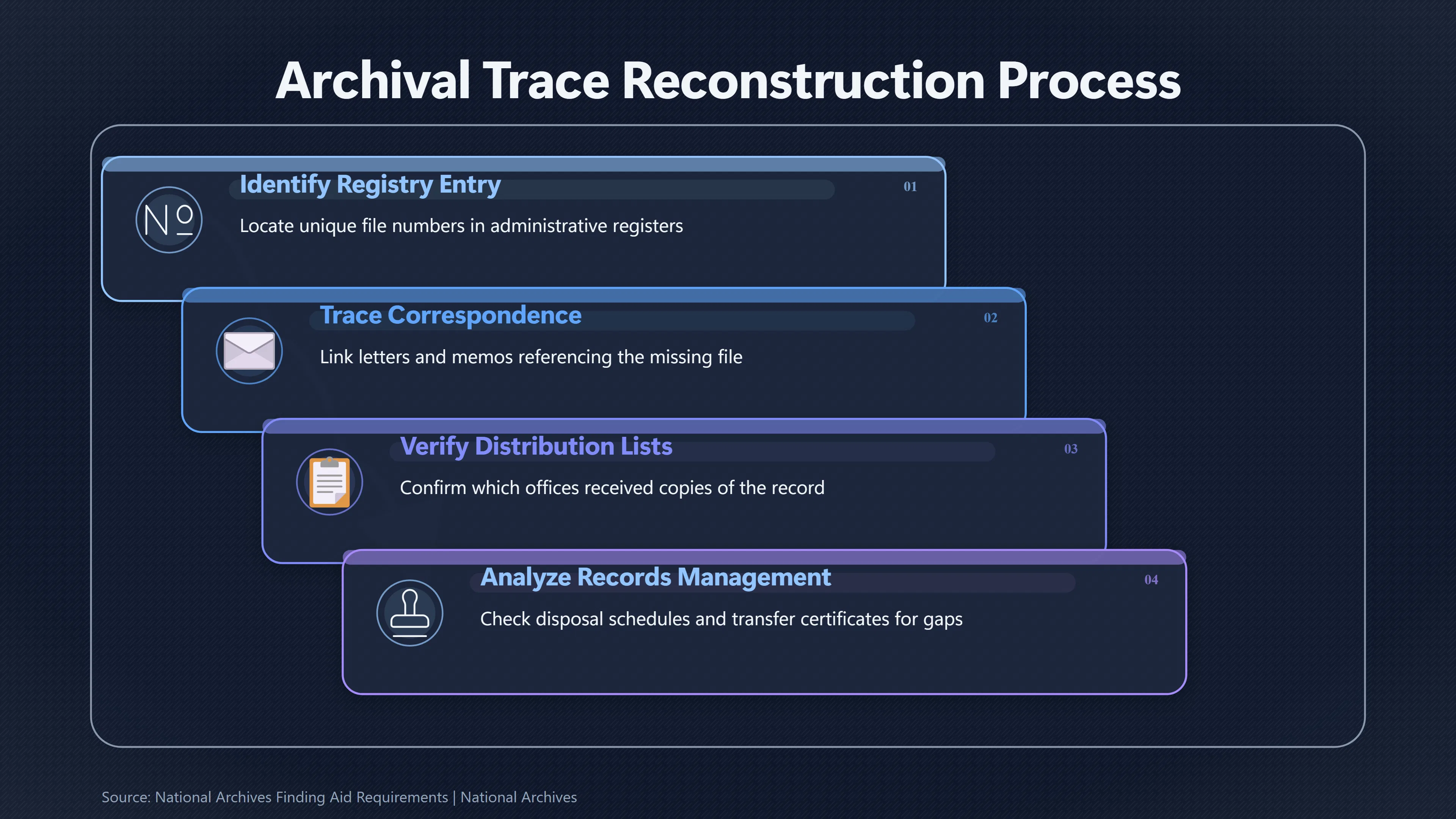
Contemporaneous indexes and file registers
The strongest evidence usually comes from records created at the same time as the missing file itself.
Government agencies routinely maintained indexes, accession logs and filing systems so officials could retrieve documents efficiently. These administrative tools often survive even when individual files do not.
For example, a file register may record:
- the assigned file number;
- the document’s title or subject;
- the originating office;
- dates of creation and movement;
- later transfer or disposal information.
Because these registers were created for administrative purposes rather than public debate, historians generally regard them as more reliable than later recollections.
National archival guidance likewise requires detailed finding aids, folder lists and related documentation when permanent records are transferred. Those finding aids frequently become independent evidence that particular files once formed part of an official record series.[National Archives]archives.govNational Archives Finding Aid Requirements | National ArchivesNational ArchivesFinding Aid Requirements | National ArchivesSeptember 19, 2023…
In archival investigations concerning alleged UFO crashes, discovering a file number without the corresponding folder is often more significant than finding an isolated anecdote, because the numbering system demonstrates that an identifiable record occupied a defined place within an official filing structure.
Amazon book picks
Further Reading
Books and field guides related to How Can You Prove a Lost UFO File Existed?. Use these as the next step if you want deeper reading beyond the article.
UFOs and Government: A Historical Inquiry
Governments around the world have had to deal with the UFO phenomenon for a good part of a century. How and why they did so is the subjec...
Going to the Sources: A Guide to Historical Research and Writing
It’s been almost 30 years since the first edition of Going to the Sources: A Guide to Historical Research and Writing was first published...
The Modern Researcher
This classic introduction to the techniques of research and the art of expression is used widely in historiography courses, but is also a...
From Reliable Sources: An Introduction to Historical Methods
A lively introduction to historical methodology, an overview of the techniques historians must master in order to reconstruct the past.
eBay marketplace picks
Marketplace Samples
Live-tested eBay searches with available results related to this page.
Selected fromUFO poster oneBay.co.uk.


Current eBay listing
I Want To Believe UFO Poster Giclée Fine Art Heavyweight Print


Current eBay listing
VINTAGE UFO FLYING SAUCERS COMIC ADVERTISING A2 POSTER PRINT
References preserved in surviving correspondence
A missing report often survives indirectly because other officials discussed it.
Letters, memoranda and routing slips may include wording such as:
- “As noted in report 17…”
- “Please see attached investigation.”
- “Reference your memorandum of 8 July…”
- “Forwarding copy for review.”
Even if the attachment has disappeared, the surrounding correspondence confirms that it once existed.
This kind of indirect documentation becomes especially persuasive when several offices independently refer to the same document. If headquarters, a field office and another agency each mention receiving the same report, the probability that the report was ever fictional becomes extremely small.
Investigators therefore reconstruct document histories by linking these scattered references into a chronological chain. Each surviving reference reduces uncertainty about whether a document was actually created.
Copies, quotations and parallel filing systems
Government correspondence was rarely unique.
Many twentieth-century offices produced:
- carbon copies;
- office copies;
- distribution copies;
- microfilm reproductions;
- later certified copies.
A missing original may therefore survive elsewhere.
Investigators also compare parallel filing systems. One office may have destroyed its copy while another retained the identical correspondence. Military headquarters, intelligence agencies, local commands and civilian departments frequently maintained overlapping collections.
Sometimes only quotations survive. A later memorandum may reproduce several paragraphs from an earlier report now believed lost. Although incomplete, such quotations demonstrate both the report’s existence and at least part of its contents.
This explains why archival researchers rarely stop searching after one unsuccessful records request. They follow every documented distribution path to determine whether another recipient preserved a duplicate.
Records-management documentation can explain the disappearance
Once investigators establish that a file existed, the next question becomes why it is missing.
Records-management evidence is often more informative than speculation.
Researchers examine:
- approved disposal schedules;
- transfer forms;
- accession records;
- destruction certificates;
- retention authorities;
- archival correspondence concerning missing boxes.
If documentation shows that the file series was legally destroyed under an authorised retention schedule, the disappearance may reflect ordinary administration rather than concealment.
Conversely, if a register records a file that should have been transferred permanently but no transfer record or destruction authority exists, the gap deserves closer scrutiny.
The absence of required records-management paperwork is therefore evidence about recordkeeping, not necessarily about the underlying UFO claim.
The role of FOIA responses
Freedom of Information Act (FOIA) requests frequently reveal important metadata even when agencies cannot locate the requested file.
An agency may acknowledge:
- the existence of a file designation;
- relevant index entries;
- searches of specific record systems;
- transfers to another repository;
- destruction under an approved schedule;
- inability to account for missing records.
For example, the FBI explains that most of its records are indexed within its Central Records System and that researchers often need those file designations before records transferred to the National Archives can be located. Likewise, the FBI’s electronic FOIA library demonstrates how indexed records may survive even when researchers continue searching for related material.[fbi.gov]fbi.govFreedom of Information/Privacy Act — FBIFreedom of Information/Privacy Act — FBI…
For UFO researchers, these administrative responses can establish that a file number or case record existed even when the underlying documents remain unavailable.
Why witness testimony alone is usually insufficient
Former officials sometimes recall preparing reports that cannot now be found.
Such testimony can be valuable, particularly when the witness had direct responsibility for creating or filing records. Nevertheless, historians generally seek documentary corroboration before concluding that a specific government file once existed.
Records officers, archivists and clerical staff can be especially important witnesses because they explain:
- how documents were numbered;
- whether duplicate copies were routinely created;
- how transfers occurred;
- whether files were known to have been misplaced or destroyed.
When their descriptions match surviving registers or correspondence, confidence in the reconstructed record history increases substantially.
What proving existence does—and does not—show
Demonstrating that a missing UFO-related file once existed is a meaningful archival finding, but its significance has clear limits.
It can show:
- an identifiable document was created;
- it occupied a recognised place within an official filing system;
- other officials referred to it;
- later recordkeeping became incomplete.
It cannot, by itself, prove:
- the file concerned an extraterrestrial craft;
- officials removed it to conceal extraordinary evidence;
- later witness accounts accurately describe its contents.
For investigations into alleged UFO crashes, the strongest cases are therefore built from converging archival traces rather than from the absence of a single folder. A documented index entry, corroborating correspondence, surviving copies and consistent records-management evidence together can establish that a specific file once existed. What remains unresolved is the separate—and much harder—question of what that missing file actually contained.
Endnotes
1.
Source: archives.gov
Title: National Archives Finding Aid Requirements | National Archives
Link:https://www.archives.gov/records-mgmt/accessioning/finding-aid.html
Source snippet
National ArchivesFinding Aid Requirements | National ArchivesSeptember 19, 2023...
Published: September 19, 2023
2.
Source: archives.gov
Link:https://www.archives.gov/research/investigations/fbi/access
Source snippet
Accessing Federal Bureau of Investigation Records (RG 65) | National ArchivesFebruary 27, 2020 — ACCESSING FEDERAL BUREAU OF INVESTIGATIO...
Published: February 27, 2020
3.
Source: fbi.gov
Title: Freedom of Information/Privacy Act — FBI
Link:https://www.fbi.gov/how-we-can-help-you/more-fbi-services-and-information/freedom-of-information-privacy-act/
Source snippet
Freedom of Information/Privacy Act — FBI...
4.
Source: vault.fbi.gov
Title: — Federal Bureau of Investigation
Link:https://vault.fbi.gov/foia
Source snippet
FBI — Federal Bureau of Investigation...
5.
Source: fbi.gov
Title: inside the fbi podcast preserving bureau history
Link:https://www.fbi.gov/news/podcasts/inside-the-fbi-podcast-preserving-bureau-history
Source snippet
It has a mysterious, energetic feel. The track is driven by what sounds like drums and keyboard, and features synthesizers.] Dr. Fox: Wel...
6.
Source: archives.gov
Title: How to File a Freedom of Information Act (FOIA) Request | National Archives
Link:https://www.archives.gov/research/foia/file-foia-request
Source snippet
April 16, 2024 — HOW TO FILE A FREEDOM OF INFORMATION ACT (FOIA) REQUEST Because of their age, most records in the National Archives' arc...
Published: April 16, 2024
7.
Source: archives.gov
Title: Finding Aid | National Archives
Link:https://www.archives.gov/records-mgmt/accessioning/finding-aid
Source snippet
In most cases, the finding aid should take the form of a folder title list. Per 36 CFR 1232.16 permanent rec...
8.
Source: fbi.gov
Title: new efoipa system
Link:https://www.fbi.gov/news/stories/new-efoipa-system
9.
Source: fbi.gov
Title: ufos and the guy hottel memo
Link:https://www.fbi.gov/news/stories/ufos-and-the-guy-hottel-memo
10.
Source: fbi.gov
Title: new records vault comes online
Link:https://www.fbi.gov/news/stories/new-records-vault-comes-online/
11.
Source: fbi.gov
Link:https://www.fbi.gov/how-we-can-help-you/more-fbi-services-and-information/freedom-of-information-privacy-act/vault
12.
Source: vault.fbi.gov
Link:https://vault.fbi.gov/%0A/interact.sh/
13.
Source: vault.fbi.gov
Link:https://vault.fbi.gov/search?SearchableText=roswell&b_start%3Aint=60
14.
Source: vault.fbi.gov
Link:https://vault.fbi.gov/Roswell%2520UFO
15.
Source: media.nationalarchives.gov.uk
Link:https://media.nationalarchives.gov.uk/index.php/ufo-files-national-archives/
16.
Source: nationalarchives.gov.uk
Title: colonies dependencies further research
Link:https://www.nationalarchives.gov.uk/help-with-your-research/research-guides/colonies-dependencies-further-research/
17.
Source: nationalarchives.gov.uk
Link:https://www.nationalarchives.gov.uk/help-with-your-research/research-guides/colonies-and-dependencies-1850-1926-using-colonial-office-registers-to-locate-correspondence/
18.
Source: nationalarchives.gov.uk
Title: home office correspondence 1782 1979
Link:https://www.nationalarchives.gov.uk/help-with-your-research/research-guides/home-office-correspondence-1782-1979/
19.
Source: nationalarchives.gov.uk
Title: Misfiled items
Link:https://www.nationalarchives.gov.uk/about-us/how-we-work/transparency/misfiled-items/
20.
Source: nationalarchives.gov.uk
Title: treasury board letters papers 1557 1920
Link:https://www.nationalarchives.gov.uk/help-with-your-research/research-guides/treasury-board-letters-papers
Additional References
21.
Source: disclosurearchives.com
Title: fbi flying disc master file 1947 1968
Link:https://disclosurearchives.com/events/fbi-flying-disc-master-file
Source snippet
FBI 62-HQ-83894: the master 'flying disc' file, 1947–1968 · Disclosure ArchivesMay 8, 2026 — Document Release Records: 1947–1968 · Releas...
Published: May 8, 2026
22.
Source: youtube.com
Link:https://www.youtube.com/watch?v=ogJplVuElLs
Source snippet
We Found Missing Evidence from the Weirdest UFO Encounter | Episode 21 | Haunted Objects Podcast...
23.
Source: youtube.com
Title: Project [Blue Book]({{ ‘blue-book/’ | relative_url }})
Link:https://www.youtube.com/watch?v=_xyesq1k3Ns
Source snippet
A secret history: Inside shadow intelligence, the MJ-12 documents | Reality Check...
Published: December 2021
24.
Source: youtube.com
Title: Top UFO Investigator Reveals What they REALLY Found at Roswell | UAP Gerb
Link:https://www.youtube.com/watch?v=cyEvNIAMXo0
Source snippet
Explosive Proof the Government Hid UFOs for 80 Years...
25.
Source: nsa.gov
Link:https://www.nsa.gov/serve-from-netstorage/news-features/declassified-documents/index.html
26.
Source: ssa.gov
Link:https://www.ssa.gov/history/archives/nara/FEDRecords.htm
27.
Source: ssa.gov
Link:https://www.ssa.gov/history/archives/nara/FindingAids.htm
28.
Source: ssa.gov
Link:https://www.ssa.gov/history/archives/nara/NARAfiles.htm
29.
Source: loc.gov
Link:https://www.loc.gov/research-centers/manuscript/researcher-resources/finding-aids/using-finding-aids/
30.
Source: youtube.com
Link:https://www.youtube.com/watch?v=MaKZPy9NPYk