Within Proof Standard
What Ordinary Object Could This Debris Be?
Alleged crash material must be tested against aircraft parts, meteorites, rockets, industrial waste and known manufacturing processes before exotic claims.
On this page
- Comparing alloys with aerospace and industrial materials
- Identifying meteorites, re entry debris and balloon hardware
- Handling the limits of classified terrestrial technology
Page outline Jump by section
Introduction
A claim that crash debris came from a non-human craft cannot be supported simply because a fragment looks unusual or its exact origin is unknown. Before any extraordinary explanation is considered, investigators must systematically eliminate ordinary ones. That means comparing the material against aircraft alloys, rocket and satellite hardware, meteorites, balloon components, industrial waste, manufacturing by-products and other terrestrial sources using established forensic and materials-science methods. If a specimen matches a known alloy, manufacturing process or natural geological material, the burden of proof shifts back to the claimant. Even when no exact source is identified, “unidentified” is not equivalent to “extraterrestrial”. Modern forensic practice treats exclusion of conventional explanations as a prerequisite rather than an optional step.[AARO]aaro.milSynopsis: Analysis of a Metallic SpecimenSynopsis: Analysis of a Metallic SpecimenJuly 10, 2024…
What Ordinary Object Could This Debris Be?
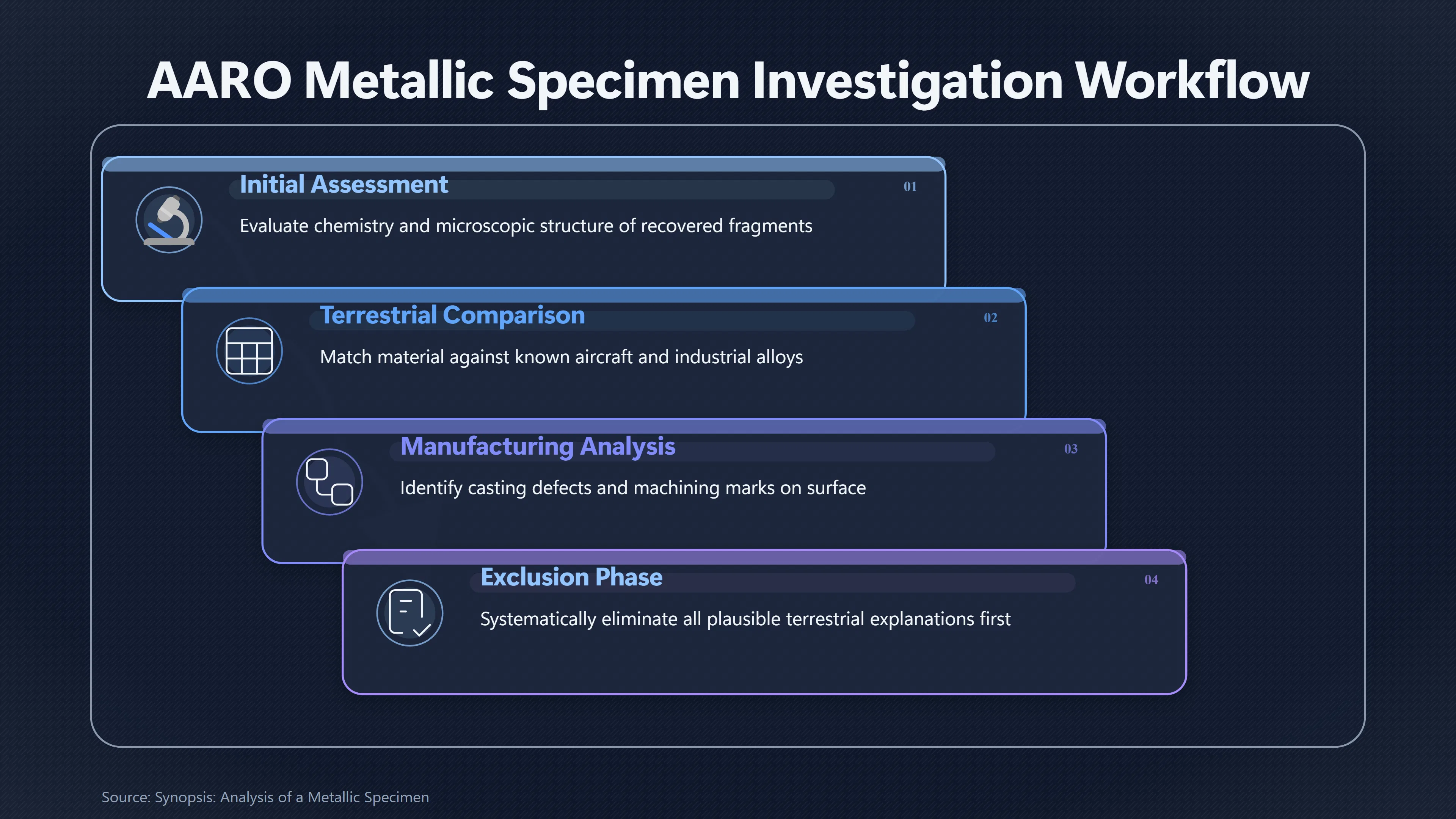
The first question specialists ask is not whether an object is exotic, but whether it resembles something already found on Earth. This process relies on comparison rather than speculation. Every recovered fragment is assessed for its chemistry, microscopic structure, manufacturing marks, corrosion patterns and physical behaviour before broader conclusions are drawn.
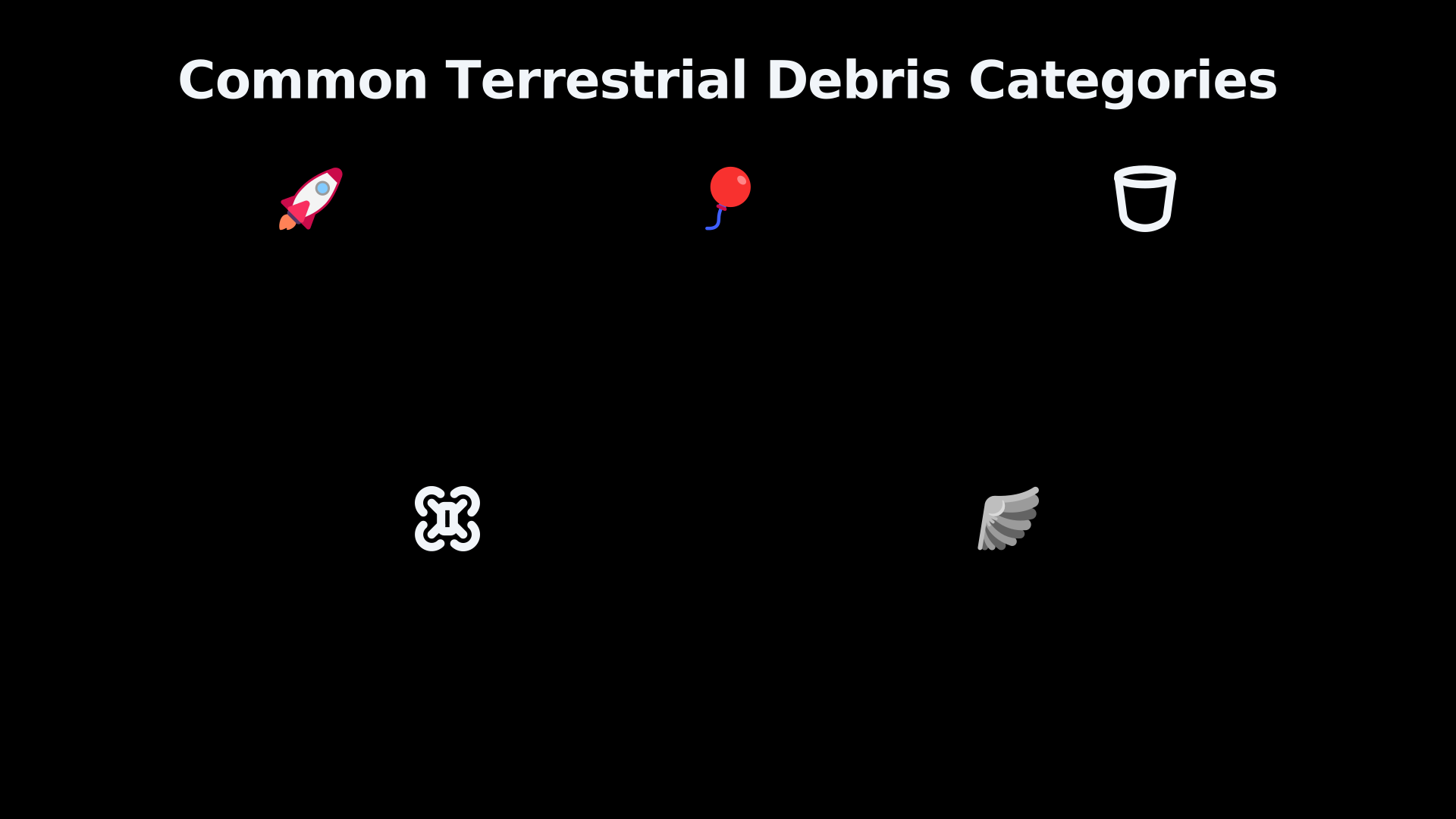
A convincing investigation attempts to explain the material using the simplest plausible terrestrial source first. Common candidates include:
- Aircraft structural components and engine parts.
- Rocket stages, satellites and atmospheric re-entry debris.
- Weather balloons and high-altitude research equipment.
- Meteorites and naturally occurring minerals.
- Industrial castings, machining offcuts and metallurgical waste.
- Military training debris or experimental hardware.
- Modern composites, ceramics and advanced commercial materials.
Only after these categories have been rigorously examined without success would investigators have reason to consider more unusual possibilities.
Comparing Alloys with Aerospace and Industrial Materials
Most alleged UFO fragments ultimately undergo conventional materials characterisation. Laboratories determine elemental composition using spectroscopy, examine crystal structure through electron microscopy and measure isotope ratios to establish whether the constituent elements are consistent with terrestrial manufacture.
Matching composition alone is rarely enough. Investigators also compare:
- Grain size and crystal growth.
- Heat-treatment signatures.
- Casting defects.
- Machining marks.
- Welding or brazing residues.
- Oxidation layers.
- Residual stresses from manufacturing.
These features often reveal how an object was produced. For example, pores, shrinkage cavities and dendritic crystal structures indicate conventional casting processes rather than unknown fabrication methods. Likewise, alloy compositions can frequently be matched with published aerospace or industrial standards.
A useful recent example comes from analyses commissioned by the US All-domain Anomaly Resolution Office (AARO). Oak Ridge National Laboratory examined metallic specimens that had been promoted as potentially anomalous. In one case, the laboratory concluded that the material was terrestrial and lacked the structure required for the claimed exotic electromagnetic properties. In another, a supposedly unusual aluminium specimen proved consistent with ordinary aluminium-silicon casting alloys used in conventional manufacturing.[AARO]aaro.milSynopsis: Analysis of a Metallic SpecimenSynopsis: Analysis of a Metallic SpecimenJuly 10, 2024…
How Meteorites Are Distinguished from Manufactured Objects
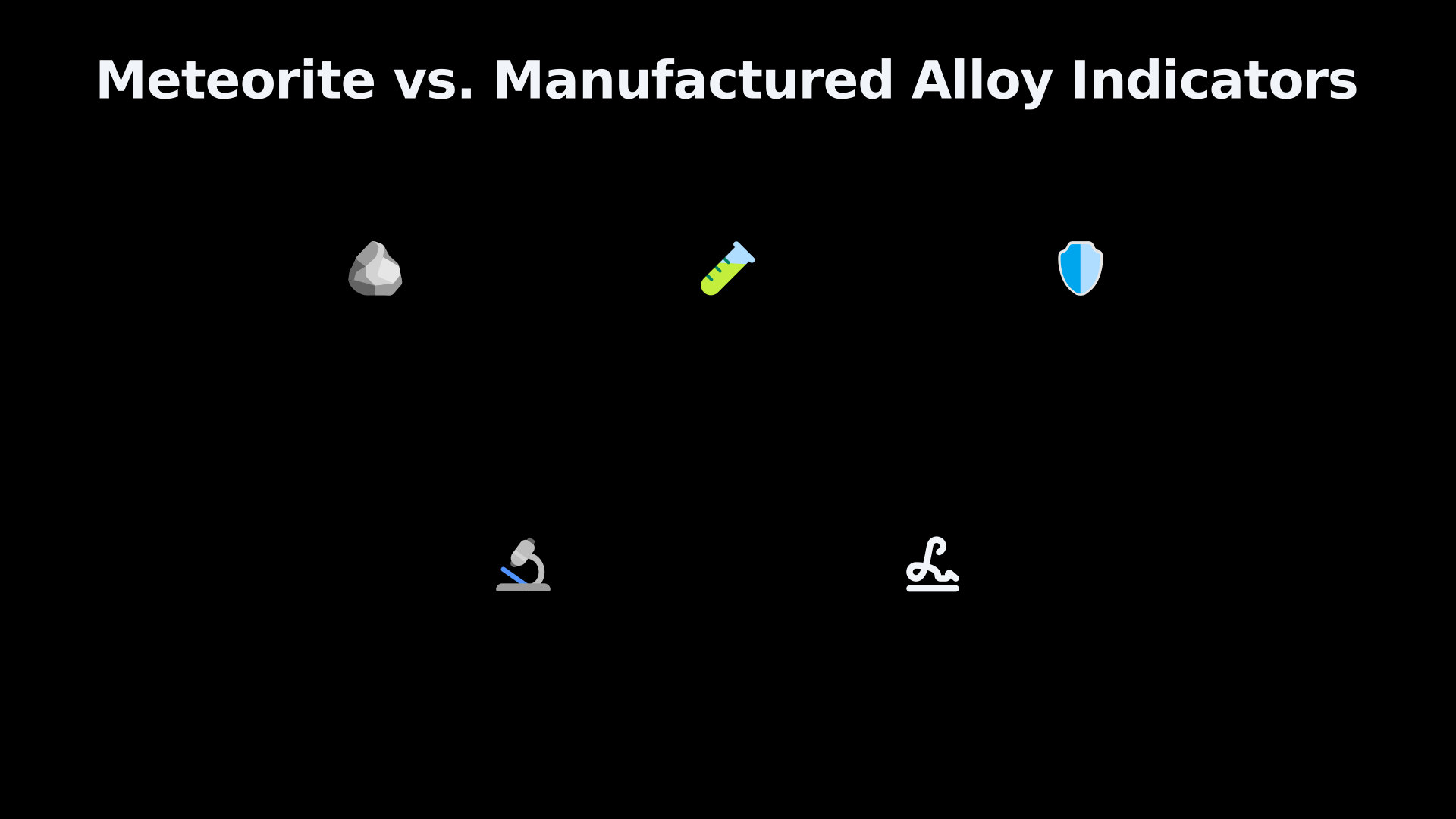
Metallic objects recovered after a reported aerial event are sometimes mistaken for meteorites. Planetary scientists use several independent tests to separate natural space rocks from manufactured materials.
Important indicators include:
- Mineralogy. Meteorites contain characteristic mineral assemblages that differ from industrial alloys.
- Nickel content. Iron meteorites typically contain distinctive iron-nickel compositions unlike most engineering steels.
- Fusion crust. Genuine meteorites usually develop a thin melted exterior during atmospheric entry.
- Internal texture. Some iron meteorites display Widmanstätten patterns formed by extremely slow cooling inside parent asteroids over millions of years.
- Isotopic measurements. Oxygen and other isotope systems help identify extraterrestrial geological origins.
Meteorites are therefore recognised through a combination of geological, chemical and structural evidence rather than appearance alone. Conversely, manufactured alloys often contain processing features impossible to produce through natural planetary formation.[NASA Science]science.nasa.govScience Meteors and Meteorites: FactsNASA ScienceMeteors and Meteorites: Facts - NASA Science…
Recognising Re-entry Debris and Balloon Hardware
Space hardware returning through Earth’s atmosphere can produce debris fields that appear unfamiliar to non-specialists. Re-entry fragments often include:
- Titanium pressure vessels.
- Heat-resistant ceramics.
- Carbon-fibre composites.
- Aluminium honeycomb structures.
- Insulation foams.
- Wiring bundles and electronic assemblies.
These materials may show melting, ablation or fragmentation caused by atmospheric heating rather than impact alone.
Weather balloons and scientific balloons can also leave debris that initially appears mysterious. Latex, polyethylene film, lightweight aluminium fittings, radar reflectors and instrument packages have repeatedly been mistaken for more exotic objects because they are encountered unexpectedly and often damaged by weather or impact.
Investigators compare suspected debris against catalogues of aerospace hardware, known satellite components and documented balloon systems before concluding that a fragment represents an unknown technology.
Manufacturing Processes Often Explain “Impossible” Materials
Claims of extraordinary materials sometimes rely on unusual layering, purity or microstructure. However, modern metallurgy routinely produces combinations that appear surprising outside specialist fields.
Examples include:
- Powder metallurgy.
- Additive manufacturing.
- Diffusion bonding.
- Directional solidification.
- Thin-film deposition.
- Vacuum casting.
- Electron-beam welding.
Many complex layered materials once regarded as mysterious are now recognised as products of ordinary industrial techniques. Even if investigators cannot identify the exact factory or manufacturer, they may still determine that the production method is entirely consistent with known engineering.
The AARO-sponsored analyses illustrate this distinction. Although investigators could not always reconstruct the complete manufacturing history of a specimen, they found no evidence requiring non-terrestrial technology. Instead, observed features were compatible with conventional alloys, industrial processing and aerospace materials research.[AARO]aaro.milSupplement to Oak Ridge National Laboratory’s Analysis of a Metallic SpecimenAARO Supplement to Oak Ridge National Laboratory’s Analysis of a Metallic Specimen…
Could Classified Human Technology Be Mistaken for Something Alien?
One genuine complication is that investigators may encounter hardware from classified military or intelligence programmes. An unusual material may therefore be unfamiliar even to experienced scientists.
This possibility changes the interpretation but not the investigative method.
Experts continue by asking:
- Does the chemistry fit known engineering materials?
- Can the manufacturing process be reproduced using current technology?
- Are there design features associated with aerospace engineering?
- Does the object exhibit realistic mechanical properties?
- Are there signs of terrestrial machining or fabrication?
An inability to identify the exact programme or manufacturer does not justify concluding that the object is extraterrestrial. Classified technology remains a terrestrial explanation until evidence demonstrates otherwise.
This distinction is reflected in official UAP investigations, which recognise that some reports may involve sensitive defence activities while also reporting no verified evidence of recovered extraterrestrial technology.[AARO]aaro.milUnclassified Final DSD AARO Historical ReportUnclassified Final DSD AARO Historical Report…
Why Failure to Find a Match Is Not Positive Evidence
Perhaps the most common misunderstanding is that an unidentified object becomes evidence for alien technology once experts cannot immediately identify it.
Scientific reasoning works differently.
A fragment may remain unidentified because:
- The sample is incomplete.
- Provenance is uncertain.
- Weathering has altered its chemistry.
- Manufacturing records no longer exist.
- Multiple terrestrial explanations remain equally plausible.
- The evidence is insufficient for definitive classification.
These situations justify an “unknown” label, not an extraterrestrial one. Positive identification requires evidence supporting a specific origin, whereas failure to identify only reflects incomplete knowledge.
For this reason, forensic investigations treat the systematic elimination of ordinary explanations as a necessary but not sufficient condition. Even if every common terrestrial source could be ruled out, investigators would still need additional evidence—secure provenance, documented recovery, independent laboratory confirmation and reproducible analyses—before concluding that debris originated from a genuinely extraordinary source.
Amazon book picks
Further Reading
Books and field guides related to What Ordinary Object Could This Debris Be?. Use these as the next step if you want deeper reading beyond the article.
Materials Selection in Mechanical Design
Understanding materials, their properties and behavior is fundamental to engineering design, and a key application of materials science....
Rocks from Space
Appendices A-C: Meteorite verification laboratories, Commercial meteorite dealers, Selected list of suspected impact craters worldwide.
Meteorites: A Petrologic, Chemical and Isotopic Synthesis
Meteorite research is fundamental to our understanding of the origin and early history of the Solar System. Some meteorites were produced...
eBay marketplace picks
Marketplace Samples
Live-tested eBay searches with available results related to this page.
Selected fromspace debris display oneBay.co.uk.




Endnotes
1.
Source: aaro.mil
Title: Synopsis: Analysis of a Metallic Specimen
Link:https://www.aaro.mil/Portals/136/PDFs/Information%20Papers/ORNL-Synopsis_Analysis_of_a_Metallic_Specimen.pdf?ver=V1rMXfRV-VUb2gjTd4DzVg%3D%3D
Source snippet
Synopsis: Analysis of a Metallic SpecimenJuly 10, 2024...
Published: July 10, 2024
2.
Source: aaro.mil
Title: Synopsis: Analysis of an Aluminum Specimen
Link:https://www.aaro.mil/Portals/136/PDFs/Information%20Papers/ORNL_ANALYSIS_OF_AN_ALUMINUM_SPECIMEN.pdf
Source snippet
Synopsis: Analysis of an Aluminum Specimen...
3.
Source: science.nasa.gov
Title: Science Meteors and Meteorites: Facts
Link:https://science.nasa.gov/solar-system/meteors-meteorites/facts/
Source snippet
NASA ScienceMeteors and Meteorites: Facts - NASA Science...
4.
Source: aaro.mil
Title: Supplement to Oak Ridge National Laboratory’s Analysis of a Metallic Specimen
Link:https://www.aaro.mil/Portals/136/PDFs/Information%20Papers/AARO_Metallic_Materials_Analysis_Supplement_Jan2026.pdf
Source snippet
AARO Supplement to Oak Ridge National Laboratory’s Analysis of a Metallic Specimen...
5.
Source: aaro.mil
Title: ‘s Supplement to Oak Ridge National Laboratory’s Analysis of a Metallic Specimen
Link:https://www.aaro.mil/Portals/136/PDFs/Information%20Papers/AAROs_Supplement_to_ORNLs_Analysis_of_a_Metallic_Specimen.pdf?ver=sz9XCNLG8heNHWXWQJiLgw%3D%3D
Source snippet
AARO's Supplement to Oak Ridge National Laboratory's Analysis of a Metallic Specimen...
6.
Source: aaro.mil
Title: Unclassified Final DSD AARO Historical Report
Link:https://www.aaro.mil/Portals/136/PDFs/AARO_Historical_Record_Report_Vol_1_2024.pdf?emci=622cd777-b774-f011-8dc9-6045bda9d96b&emdi=ea000000-0000-0000-0000-000000000001&sourceid=1070813
Source snippet
Unclassified Final DSD AARO Historical Report...
7.
Source: aaro.mil
Title: UAP Records
Link:https://www.aaro.mil/UAP-Records/fbclid/IwZXh0bgNhZW0CMTEAAR0F9nbI4TTQyu8d96BuOtBb1uVQuvapZEvLug7mWxQC4ZqlNDrM5_ejMt4_aem_q0czZMebJdVWJ-6XDLdWAA/
Source snippet
AARO UAP Records...
8.
Source: astrobiology.nasa.gov
Title: a story of a meteorites voyage to earth
Link:https://astrobiology.nasa.gov/news/a-story-of-a-meteorites-voyage-to-earth/
9.
Source: planetary.msfc.nasa.gov
Title: Meteorites and Craters
Link:https://planetary.msfc.nasa.gov/Meteorites_and_Craters.html
10.
Source: aaro.mil
Link:https://www.aaro.mil/Next-AARO-Home-redesign/Inactive-Parent/Next-AARO-UAP-DT-Records/
11.
Source: aaro.mil
Link:https://www.aaro.mil/
12.
Source: ares.jsc.nasa.gov
Title: what are meteorites
Link:https://ares.jsc.nasa.gov/meteorite-falls/what-are-meteorites/
13.
Source: jpl.nasa.gov
Title: fast facts
Link:https://www.jpl.nasa.gov/asteroid-watch/fast-facts/
Additional References
14.
Source: legalclarity.org
Title: ufo material government programs lab results and [roswell]({{ ‘roswell/’ | relative_url }})
Link:https://legalclarity.org/ufo-material-government-programs-lab-results-and-roswell/
Source snippet
UFO Material: Government Programs, Lab Results, and Roswell - LegalClarityJuly 5, 2026 — THE KONA BLUE PROPOSAL After the DIA program end...
Published: July 5, 2026
15.
Source: hjkc.de
Title: Raumfahrt+Astronomie-Blog von CENAP
Link:https://www.hjkc.de/_blog/27064-ufo-forschung-the-pentagon-s-ufo-report-update-152-aaro-synopsis-analysis-of-an-aluminum-specimen/
Source snippet
März 2026 - 19:00 UFO-Forschung - The Pentagon’s UFO Report -Update-152 - AARO: SYNOPSIS: Analysis of an Aluminum Specimen 27.03.2026 Ima...
16.
Source: arxiv.org
Link:https://arxiv.org/abs/2107.07909
17.
Source: youtube.com
Link:https://www.youtube.com/watch?v=J6xtxZwrGLY
Source snippet
Art's Parts 1: UFO Crash Recovery Material Analysis...
18.
Source: youtube.com
Title: Art’s Parts 1: UFO Crash Recovery Material Analysis
Link:https://www.youtube.com/watch?v=f1LylzKZC-U
Source snippet
The Llanilar UFO Crash & Material Sample...
19.
Source: youtube.com
Title: The Llanilar UFO Crash & Material Sample
Link:https://www.youtube.com/watch?v=5w5NHFPg7W8
Source snippet
Art's Parts UFO Metallurgy & Propulsion Experiments...
20.
Source: youtube.com
Title: Art’s Parts UFO Metallurgy & Propulsion Experiments
Link:https://www.youtube.com/watch?v=5tLN3K8rvfE
Source snippet
Garry Nolan: UFOs and Aliens...
21.
Source: en.wikisource.org
Title: Page:AARO Historical Record Report Volume 1 2024
Link:https://en.wikisource.org/wiki/Page%3AAARO_Historical_Record_Report_Volume_1_2024.pdf/33
22.
Source: youtube.com
Title: Garry Nolan: UFOs and Aliens
Link:https://www.youtube.com/watch?v=uTCc2-1tbBQ
23.
Source: en.wikisource.org
Title: Section 5
Link:https://en.wikisource.org/wiki/Report_on_the_Historical_Record_of_U.S._Government_Involvement_with_Unidentified_Anomalous_Phenomena/Volume_1/Section_5