Within Field Protocol
Is the Viral Crash Clip Still Verifiable?
Original files, device clocks, transfer records and surrounding footage can determine whether a striking clip remains scientifically useful.
On this page
- Obtaining originals instead of social copies
- Preserving metadata, audio and adjacent footage
- Hashing files and documenting every transfer
Page outline Jump by section
Introduction
In any investigation of a reported UFO crash, witness photographs and videos are only as valuable as their provenance. A dramatic clip circulating on social media may attract attention, but once it has been compressed, cropped, re-encoded or stripped of metadata, much of its evidential value may already have been lost. The priority is therefore not to collect the most widely shared version, but to secure the earliest available original recording directly from the device or service that created it. Original files preserve technical information about timing, recording parameters, file structure and, in some cases, location data that investigators can examine alongside witness testimony. Those details often determine whether a recording can be independently tested or whether it has become impossible to verify.[SWGDE - SWGDE]swgde.orgBest Practices for Digital Video AuthenticationSWGDEBest Practices for Digital Video Authentication - SWGDEMarch 7, 2024…
Is the Viral Crash Clip Still Verifiable?
A viral upload is rarely the best evidence. Most social platforms routinely recompress media, change filenames, remove or alter metadata and sometimes modify frame rates or image dimensions. Even if the visible content appears unchanged, the technical information needed for forensic examination may no longer exist.[SWGDE - SWGDE]swgde.orgBest Practices for Digital Video AuthenticationSWGDEBest Practices for Digital Video Authentication - SWGDEMarch 7, 2024…
For that reason, investigators should regard public uploads primarily as leads rather than as primary evidence. The objective is to identify:
- the first person who recorded the event;
- every person who subsequently received or copied the file;
- whether cloud backups contain an earlier version;
- whether additional recordings from the same witness exist before or after the widely circulated clip.
Many recordings that become famous online represent only a few seconds extracted from a much longer sequence. Recovering the complete recording often reveals context that was omitted from the viral version, including camera movement, environmental sounds or mundane explanations that cannot be seen in the edited excerpt.
Obtaining the Original Rather Than a Social Copy
The most reliable source is the file stored on the recording device or its original cloud backup rather than a messaging application, screenshot or downloaded social-media copy.
When obtaining witness media, investigators should request:
- the original image or video file without editing;
- the complete recording rather than a selected highlight;
- any burst photographs or Live Photos captured at the same time;
- files immediately before and after the reported event;
- the original transfer method used when sharing the material.
Adjacent recordings are frequently as informative as the principal clip. A witness may have begun recording before noticing the alleged crash or continued filming afterwards while lowering the camera, speaking to companions or showing surrounding landmarks. Those additional moments can establish viewing direction, lighting, weather, camera orientation and the witness’s own reactions more reliably than an isolated excerpt.
If cloud synchronisation is enabled, investigators should avoid workflows that automatically export reduced-quality copies when the full-resolution original remains available. Digital evidence guidance consistently recommends preserving native files in their original format whenever possible.[SWGDE - SWGDE]swgde.orgBest Practices for Digital Evidence CollectionSWGDEBest Practices for Digital Evidence Collection - SWGDE…
Why Metadata Matters More Than It Appears
Original media frequently contain metadata that cannot be reconstructed after it has been removed.
Depending on the device and file format, investigators may recover information such as:
- date and time recorded;
- camera make and model;
- image resolution and frame rate;
- codec and compression settings;
- exposure information;
- GPS coordinates, if enabled;
- software that subsequently modified the file.
However, metadata should never be treated as definitive proof by itself. Some fields are easily altered, different manufacturers store information differently, and video formats do not have a universal metadata standard equivalent to EXIF for still photographs. Professional forensic guidance therefore recommends comparing metadata with the internal structure of the file, witness statements and other independent evidence rather than relying on metadata alone.[SWGDE - SWGDE]swgde.orgBest Practices for Digital Video AuthenticationSWGDEBest Practices for Digital Video Authentication - SWGDEMarch 7, 2024…
A discrepancy is not automatically evidence of deception. For example:
- incorrect device clocks may produce inaccurate timestamps;
- copied files may receive new filesystem dates;
- messaging applications often create entirely new files;
- editing software may legitimately rewrite technical metadata.
The important question is whether the complete body of evidence remains internally consistent.
Preserve Audio and the Footage Around the Event
Visual imagery naturally attracts attention, yet audio often contains equally valuable evidence.
Original recordings may capture:
- reactions from multiple witnesses;
- references to direction or distance;
- aircraft engines or helicopters;
- weather conditions;
- emergency vehicles;
- camera handling noises that reveal when recording began or ended.
Cropping a clip to remove “unimportant” material may eliminate precisely the contextual evidence needed to reconstruct events.
Similarly, investigators should preserve footage recorded immediately before and after the reported incident. These surrounding sequences may show:
- the witness locating the object;
- camera zoom changes;
- landmarks useful for geolocation;
- lighting conditions before any alleged impact;
- other people observing the same event.
A seemingly ordinary thirty seconds before the dramatic moment may contribute more to later verification than the striking frames themselves.
Device Clocks and Timing Should Be Documented
Consumer devices do not always maintain perfectly accurate clocks.
Investigators should therefore document:
- the displayed device time;
- whether automatic network time synchronisation was enabled;
- the witness’s account of when recording occurred;
- the time files were transferred;
- any known travel across time zones.
When several witnesses independently record the same event, comparing their timelines may reveal whether clocks differ by seconds or minutes. Such offsets can often be corrected during reconstruction, but only if the original information has been preserved.
Synchronising witness recordings with external references—such as emergency service dispatch times, publicly available weather observations or known aircraft movements—may also help establish a more reliable chronology without depending solely on camera timestamps.
Hash Every Original File Before Analysis
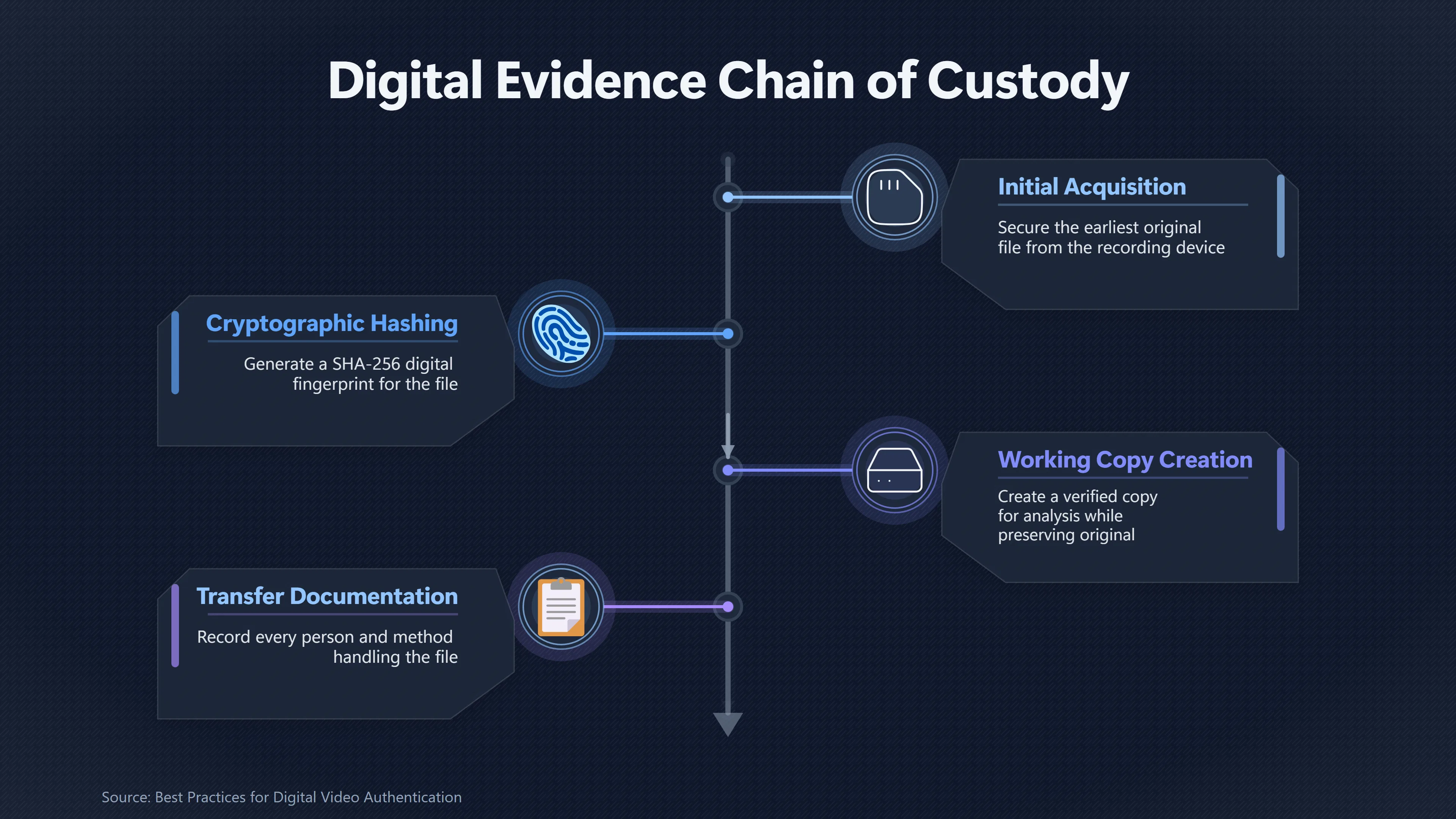
Before examining or distributing a witness file, investigators should create a cryptographic hash value such as SHA-256.
A hash functions as a digital fingerprint:
- identical files generate identical hashes;
- any alteration produces a different result;
- later investigators can confirm whether a file remained unchanged.
Good forensic practice is to hash the original immediately after acquisition, create a verified working copy for analysis and preserve the untouched original in secure storage. Verification hashes can then demonstrate that later examinations were conducted on exact copies rather than modified files.[SWGDE - SWGDE]swgde.orgBest Practices for Digital Evidence CollectionSWGDEBest Practices for Digital Evidence Collection - SWGDE…
Hashing does not prove that a recording depicts what it claims to show. It demonstrates that the particular file being examined has not changed since it entered evidence.

Every Transfer Should Leave a Paper Trail
The credibility of digital evidence depends not only on the file itself but also on documenting who handled it.
For each transfer, investigators should record:
- the source of the file;
- date and time received;
- transfer method;
- storage medium;
- filename;
- calculated hash value;
- person releasing the file;
- person receiving the file.
Even routine actions such as downloading from cloud storage, copying to forensic media or sending a working copy to an examiner should be documented. Digital evidence standards emphasise maintaining a contemporaneous chain of custody throughout the life of an investigation so that later reviewers can reconstruct every significant handling event.[SWGDE - SWGDE]swgde.orgBest Practices for Digital Evidence CollectionSWGDEBest Practices for Digital Evidence Collection - SWGDE…
Modern Provenance Tools Can Help—but They Do Not Replace Original Files
Some modern cameras and software now support cryptographically signed provenance systems, including emerging Content Credentials (C2PA) technologies that record aspects of a file’s creation and editing history.
Where present, these records can provide useful supplementary evidence regarding provenance. However, current research and forensic guidance also note important limitations. Provenance records may be absent because many online platforms strip them during upload, and their presence does not independently establish that the recorded scene is genuine. They should therefore be considered alongside the original media, witness accounts, metadata, file structure and other corroborating evidence rather than treated as conclusive proof.[arXiv]arxiv.orgInteroperable Provenance Authentication of Broadcast Media using Open Standards-based Metadata, Watermarking and CryptographyMay 20…
The Practical Test of a Useful Witness Recording
A witness recording remains scientifically valuable when independent investigators can answer a series of straightforward questions:
- Is this the earliest available original file?
- Has every transfer been documented?
- Does the cryptographic hash remain unchanged?
- Are metadata and file structure internally consistent?
- Is the complete recording available rather than only a clipped extract?
- Can the timing be compared with other independent observations?
- Does the recording retain its original audio and surrounding footage?
If those questions can be answered confidently, the recording remains open to meaningful forensic examination. If only compressed social-media copies survive, much of the information needed to test authenticity, reconstruct events and evaluate alternative explanations may already have been permanently lost.
Amazon book picks
Further Reading
Books and field guides related to Is the Viral Crash Clip Still Verifiable?. Use these as the next step if you want deeper reading beyond the article.
Digital Evidence and Computer Crime
Digital Evidence and Computer Crime, Third Edition, provides the knowledge necessary to uncover and use digital evidence effectively in a...
Handbook of Digital Forensics of Multimedia Data and Devices
Digital forensics and multimedia forensics are rapidly growing disciplines whereby electronic information is extracted and interpreted fo...
Practical Forensic Imaging
Forensic image acquisition is an important part of postmortem incident response and evidence collection. Digital forensic investigators a...
eBay marketplace picks
Marketplace Samples
Live-tested eBay searches with available results related to this page.
Selected fromalien video sticker oneBay.co.uk.



Endnotes
1.
Source: swgde.org
Title: Best Practices for Digital Video Authentication
Link:https://www.swgde.org/23-v-001/
Source snippet
SWGDEBest Practices for Digital Video Authentication - SWGDEMarch 7, 2024...
Published: March 7, 2024
2.
Source: swgde.org
Title: Best Practices for Digital Evidence Collection
Link:https://www.swgde.org/documents/published-complete-listing/18-f-002-2-0/
Source snippet
SWGDEBest Practices for Digital Evidence Collection - SWGDE...
3.
Source: swgde.org
Title: Best Practices for Acquiring Online Content
Link:https://www.swgde.org/documents/published-complete-listing/21-f-001-best-practices-for-acquiring-online-content/
Source snippet
SWGDEBest Practices for Acquiring Online Content - SWGDE...
4.
Source: arxiv.org
Title: arXiv Forensic Analysis of Video Files Using Metadata
Link:https://arxiv.org/abs/2105.06361
5.
Source: swgde.org
Title: SCIENTIFIC WORKING GROUP ON DIGITAL EVIDENCE
Link:https://www.swgde.org/wp-content/uploads/2024/04/2024-03-22-SWGDE-Best-Practices-for-Digital-Forensic-Video-Analysis-18-V-001-1.1.pdf
Source snippet
SWGDESCIENTIFIC WORKING GROUP ON DIGITAL EVIDENCE...
6.
Source: swgde.org
Link:https://www.swgde.org/wp-content/uploads/2023/11/2017-07-18-SWGDE-Best-Practices-for-Maintaining-the-Integrity-of-Imagery.pdf
Source snippet
SWGDEScientific Working Group on...
7.
Source: swgde.org
Link:https://www.swgde.org/wp-content/uploads/2023/11/2020-09-17-SWGDE-Practical-Considerations-for-Submission-and-Presentation-of-Multimedia-Evidence-in-Court_v1.0.pdf
Source snippet
SWGDEScientific Working Group on...
8.
Source: arxiv.org
Link:https://arxiv.org/abs/2405.12336
Source snippet
Interoperable Provenance Authentication of Broadcast Media using Open Standards-based Metadata, Watermarking and CryptographyMay 20...
9.
Source: arxiv.org
Link:https://arxiv.org/abs/2604.24890
10.
Source: c2pa.wiki
Link:https://c2pa.wiki/getting-started/faq/
11.
Source: swgde.org
Title: Focused Collection and Examination of Digital Evidence
Link:https://www.swgde.org/documents/published-complete-listing/14-f-003-focused-collection-and-examination-of-digital-evidence/
12.
Source: spec.c2pa.org
Link:https://spec.c2pa.org/specifications/specifications/2.2/specs/C2PA_Specification.html
13.
Source: swgde.org
Title: Best Practices for Digital Forensic Video Analysis
Link:https://www.swgde.org/documents/published-complete-listing/18-v-001-best-practices-for-digital-forensic-video-analysis/
14.
Source: swgde.org
Link:https://www.swgde.org/documents/published-by-committee/video/
15.
Source: swgde.org
Title: Archived Documents
Link:https://www.swgde.org/documents/archived-documents/
16.
Source: swgde.org
Title: Publication Documents
Link:https://www.swgde.org/documents/published-complete-listing/
17.
Source: c2pa.org
Link:https://c2pa.org/specifications/specifications/2.2/explainer/Explainer.html
18.
Source: spec.c2pa.org
Link:https://spec.c2pa.org/specifications/specifications/2.0/specs/C2PA_Specification.html
19.
Source: c2pa.org
Link:https://c2pa.org/specifications/specifications/1.0/guidance/Guidance.html
20.
Source: c2pa.org
Link:https://c2pa.org/specifications/specifications/1.3/guidance/Guidance.html
21.
Source: spec.c2pa.org
Link:https://spec.c2pa.org/specifications/specifications/2.4/specs/C2PA_Specification.html
22.
Source: archiving.witness.org
Title: video as evidence
Link:https://archiving.witness.org/archive-guide/resources/video-as-evidence/
23.
Source: metopedia.com
Title: Digital evidence standards
Link:https://metopedia.com/Metopedia%3ADigital_evidence_standards
Source snippet
Digital evidence standardsJuly 23, 2026 — METOPEDIA DIGITAL EVIDENCE STANDARDS * Project page * Discussion [Input] English * Re...
Published: July 23, 2026
24.
Source: nist.gov
Title: digital evidence
Link:https://www.nist.gov/itl/ssd/software-quality-group/computer-forensics-tool-testing-program-cftt/digital-evidence
25.
Source: nist.gov
Link:https://www.nist.gov/digital-evidence
26.
Source: archives.fbi.gov
Link:https://archives.fbi.gov/archives/about-us/lab/forensic-science-communications/fsc/april2000/swgde.htm
Additional References
27.
Source: youtube.com
Title: How to Identify Digital Evidence
Link:https://www.youtube.com/watch?v=-qF7uFTxlhI
Source snippet
This video on digital forensics preservation provides direct insights into maintaining chain of custody and protecting original media met...
28.
Source: youtube.com
Title: From Collection to Court: Ensuring Evidence Authenticity with Chain of Custody
Link:https://www.youtube.com/watch?v=P0Z5Yrybm9A
Source snippet
How to Identify Digital Evidence | Introduction to Digital Forensics...
29.
Source: youtube.com
Title: Digital Forensics Essentials: Understanding the Basics of Preservation
Link:https://www.youtube.com/watch?v=ZmvYc8wWnEo
Source snippet
The Digital Forensics Collection Process: A Comprehensive Guide...
30.
Source: youtube.com
Title: Metadata: The Hidden Evidence That Wins Cases
Link:https://www.youtube.com/watch?v=JaymjAVQLPM
Source snippet
From Collection to Court: Ensuring Evidence Authenticity with Chain of Custody...
31.
Source: youtube.com
Title: The Digital Forensics Collection Process: A Comprehensive Guide
Link:https://www.youtube.com/watch?v=IWUEyndGCwU
Source snippet
Metadata: The Hidden Evidence That Wins Cases...
32.
Source: linkedin.com
Link:https://www.linkedin.com/posts/swgde_best-practices-for-digital-video-authentication-activity-7341830446810316800-ysGW
33.
Source: nist.gov
Title: digital evidence preservation considerations evidence handlers
Link:https://www.nist.gov/publications/digital-evidence-preservation-considerations-evidence-handlers
34.
Source: GOV.UK
Title: www.gov.uk Digital investigations: Digital imaging and multimedia procedure
Link:https://www.gov.uk/government/publications/digital-investigations-digital-imaging-and-multimedia-procedure
35.
Source: scribd.com
Title: Best Practices for Video Authentication | PDF | Metadata | File Format
Link:https://www.scribd.com/document/891054878/2024-03-07-Best-Practices-for-Digital-Video-Authentication-23-v
36.
Source: GOV.UK
Title: www.gov.uk Forensic science activities: statutory code of practice
Link:https://www.gov.uk/government/publications/forensic-science-activities-statutory-code-of-practice-version-2/forensic-science-activities-statutory-code-of-practice-version-2-accessible