Within Chain of Custody
When Testing Destroys the Best UFO Evidence
Cutting or dissolving a rare fragment without a documented sampling plan can erase surfaces, residues and links between later test pieces.
On this page
- What destructive tests remove
- How subsamples should be mapped and logged
- Why untouched reserve material matters
Page outline Jump by section
Introduction
When a claimed UFO crash fragment is rare or unique, destructive testing creates a governance problem as much as a scientific one. Analyses such as cutting, polishing, drilling, acid digestion or complete dissolution may reveal composition or microstructure, but they also permanently remove surfaces, residues and physical relationships that cannot be recreated. If the fragment’s provenance is already disputed, poorly documented destructive testing can eliminate the very features needed to evaluate later claims about where the object came from or whether it has been altered.
For alleged crash debris, the central policy question is therefore not whether destructive testing should occur, but how it should be authorised, documented and limited. Established forensic practice and scientific curation both emphasise that destructive analysis should follow a documented sampling strategy, preserve an untouched reserve wherever possible and maintain an auditable record linking every subsample back to its original position within the parent specimen.[nasa.gov]nodis3.gsfc.nasa.govdisplay Dir.cfmNPR 7100.5 - Chapter6August 16, 2023…
What destructive tests permanently remove
Many of the most informative laboratory methods require altering the specimen. The scientific value of these techniques is real, but each carries irreversible consequences.
Common examples include:
- Sectioning and cutting, which destroy the original continuity of the object and remove fracture relationships that may later prove important.
- Grinding and polishing, used for microscopic examination, which erase original surface finishes, weathering layers and contamination patterns.
- Acid digestion or dissolution, used for elemental or isotopic analysis, which consumes part or all of the sampled material.
- Ion-beam or laser sampling, which removes small amounts of material that cannot later be re-examined in their original state.
- Mechanical machining, which may introduce fresh tool marks that complicate later forensic examination.
For an alleged UFO fragment, the outermost surface may be as informative as the interior. Weathering products, adhered soil, paint residues, oxidation layers or manufacturing marks can all provide evidence about terrestrial history, handling or environmental exposure. Once those surfaces are removed, later investigators lose the opportunity to examine them using improved techniques that may become available years afterwards.
This is particularly significant because extraordinary provenance claims often receive repeated scrutiny over decades. A fragment tested today may be reinterpreted using instruments that do not yet exist. Destroying unique surfaces without careful planning therefore reduces future evidential value regardless of whether the material eventually proves ordinary or unusual.[NODIS3]nodis3.gsfc.nasa.govdisplay Dir.cfmNPR 7100.5 - PrefaceAugust 16, 2023…
Why every subsample must remain traceable
A destructive test should never create anonymous pieces of material.
Once a fragment is divided, every daughter sample should remain permanently linked to its exact location within the original object. That requires more than assigning laboratory numbers after cutting.
A defensible sampling record typically includes:
- photographs before and after sampling;
- orientation markers identifying which face was removed;
- measurements showing cut locations;
- diagrams or three-dimensional maps locating every extracted piece;
- unique identifiers assigned before separation;
- recorded mass before and after each sampling event;
- documentation identifying the person, instrument and purpose of every cut.
Without this information, later investigators cannot determine whether two laboratories analysed neighbouring regions or entirely different parts of a heterogeneous specimen.
This matters because many metallic and mineral materials are not compositionally uniform. Surface contamination, corrosion layers, welds, coatings, inclusions and repaired areas can produce substantially different analytical results depending on precisely where the sample originated. Apparent disagreements between laboratories may therefore reflect inconsistent sampling rather than conflicting measurements. Established forensic and laboratory guidance consequently stresses documented sampling strategies whenever representative portions must be removed from larger exhibits.[gov.uk]GOV.UKForensic science activities: statutory code of practiceversion 2 (accessible) - GOV.UK…
Multiple laboratories increase the documentation burden
Alleged UFO fragments are often circulated among private researchers, universities and commercial laboratories over many years.
Every transfer increases the possibility that:
- pieces become mixed with unrelated material;
- labels no longer match physical fragments;
- undocumented cuts create uncertainty about sample origin;
- later publications analyse different portions while assuming they represent the same object.
A detailed sampling map allows independent laboratories to understand exactly which region produced each reported result and reduces confusion when analytical findings differ.
Why untouched reserve material matters
Perhaps the most important governance safeguard is preserving part of the specimen in its original condition.
An untouched reserve serves several purposes simultaneously.
First, it enables independent replication. Future investigators can test previously unexamined material without relying solely on published data or archived laboratory notes.
Second, it protects against analytical error. If contamination, calibration problems or unexpected artefacts are discovered later, fresh material remains available for confirmation.
Third, it accommodates advances in instrumentation. Scientific capability improves continuously. Techniques requiring much smaller samples or providing much greater spatial resolution may extract new information from material that earlier investigators would have consumed unnecessarily.
NASA’s policies for curated extraterrestrial materials illustrate this principle. Destructive analysis is permitted only when scientifically justified and formally approved, with specimen allocation subject to documented review. NASA also requires long-term curation practices designed to preserve material for future investigations, including maintaining protected portions of collections against loss or damage. Although alleged UFO debris is not governed by NASA’s astromaterials procedures, the underlying preservation philosophy demonstrates recognised best practice for scarce scientific specimens.[NODIS3]nodis3.gsfc.nasa.govdisplay Dir.cfmNPR 7100.5 - Chapter6August 16, 2023…
Governance choices that preserve evidential value
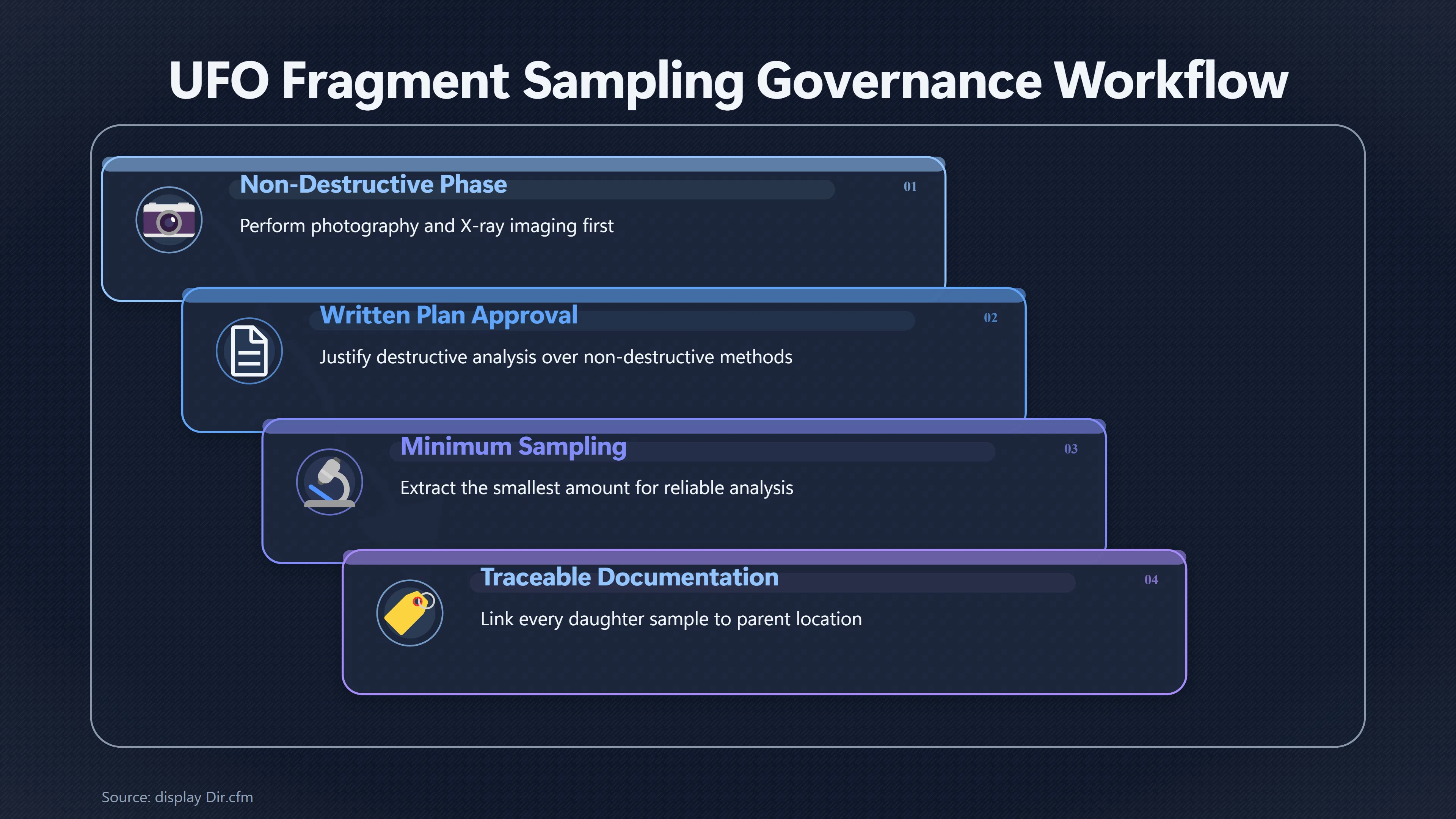
For alleged crash debris, destructive testing should be treated as an exceptional intervention rather than a routine laboratory step.
A governance framework would normally require:
- A written sampling plan explaining why destructive analysis is necessary and why non-destructive alternatives are insufficient.
- Independent review before consuming irreplaceable material where practical.
- Progressive testing, beginning with photography, microscopy, X-ray imaging and other non-destructive methods before removing material.
- Minimum necessary sampling, extracting the smallest amount compatible with reliable analysis.
- Complete documentation, including photographs, measurements, chain-of-custody updates and permanent links between parent fragments and all derived specimens.
- Protected reserve material, retained specifically for future verification using improved analytical methods.
Such measures do not validate claims that a fragment originated from a UFO. They instead preserve the ability of future investigators to evaluate those claims using the best available evidence rather than relying on incomplete records and consumed specimens.
Testing should strengthen, not weaken, provenance
The scientific objective of destructive testing is to obtain information unavailable by less invasive means. In alleged UFO crash investigations, however, the evidential objective is broader. Every cut, drilled hole or dissolved fragment changes the specimen permanently, making documentation part of the evidence rather than an administrative afterthought.
A laboratory may accurately characterise a small piece of metal, yet if destructive sampling occurred without a documented plan, mapped subsamples and preserved reserve material, later researchers may be unable to determine exactly what was analysed or whether the remaining object still represents the original recovery. Careful governance therefore protects both scientific integrity and chain of custody, ensuring that testing enhances rather than diminishes the evidential value of exceptionally rare alleged crash debris.[astm.org]store.astm.orgASTM International StoreE1492 Standard Practice for Receiving, Documenting, Storing, and Retrieving Evidence by a Forensic Service Provider…
Amazon book picks
Further Reading
Books and field guides related to When Testing Destroys the Best UFO Evidence. Use these as the next step if you want deeper reading beyond the article.
Practical Crime Scene Processing and Investigation
All too often, the weakest link in the chain of criminal justice is the crime scene investigation. Improper collection of evidence blocks...
Materials Characterization: Introduction to Microscopic and S...
This book covers state-of-the-art techniques commonly used in modern materials characterization. Two important aspects of characterizatio...
Scanning Electron Microscopy and X-Ray Microanalysis
In the decade since the publication of the second edition of Scanning Electron Microscopy and X-Ray Microanalysis, there has been a great...
Metallography: Principles and Practice
First published 1984. Subjects: Metallography, Physical metallurgy, TECHNOLOGY & ENGINEERING, Metallurgy, Metallographie.
eBay marketplace picks
Marketplace Samples
Live-tested eBay searches with available results related to this page.
Selected fromUFO collectible oneBay.co.uk.



Endnotes
1.
Source: nodis3.gsfc.nasa.gov
Title: display Dir.cfm
Link:https://nodis3.gsfc.nasa.gov/displayDir.cfm?Internal_ID=N_PR_71000005&page_name=Chapter6
Source snippet
NPR 7100.5 - Chapter6August 16, 2023...
Published: August 16, 2023
2.
Source: GOV.UK
Title: Forensic science activities: statutory code of practice
Link:https://www.gov.uk/government/publications/forensic-science-activities-statutory-code-of-practice-version-2/forensic-science-activities-statutory-code-of-practice-version-2-accessible
Source snippet
version 2 (accessible) - GOV.UK...
3.
Source: store.astm.org
Link:https://store.astm.org/e1492-25.html
Source snippet
ASTM International StoreE1492 Standard Practice for Receiving, Documenting, Storing, and Retrieving Evidence by a Forensic Service Provider...
4.
Source: nodis3.gsfc.nasa.gov
Title: display Dir.cfm
Link:https://nodis3.gsfc.nasa.gov/displayDir.cfm?Internal_ID=N_PR_71000005&page_name=Preface
Source snippet
NPR 7100.5 - PrefaceAugust 16, 2023...
Published: August 16, 2023
5.
Source: store.astm.org
Link:https://store.astm.org/e3329-21.html
Source snippet
ASTM International StoreE3329 Standard Practice for Establishing an Examination Scheme for Explosive Residues...
6.
Source: nodis3.gsfc.nasa.gov
Title: display Dir.cfm
Link:https://nodis3.gsfc.nasa.gov/displayDir.cfm?c=7100&s=10F&t=NPD
Source snippet
NPD 7100.10F - main...
7.
Source: store.astm.org
Link:https://store.astm.org/e2548-26.html
Source snippet
astm.orgE2548 Standard Practice for Sampling Seized Drugs for Qualitative and Quantitative AnalysisApril 8, 2026 — ASTM E2548-26 STANDARD...
Published: April 8, 2026
8.
Source: store.astm.org
Link:https://store.astm.org/e3457-25.html
Source snippet
astm.orgE3457 Standard Guide for Detection and Preservation of Forensic Trace EvidenceDecember 2, 2025 — ASTM E3457-25 STANDARD GUIDE FOR...
Published: December 2, 2025
9.
Source: astm.org
Title: trace evidence collection subject of proposed astm standard
Link:https://www.astm.org/news/trace-evidence-collection-subject-of-proposed-astm-standard
10.
Source: GOV.UK
Title: www.gov.uk Draft code of practice (accessible)
Link:https://www.gov.uk/government/consultations/forensic-science-code-of-practice-version-2/draft-code-of-practice-accessible
11.
Source: astm.org
Title: workitem wk89493
Link:https://www.astm.org/membership-participation/technical-committees/workitems/workitem-wk89493
12.
Source: science.nasa.gov
Link:https://science.nasa.gov/planetary-science/resources/documents/decadal-studies-2013-2022/development-of-capabilities-and-instrumentation-for-curation-and-analysis-of-returned-samples/
13.
Source: nodis3.gsfc.nasa.gov
Title: display Dir.cfm
Link:https://nodis3.gsfc.nasa.gov/displayDir.cfm?Internal_ID=N_PR_71000005&page_name=Chapter2
14.
Source: nodis3.gsfc.nasa.gov
Title: display Dir.cfm
Link:https://nodis3.gsfc.nasa.gov/displayDir.cfm?Internal_ID=N_PR_71000005&page_name=Chapter3
15.
Source: nodis3.gsfc.nasa.gov
Title: display Dir.cfm
Link:https://nodis3.gsfc.nasa.gov/displayDir.cfm?Internal_ID=N_PR_71000005&page_name=Chapter4
16.
Source: nodis3.gsfc.nasa.gov
Title: display Dir.cfm
Link:https://nodis3.gsfc.nasa.gov/displayDir.cfm?Internal_ID=N_PR_71000005&page_name=main
17.
Source: nasa.gov
Title: NAS A Gathering Tools to Assess Damage, Verify Parts Made in Space
Link:https://www.nasa.gov/technology/gathering-tools-to-assess-damage-verify-parts-made-in-space/
18.
Source: ntrs.nasa.gov
Link:https://ntrs.nasa.gov/citations/20210022360
19.
Source: ntrs.nasa.gov
Link:https://ntrs.nasa.gov/citations/20180007273
20.
Source: ares.jsc.nasa.gov
Title: astromaterials newsletter
Link:https://ares.jsc.nasa.gov/astromaterials-newsletter/
21.
Source: store.astm.org
Title: e1492 11r17
Link:https://store.astm.org/e1492-11r17.html
Additional References
22.
Source: intertekinform.com
Title: astm e 1492 2025 139875 saig astm astm 3733317
Link:https://www.intertekinform.com/en-gb/standards/astm-e-1492-2025-139875_saig_astm_astm_3733317/
Source snippet
Add to Watchlist Image: header thumbnail STANDARD PRACTICE FOR RECEIVING, DOCUMENTING, STORING, AND RETRIEVING EVIDENCE BY A F...
23.
Source: youtube.com
Title: Jacques Vallée, Testing UFO/UAP Retrieved Materials
Link:https://www.youtube.com/watch?v=RKPDoTo1es0
Source snippet
Robert Powell UFO crash [material testing]({{ 'material-testing/' | relative_url }}) Robert Powell and Mick West on The Nimitz UFO Encounter Inside The Black Vault...
24.
Source: youtube.com
Title: New UAP Materials Tests: What the Results Reveal | Dr. Garry Nolan
Link:https://www.youtube.com/watch?v=Mifx4nzPY68
Source snippet
Jacques Vallée, Testing UFO/UAP Retrieved Materials...
25.
Source: youtube.com
Title: Art’s Parts 1: UFO Crash Recovery Material Analysis
Link:https://www.youtube.com/watch?v=f1LylzKZC-U
Source snippet
New UAP Materials Tests: What the Results Reveal | Dr. Garry Nolan...
26.
Source: youtube.com
Title: Through Conversations Podcast
Link:https://www.youtube.com/watch?v=BBHrrdrmYIQ&t=1245s
Source snippet
Dr. Garry Nolan analyzes UAP whistleblower's injury claims | Reality Check NewsNation...
27.
Source: youtube.com
Title: Analysis of the “[Ubatuba]({{ ‘ubatuba/’ | relative_url }})” material by Robert Powell
Link:https://www.youtube.com/watch?v=NamnxaADugo
Source snippet
Garry Nolan, Ph.D. on The Material Science of UAP...
28.
Source: youtube.com
Title: Garry Nolan, Ph.D. on The Material Science of UAP
Link:https://www.youtube.com/watch?v=7UW1jyN2o8A
Source snippet
Art's Parts 1: UFO Crash Recovery Material Analysis...
29.
Source: nij.ojp.gov
Title: chain custody typical checklist
Link:https://nij.ojp.gov/nij-hosted-online-training-courses/law-101-legal-guide-forensic-expert/sources-scientific-evidence/testing-or-evaluating-evidence-and-writing-reports/chain-custody-typical-checklist
30.
Source: youtube.com
Title: Lex Clips
Link:https://www.youtube.com/watch?v=uTCc2-1tbBQ
Source snippet
New UAP Materials Tests: What the Results Reveal | Dr. Garry Nolan The Sol Foundation...
31.
Source: fsis.usda.gov
Link:https://www.fsis.usda.gov/policy/fsis-directives/8010.3